

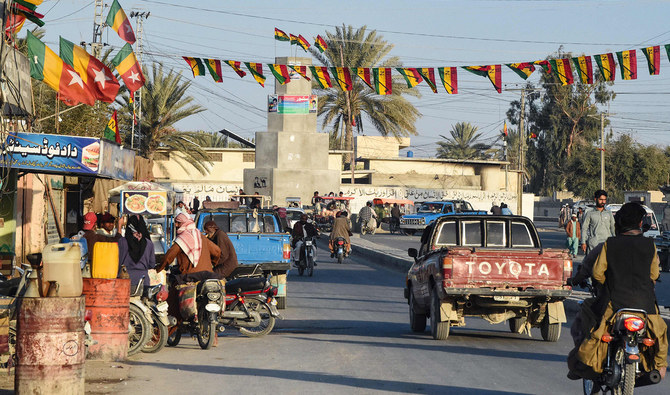

KARACHI: Business and travel at the Pakistan-Iran border continued as usual on Friday despite an exchange of air strikes between the two countries against what they called militant hideouts, traders and locals said, amid persisting tensions in the border region.
Iran this week conducted an airstrike against alleged militant bases in Pakistan’s southwestern Balochistan province. Islamabad said the strike killed two children in a border village.
In a tit-for-tat move, the Pakistan military on Thursday launched multiple strikes in Iran’s Sistan-Baluchestan province, raising an alarm about a wider conflict in the region.
Pakistan’s stock market, which initially reacted negatively to Thursday’s strikes by Islamabad, showed signs of recovery, while business and the flow of pilgrims continued as usual at the border between the two countries on Friday, according to traders and residents.
Hajji Abdullah Achakzai, president of the Quetta Chambers of Commerce and Industry (QCCI), said while the trade flow at the border was normal, it could be disrupted if tensions were not deescalated.
“At present there is no problem with the trade flow, but it may disrupt in the future,” Achakzai said.
A Pakistani government official, who declined to be named as he was not authorized to speak to media, told Arab News that no instructions had yet been issued to close the border with Iran.
A resident of the Pakistani border town of Taftan confirmed that the border was open for travel and business activities, though fears of further retaliatory actions persisted in the region.
“The borders are open but the military presence has increased,” he said, on the condition of anonymity.
Najamul Hassan Jawa, chairman of the Federation of Pakistan Chambers of Commerce and Industry’s (FPCCI) Pakistan-Iran Business Council, confirmed the strikes had not disrupted business at the border markets, but urged for discussions between both sides to resolve the issues.
“Things have deescalated to a large extent and as business community, we would like that instead of going into adventurism, we should sit and talk,” Jawa said.
Formal trade between Pakistan and Iran has been nominal due to sanctions imposed on Tehran, while informal trade of small quantities of goods remains on the higher side.
Pakistan mainly exports rice, dry dates and some other commodities, while it imports plastic, confectionery and liquefied petroleum gas (LPG) from Iran. Pakistan also buys electricity for its border towns from Iran.
In 2022, Pakistan’s commerce ministry issued a notification for the operationalization of barter trade under an agreement between the QCCI and Iran’s Zahidan Chambers of Commerce and Industry (ZCCI), but it has yet to be fully operationalized.
Islamabad and Tehran resolved in 2021 to take bilateral trade volume to $5 billion by 2023, but it could not increase beyond an estimated $2 billion, which mainly comprises unofficial barter trade.
Though trade at border remains normal, Pakistani LPG distributors have already raised its price by Rs10 per kilogram.
“LPG distributors have hiked the price by Rs10 per kg against the backdrop of tensions between Pakistan and Iran,” Irfan Khokhar, founding chairman of the LPG Industry Association of Pakistan, told Arab News.
Pakistan has a daily consumption of 6,000 tons of LPG, according to Khokhar. Following the hike, the price of domestic and commercial cylinders has been respectively increased to Rs125 and Rs450 per kg.
Shaukat Populzai, president of the Balochistan Economic Forum, ruled out trade suspension between both countries.
“The livelihood of people living on both sides depends on each other and there is no other way to cater to the population,” Populzai said.
Jawa, the FPCCI representative, called for the continuation of commercial activities, citing the reliance of a large number of people on both sides of the border on bilateral trade.
“To increase the trade volume and the value, the countries must resolve their disputes mutually,” he said.


