

Middle East’s real estate markets in spotlight at WEF

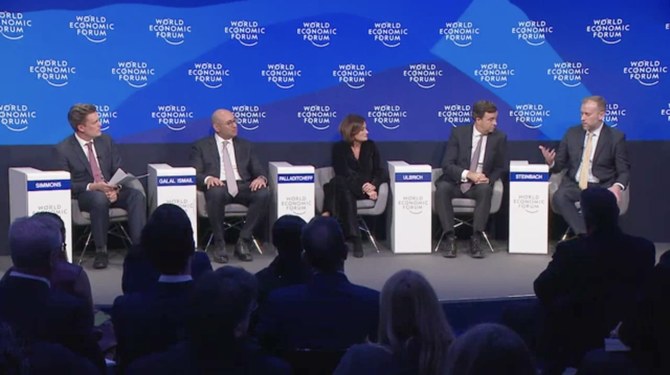
Speakers discuss the real estate sector in the Middle East during a panel discussion at the World Economic Forum in Davos, Switzerland.
Short Url
Updated 18 January 2024
Follow

Middle East’s real estate markets in spotlight at WEF

DAVOS: The World Economic Forum in Davos brought together global leaders and industry experts to discuss the current state of the world, with a focus on real estate and global economic trends.

Christian Ulbrich, global chief executive officer and president of JLL, praised the ongoing development in the Middle East’s real estate sector with large-scale projects underway across the region.

“The Middle East is doing brilliantly on many fronts, not only on the luxury side but also on the production side.”

Positive outlook for Saudi Arabia

He also expressed optimism about the sector in Saudi Arabia. “I’m extremely positive for Saudi Arabia. I was attending the FII (Future Investment Initiative) a couple of weeks ago, and I was massively impressed by the progress that has been made. The country is putting businesses in a position to feel comfortable investing, and the changing workforce is notable.”

Lauding the increasing role of women in leadership positions, Ulbrich said: “It is extremely positive to see how many females are now in leadership positions and how crucial they are for the success of the country.”

Ahmed Galal Ismail, CEO of Majid Al Futtaim Holding, emphasized the growing significance of Middle Eastern markets, including the UAE and Saudi Arabia, noting their increasing economic stature and forward-looking views.

Four ‘Ds’

David Steinbach, global chief investment officer at Hines Interests Limited Partnership, discussed what he called the “four Ds.” 

He said: “There’s ‘deglobalization’ occurring, ‘demographics’ are shifting, there needs to be a fair amount of ‘deleveraging’ in the market, and ‘decarbonization’ is one of the biggest investment opportunities.”

Steinbach emphasized that these trends would impact how investors allocate capital over the next decade.

Diverse nature 

Nathalie Palladitcheff, president and CEO of Ivanhoe Cambridge, highlighted the diverse nature of real estate. 

She remarked: “There is no such thing as real estate. In fact, there are as many real estate sectors, asset classes, and regions as we have on this panel and around the world.”

Palladitcheff urged a broader perspective, stating: “Real estate is not only offices; it’s a tangible asset class with its own operating model, requiring specific expertise.”

Role of AI

The CEO of Majid Al Futtaim Holding addressed the challenges in real estate financing. Ismail noted: “The challenge is not with the asset; it’s with the financing.” 

He expressed concerns about the industry becoming complacent due to a benign monetary environment, leading to lowered underwriting standards.

Steinbach stressed the importance of considering long-term timeframes for real estate investments. He commented: “For an investor in the real estate asset class, it is important to remember timeframes because business plans are typically at least five to ten years.”

Steinbach also highlighted the growing influence of AI in the real estate sector, saying: “AI is starting to work its way in, and there’s a strategic and tactical element to that.”

Echoing similar sentiment, Ulbrich stated: “AI is probably the first industrial revolution which is going to impact the white collars, and these are our tenants.”

Transition from art to science 

Steinbach reflected on the evolution of real estate analysis, noting: “Thirty years ago, we didn’t actually know what a vacancy rate was in a market or building. It was an art. Now, through works like JLL and others, it has become a science with actual data.”

The World Economic Forum in Davos provided a platform for these diverse perspectives, shedding light on the multifaceted nature of global real estate and the dynamic trends shaping the industry.


PIF-backed EV maker Lucid hits 16k 2025 deliveries, sets sights on robotaxi deployment

Updated 25 February 2026
Follow

PIF-backed EV maker Lucid hits 16k 2025 deliveries, sets sights on robotaxi deployment

RIYADH: Electric vehicle manufacturer Lucid Group, majority-owned by Saudi Arabia’s Public Investment Fund, announced a surge in deliveries in 2025 with volumes reaching 15,841 units, a 55 percent increase year-on-year.

According to a statement, the EV maker also provided an optimistic production outlook for 2026, signaling confidence in its operational turnaround and strategic shift toward autonomy.

In September 2023, the group opened its first-ever international car manufacturing facility in the Kingdom. The hub serves as the company’s second Advanced Manufacturing Plant and its first outside of the US.

According to the earnings report, the company delivered 5,345 vehicles in the fourth quarter of 2025, up 72 percent from the same period in the previous year, marking its eighth consecutive quarter of record deliveries.

Interim CEO Marc Winterhoff said that 2025 “was all about execution and strategy adjustment to set Lucid up for long-term success. Against a challenging macro backdrop, we nearly doubled production, gained market share, reduced unit costs, and strengthened our financial position.”

This commercial momentum translated directly into financial gains. Lucid’s fourth-quarter revenue soared 123 percent to $522.7 million, while full-year 2025 earnings climbed 68 percent to $1.35 billion. The company ended the quarter with a robust liquidity position of approximately $4.6 billion.

A key driver of the improved performance was the ramp-up of production, including the launch of the Lucid Gravity SUV. Despite facing supply chain and tariff headwinds, Lucid nearly doubled its total production for the year.

The company clarified its final production figures for 2025, reporting a total of 17,840 vehicles. This aligns with its previous guidance of approximately 18,000 units.

Lucid explained that a preliminary estimate of 18,378 units, announced in early January, was revised after 538 vehicles were found not to have completed the final internal validation procedures required to be classified as “produced.”

These vehicles are expected to be finalized in 2026, and the company stressed the revision does not impact previously reported financial results.

The manufacturer expects to produce between 25,000 and 27,000 vehicles in 2026, representing growth of up to 51 percent compared with 2025.

Chief Financial Officer Taoufiq Boussaid said: “Q4 marked a clear step-change in production and unit economics. The progress we made is structural, creating a more repeatable and stable operating cadence heading into 2026.”

Beyond the production numbers, Lucid outlined a pivot toward software and autonomy. Winterhoff highlighted the company’s ambition to become an “early mover in the emerging robotaxi market” by leveraging its industry-leading EV technology and strategic partnerships.

To fund these future growth platforms while maintaining financial discipline, the company is making targeted adjustments to its workforce.

“As we prepare for the next stage of our product and volume expansion, we are making targeted adjustments to our US-based, non-manufacturing workforce to reallocate resources to support the next stage of our growth and margin progression,” Boussaid added.

He reiterated the company’s commitment to “financial rigor, operational efficiency, and thoughtful capital allocation.”

In January 2025, the EV maker became the first global automotive company to join the Kingdom’s “Made in Saudi” program, granting it the right to use the “Saudi Made” label on its products, symbolizing the nation’s focus on quality and innovation.

Lucid’s facility, located in King Abdullah Economic City, can currently assemble 5,000 vehicles annually during its first phase. Once fully operational, the complete manufacturing plant, including the assembly line, is expected to produce up to 155,000 electric cars per year. 

This comes as the Kingdom is promoting the adoption of electric vehicles as part of its Vision 2030 strategy, which aims to achieve net-zero carbon emissions by 2060.
A critical target of the initiative is for 30 percent of all vehicles in Riyadh to be electric by 2030, contributing to a broader goal of reducing emissions in the capital by 50 percent.