- 2017 reforms to electoral laws made it mandatory for political parties to allot five percent tickets to women
- Observers say despite more women in government, there is “long way” to go to achieve gender equality in parliament
ISLAMABAD: Major political parties in Pakistan have fielded women candidates for national and provincial assembly seats in fulfillment of election laws but observers said this week female participation in upcoming polls would be “insignificant” for a country where almost half the population comprises women.
Reforms to Pakistan’s electoral laws in 2017 made it mandatory for political parties to allot five percent of their tickets to women candidates. Under Pakistan’s constitution, women are guaranteed seats through a quota system in the national parliament and regional assemblies in Punjab, Sindh, Khyber Pakhtunkhwa and Balochistan provinces.
However, traditional gender roles and cultural norms often restrict women’s participation in politics and other spheres of public life in Pakistan.
“The data collected so far shows political parties have apparently abided by the requirement of the election law to award five percent tickets to women on general seats,” Rukhsana Shama, the team lead at the Trust for Democratic Education and Accountability, a spin-off of the Free and Fair Election Network (FAFEN) body, told Arab News.
“But this is not enough if we want to see an inclusive democracy in our country.”
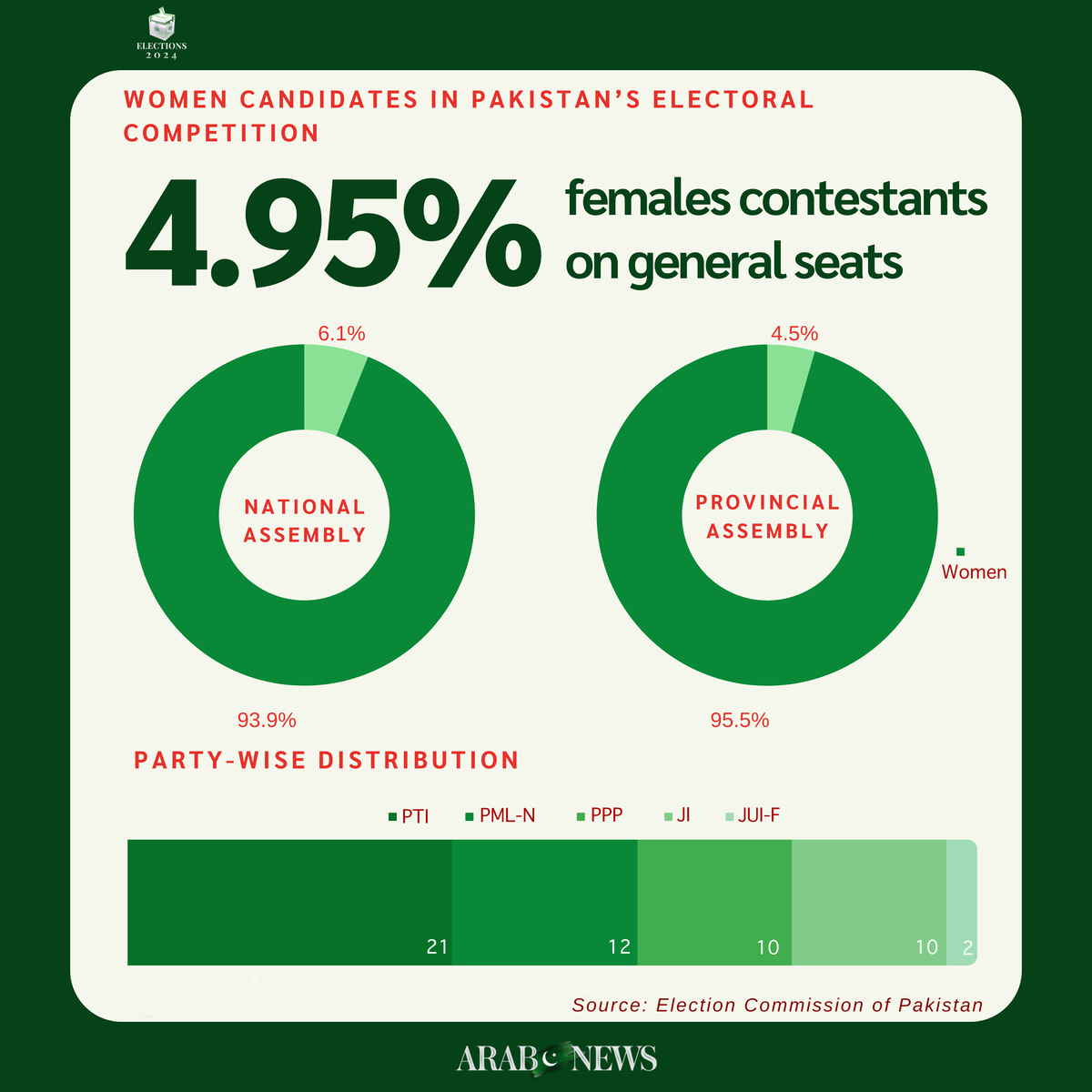
Ahead of general elections on Feb. 8, former prime minister Imran Khan’s Pakistan Tehreek-e-Insaf (PTI) party has awarded National Assembly tickets to 21 women candidates. However, it has become difficult to collect data on exactly how many women candidates have been issued PTI party tickets after Pakistan’s top court last week stripped the PTI of its unified election symbol of a cricket bat, meaning the candidates of the party will now contest the polls as independents, each with a different election symbol.
The other major parties in Pakistan have also awarded seats to women in fulfillment of legal requirements.
The Pakistan Peoples Party awarded 23 party tickets to women candidates, 10 on National Assembly seats and 13 on provincial assembly seats, while the Pakistan Muslim League-Nawaz (PML-N) has issued 16 party tickets to women candidates, 12 for National Assembly seats and four for provincial assembly constituencies.
Pakistan’s religious parties, the Jamiat Ulama-e-Pakistan Fazl (JUI-F), has awarded two tickets to women for National Assembly seats and nine for the provincial assembly seats, while the Jamat-e-Islami has awarded 10 tickets to women contestants for National Assembly seats and 19 for provincial assembly seats, according to data collected by FAFEN.
Shama said parties allocated tickets to women to “fulfil the legal requirement but their actual participation in the electoral process is still insignificant.”
She observed that political parties usually fielded women candidates from constituencies where they considered their position to be weak and did not expect to win, or where they did not have a “winning male candidate,” Shama said.
“We need effective participation of women in the electoral process instead of just fulfilling a legal requirement as they are half of the country’s population,” Shama stressed.
Ahmed Bilal Mehboob, President of the Islamabad-based Pakistan Institute of Legislative Development and Transparency (PILDAT) think tank, said the allocation of tickets to women and their participation in electoral politics was “evolving” with time but there was a “long way” to go to achieve gender equality in parliament.
“We have seen women lawmakers performing better than their male colleagues in parliament in terms of quality debates, legislation, and highlighting issues of public importance,” he told Arab News.
“If the elections are held on time and democracy flourishes in Pakistan, then obviously women’s participation will increase with the public pressure on political parties.”