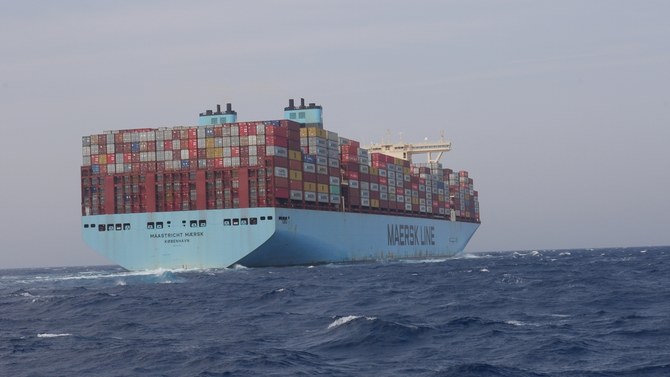

RIYADH: Businesses and consumers may be negatively affected if trade disruption through the Red Sea continues, leading to increased transport and logistics costs, according to Moody’s.
On Jan. 11, the US and UK began strikes on Yemen’s Houthis following attacks on commercial shipping through the Bab al-Mandab Strait.
The body expects that the partial Red Sea blockade by the Houthis will reduce Egypt’s current account receipts via the Suez Canal Authority.
The group reported a 40 percent drop in receipts over the first two weeks of 2024 compared to the same period last year, although recorded receipts in 2023 saw an annual increase of more than 25 percent to over $10 billion.
Moody’s outlined that higher maritime shipping and insurance costs may reduce margins for companies in the affected sectors unless increased expenses can be passed through to consumers.
Although these developments are expected to not impact Egypt’s fiscal accounts in the current year ending in June 2024, a prolonged blockade could amplify the effects. The government relies on 60 to 70 percent of the authority’s revenue, constituting around 9 percent of the government’s total earnings for this fiscal year.
The analysis noted that this may be partly mitigated by further depreciation of the Egyptian pound.
However, supply chain risks will increase as the Suez Canal is a crucial maritime link for global trade, particularly between Asia and Europe, with nearly 20,000 vessels passing through the channel each year.
Countries within the EU would be most affected, with Eurostat data showing that around 20 percent of all goods imports into the bloc were transported by sea from Asia in 2022, with most of it passing through the Suez Canal.
Retail and general manufacturers are most likely to be impacted, as the sectors depend highly on maritime transport from Asia.
According to the report, some automotive makers have paused production in Europe because of delays in the delivery of components.
Imports of European goods into Asia would be less affected because they tend to be higher value-added and can be rerouted to air freight.
While this method comes at an increased cost, these can be more easily absorbed in higher margins or passed on to customers for higher value-added goods.
The expected impact on inflation and monetary policy is projected to be relatively limited, unlike the increase in costs driven by higher energy and raw material prices on the back of Russia’s invasion of Ukraine.
In this instance, Moody’s projected that businesses will likely absorb a larger portion of the cost increase. Consumers are more price-sensitive today and “will remain so” given high interest rates and subdued economic growth.
According to the body, companies have also adapted their supply chains in response to the pandemic to be more resilient to disruptions.