ISLAMABAD: The United States (US) condemned recent Iranian airstrikes in Pakistan, Iraq and Syria, the State Department said on Wednesday, hoping that Islamabad and Tehran would resolve the issue peacefully.
The statement came a day after Pakistan said Iran had violated its airspace and attacked a border village, killing two children and injured three women. The raid occurred late Tuesday after similar attacks in Iraq and Syria.
Iranian news agency Mehr News said the “missile and drone” attack targeted the Pakistan headquarters of Jaish Al-Adl, a group formed in 2012 and blacklisted by Iran as a “terrorist group.”
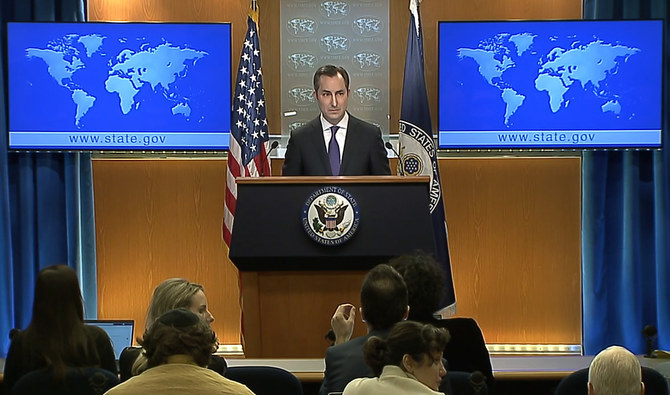
Speaking at a press briefing, US State Department spokesperson Matthew Miller condemned the Iranian strikes and said Washington wanted to see peace and stability maintained in the region.
“We do condemn those strikes. We’ve seen Iran violate the sovereign borders of three of its neighbors in just the past couple days,” Miller told reporters in Washington.
“Certainly, we always want to see peace and stability maintained, especially in this region, where it’s been the focus of our diplomatic efforts since October 7th.”
Following the Iranian strike, Pakistan recalled its ambassador from Iran and blocked Tehran’s envoy from returning to Islamabad.
Mumtaz Zahra Baloch, a spokesperson for the Pakistani foreign ministry, called the attack near the country’s border “unprovoked” and a breach of Pakistan’s sovereignty.
Asked about possible retaliation by Pakistan, the US State Department spokesman said he hoped for a peaceful resolution of the issue.
In recent years, Jaish Al-Adl has carried out several attacks on Iranian soil.
Iran said the other missile attacks targeted “spy headquarters” and “terrorist” targets in Syria and Iraq’s autonomous Kurdistan region.
The strikes come as the Middle East has been rocked by Israel’s war on Gaza since Oct 7 and attacks by Yemen’s Houthi rebels on ships in the Red Sea.
“I think it is a little rich for at one – on one hand, Iran to be the leading funder of terrorism in the region, the leading funder of instability in the region; and on the other hand, claim that it needs to take this action – these actions to counter terrorism,” Miller added.


![]()

US condemns Iranian strikes on Pakistan, Iraq and Syria — State Department
Short Url
https://arab.news/v6u33
US condemns Iranian strikes on Pakistan, Iraq and Syria — State Department
- Iran this week targeted alleged militant bases in Pakistan that Islamabad says killed two children, injured three women
- Tensions have since soared and Pakistan has recalled its ambassador from Iran, blocked Tehran’s envoy from returning
Latest updates


© 2026 SAUDI RESEARCH & PUBLISHING COMPANY, All Rights Reserved And subject to Terms of Use Agreement.