

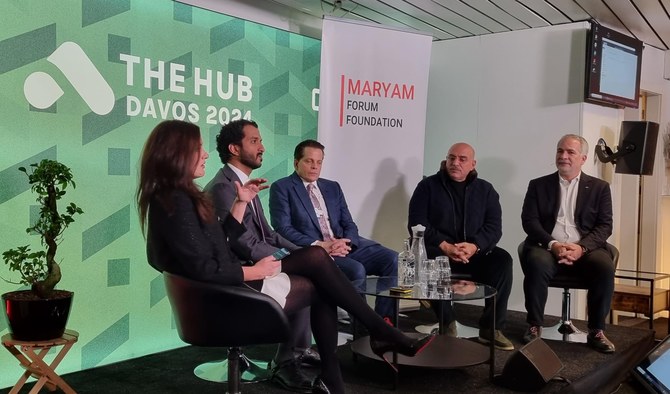

DAVOS: Gulf economies are benefiting from competition and continue to show signs of growth because of competitiveness in the Middle East region, the UAE economy minister told Arab News on Wednesday.
Abdulla bin Touq Al-Marri, who was speaking on a panel at the World Economic Forum in Davos, said that competition within the Gulf economies was a good thing, and that their trajectories were on an upward path, even in the face of current high interest rates and inflation.
“If you look at three years ago, competition was there and competition is always going to be there; the UAE grew, Saudi Arabia, Oman, Bahrain, Kuwait, the Gulf Cooperation Council grew. I’m so happy,” he said.
“The World Bank and the International Monetary Fund are expecting the Gulf to grow in 2024. Competition is really helping growth; show me competition that doesn’t lead to innovation and growth … there’s none.
“We want competition (in the UAE), because we need innovation, we need movement, we need growth; the bottom is line I want to create jobs,” he added.
Al-Marri said he was not worried about the UAE economy, or Gulf economies as a whole, despite concerns about oil price fluctuations and their being pegged to the dollar.
Bahraini businessman Khalid Janahi agreed and said competition in the region forced all countries to excel.
Concerns for Middle East security, and therefore economic growth, as a result of who might become president of the US later this year are unfounded, according to Janahi.
“It does not make any difference who will be president of the US to the region; the region has to be smart enough to deal with that,” he said. “It does rely on the US, it goes without saying, but if you look at the past four years how they’ve started to diversify their relationships; it’s fascinating,” he added.
However, Janahi said that it was vital Gulf countries focused on creating conditions that enabled a “soft landing, not a hard landing” when a move away from pegging to the dollar inevitably came in the future.
Anthony Scaramucci, a one-time adviser to former US President Donald Trump, discussed the likelihood of his former employer making it back to the White House.
Scaramucci, who has been vocal in his praise of the Saudi delegation in Davos this year and, in particular, of its highlighting of the megaprojects underway in the Kingdom, highlighted Trump’s legal case surrounding the Capitol Hill riot in January, 2020 and missing CIA files as a major roadblock to him winning the Republican nomination.
“I’m telling you, Trump is going to lose,” he said. “You don’t want this guy; you have a tough enough time in the Middle East, with Iran; you don’t want someone this unstable and impetuous as the American president.”
The “insane” development of non-oil sectors of Gulf economies, thanks to its competitiveness, has turned the region and its cities into some of the world’s most attractive prospects for its youth and expatriate communities to settle in and “build a life,” according to Julien Hawari, CEO and founder of content creation firm Special Edition.
“Five years ago, who would have thought that the hottest cities in the world were going to be called Abu Dhabi, Dubai, Riyadh, even Doha? There has been a profound transformation,” he said.
“There has been one thing missing from the conversation that has been vital, and that’s the youth empowerment, there has been a way of doing things that has completely transformed these countries, you have young leadership at ministerial level, in the UAE, in Saudi Arabia, in Qatar,” he added.
Hawari, who said he believes the economies of the US and the rest of the West are lagging 10 years behind those in the Gulf, also rejected concerns over oil price changes hampering development of Gulf economies in the next decade, and backed a mobilized work force to keep driving growth.
“Yes, price of oil will go down, but will the human capital (in the region) change? I doubt it,” he said. “(The region) has been able to ride through the good times and bad through financial discipline. Hard times will hit the region, of course. If the US, China or Europe suffer, the region is impacted, but what has been happening there is mind-boggling.”


