

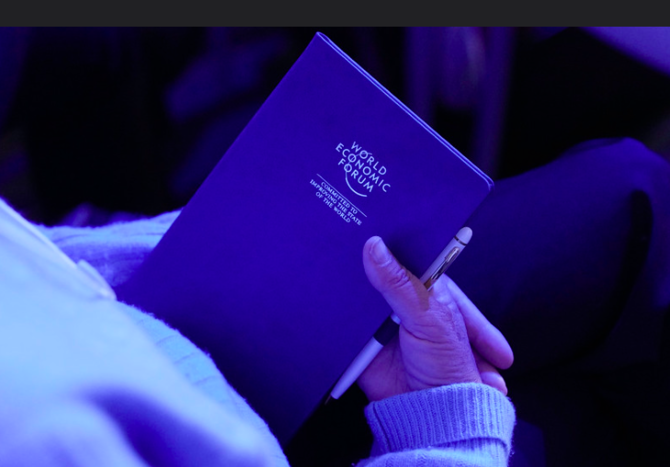
Saudi Arabia showcases its global leadership role at WEF  

The World Economic Forum is being held in Davos. WEF
Short Url
Updated 16 January 2024
Follow

Saudi Arabia showcases its global leadership role at WEF  

RIYADH: Saudi Arabia’s participation in the five-day annual meeting of the World Economic Forum is bolstered by its position and leadership role in the global arena, according to a top official.    

In a statement to the Saudi Press Agency, Princess Reema bint Bandar, the Kingdom’s ambassador to the US, said that guided by its Vision 2030 the country has made remarkable achievements in various international forums and adopted a new approach in its foreign policy.   

This has established Saudi Arabia as a leader in the region and the world.    

She also expressed her keenness to play a key role in enhancing the Kingdom’s successful engagement at the WEF by exchanging views and ideas that can help address global challenges.  

Princess Reema is eager to share Saudi Arabia’s achievements in the political, economic, climate, technical and innovative domains at the event.    

For his part, Saudi Minister of Communications and Information Technology Abdullah Al-Swaha discussed ways to enhance cooperation and digital inclusion with the secretary-general of the International Telecommunication Union, Doreen Bogdan-Martin, on Jan. 15.  

On the sidelines of the WEF annual meeting, the discussion focused on stimulating collaborations and initiatives aimed at connecting the world, empowering individuals, and protecting the planet.  

Additionally, the talks also focused on how important it is to develop partnerships in order to support the expansion of the digital economy, and how critical it is to take advantage of generative artificial intelligence prospects, advance national digital skills, and support digital entrepreneurship.  

In an effort to strengthen collaborations in the fields of innovation and the digital economy, Al-Swaha also met with a number of executives from well-known international technology and innovation businesses.  

The topics of discussion included creating technologies and solutions for cloud computing, generative AI, and improving Saudis’ digital skills in new fields like digital content localization.  

Furthermore, the minister met with Alexander Wang, the founder and CEO of Scale AI, and Borje Ekholm, president and CEO of the Ericsson Group, to discuss collaborations, share expertise, and promote the expansion of the digital economy and innovation.  

During the WEF annual meeting, Minister of Industry and Mineral Resources Bandar Alkhorayef held several meetings with a number of leaders of international companies and institutions, according to Saudi Press Agency. 

Alkhorayef discussed enhancing cooperation and promising investment opportunities in the industrial and mining sectors, as well as developing avenues for trade exchange and increasing the access of Saudi non-oil exports to global markets. 

“Saudi Arabia is open for business,” Alkhorayef said, highlighting the Kingdom’s efforts to attract investors and entrepreneurs to the mining and Industry sectors from around the world, according to a tweet by the Ministry of Economy and Planning on X. 


Egypt rules out new energy costs as IMF reviews advance 

Updated 10 sec ago
Follow

Egypt rules out new energy costs as IMF reviews advance 

RIYADH: Egypt’s government said it will impose no new burdens on citizens in the energy sector, including petroleum and natural gas, as it moves toward the final year of its economic reform program with the International Monetary Fund. 

Prime Minister Mostafa Madbouly said the targets agreed with the IMF through the end of the program “do not relate to anything that affects the Egyptian citizen,” seeking to counter speculation about additional austerity measures. 

Speaking at the weekly press conference following a cabinet meeting in the New Administrative Capital, Madbouly said the IMF has completed the fifth and sixth reviews of Egypt’s reform program.    

A Facebook post on the official Egyptian Cabinet Presidency page stated: “The Prime Minister explained that the IMF program will end within a year from now, noting that what has been done during the current stage is to follow up on the targets of the fifth and sixth reviews, in addition to agreeing on the targets of the two remaining reviews in the program, the seventh and eighth, which required more effort on the part of the Egyptian government to reach an understanding with the fund on the targets of these two reviews.” 

Madbouly said IMF assessments praised Egypt’s stabilization efforts, citing improved balance-of-payments indicators and a narrowing current-account deficit despite external shocks.  

He pointed to stronger non-oil exports and fiscal performance, including a primary surplus of 3.5 percent of gross domestic product in fiscal year 2024-25, alongside higher tax revenues and monetary policies aimed at easing inflation. 

Such evaluations matter for capital flows, Madbouly said, as foreign investors closely track IMF reporting when making investment decisions. 

He also cited a Moody’s report, saying the rating agency pointed to a sharp decline in inflation to 12.5 percent year on year in October, exchange-rate flexibility, and a clearer reduction in the current account deficit, alongside expectations for stronger growth ahead.  

On external inflows and trade, Madbouly said remittances reached about $34 billion in the first 10 months of the year, compared with $23.7 billion in the same period a year earlier.    

He added that non-oil merchandise exports in 2025 are expected to rise by more than 20 percent versus 2024.    

Tourism remains a core pillar of the government’s growth plan. Madbouly said Egypt received around 18.8 million tourists in 2025, up from about 15 million in 2024, and reiterated a target of 30 million tourists by 2030.    

He said the government aims to expand aviation capacity, including doubling the fleet of EgyptAir and other state-owned carriers within “two or three” years, to align with projected tourism growth.    

Madbouly also pointed to investment activity in the Suez Canal Economic Zone, saying the area recently signed new agreements with investors across multiple sectors with investments exceeding $1.15 billion, with inaugurations of major projects planned for January, including factories linked to solar energy supply chains.    

Finance Minister Ahmed Kouchouk said IMF negotiations were “very positive” and reflect “good financial results and the underlying potential of the Egyptian economy.”   

He said efforts to broaden the tax base lifted revenues by 35 percent “without any additional burdens on the business community,” while the government prioritizes reducing public debt and expanding targeted social spending, including higher allocations for health, education and cash support.