

Pakistan election symbols and impact on ex-PM Khan’s party losing the bat sign

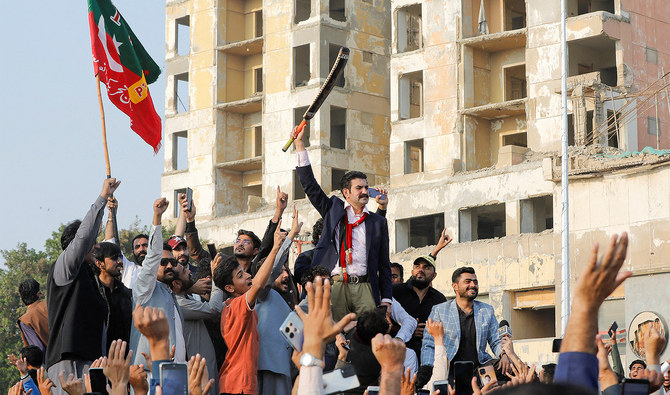
Leader Pakistan Tehreek-e-Insaf (PTI) and former prime minister Imran Khan's lawyer Sher Afzal Khan Marwat, waves a cricket bat after the Election Commission of Pakistan (ECP) had stripped the party's electoral symbol of a cricket bat on technical grounds, while speaking to supporters during a rally ahead of general elections in Karachi, Pakistan on January 14, 2024. (REUTERS/File)
Short Url
Updated 16 January 2024
Follow

Pakistan election symbols and impact on ex-PM Khan’s party losing the bat sign

  • Khan’s Pakistan Tehreek-e-Insaf has been stripped of traditional electoral symbol of a cricket bat in a court ruling
  • This means confusion for voters and extra costs to produce separate campaign material such as banners for each candidate

ISLAMABAD: The party of former Pakistan prime minister Imran Khan has been stripped of its traditional electoral symbol of a cricket bat in a court ruling, the latest blow to the jailed leader ahead of a national election in February.

Here are some facts about the significance of electoral symbols and the challenges facing Khan’s party, the Pakistan Tehreek-e-Insaf (PTI).

WHAT IS AN ELECTORAL SYMBOL?

Electoral symbols — unique pictorial identifiers — are handed out by the election commission to political parties and candidates. Parties usually have long-standing symbols, which, for the PTI, was the cricket bat, referencing Khan being a celebrated former captain of the national cricket team.

The symbols appear on ballot papers, with voters able to put a stamp on their symbol of choice. The ballot paper also has names, but over 40 percent of Pakistan’s 241 million population are illiterate, making the pictures extra important for recognition.

A majority of Pakistan’s constituencies are in rural areas where the literacy rate is around 50 percent, according to the economic survey of 2022-23.

Pakistan’s election process involves thousands of candidates and dozens of political parties and symbols. A single ballot paper has a long list of options for voters.

A total of 150 symbols have been assigned to political parties and another 174 will be given to independent candidates for this election.

Three time prime minister Nawaz Sharif’s party uses a tiger, while the party of Bilawal Bhutto Zardari, the son of slain premier Benazir Bhutto, uses an arrow.

Symbols available to independents include a donkey cart and an ironing board.

WHY WAS THE SYMBOL REMOVED?

The Election Commission of Pakistan stripped the PTI of the symbol on technical grounds that it had not held intra-party elections, a prerequisite for any party to take part in the Feb. 8 vote.

The party challenged that ruling in the Supreme Court, which ruled against it on Jan. 13. The party alleges the powerful military is attempting to keep it out of the election race, a charge the army denies.

WHAT CHALLENGES DOES THIS POSE FOR IMRAN KHAN?

Alongside Khan’s legal troubles, his party now no longer has a single electoral symbol to rally behind. Instead, each of his hundreds of candidates have been given separate symbols from the independent symbol list — including dice and a bowl.

That means confusion for his voters and also extra costs to produce separate campaign material, such as banners, for each candidate.

Khan’s party has, for now, also lost its registered status with the election commission, which means that his candidates’ bloc will not be eligible for reserved seats handed out to political parties.

There are 70 seats reserved for women and religious minorities in the National Assembly, given to parties in proportion to the number of their candidates winning elections. This provides a boost to party positions in parliament.


Pakistan, global crypto exchange discuss modernizing digital payments, creating job prospects 

Updated 8 sec ago
Follow

Pakistan, global crypto exchange discuss modernizing digital payments, creating job prospects 

  • Pakistani officials, Binance team discuss coordination between Islamabad, local banks and global exchanges
  • Pakistan has attempted to tap into growing crypto market to curb illicit transactions, improve oversight

ISLAMABAD: Pakistan’s finance officials and the team of a global cryptocurrency exchange on Friday held discussions aimed at modernizing the country’s digital payments system and building local talent pipelines to meet rising demand for blockchain and Web3 skills, the finance ministry said.

The development took place during a high-level meeting between Finance Minister Muhammad Aurangzeb, Pakistan Virtual Assets Regulatory Authority (PVARA) Chairman Bilal bin Saqib, domestic bank presidents and a Binance team led by Global CEO Richard Teng. The meeting was held to advance work on Pakistan’s National Digital Asset Framework, a regulatory setup to govern Pakistan’s digital assets.

Pakistan has been moving to regulate its fast-growing crypto and digital assets market by bringing virtual asset service providers (VASPs) under a formal licensing regime. Officials say the push is aimed at curbing illicit transactions, improving oversight, and encouraging innovation in blockchain-based financial services.

“Participants reviewed opportunities to modernize Pakistan’s digital payments landscape, noting that blockchain-based systems could significantly reduce costs from the country’s $38 billion annual remittance flows,” the finance ministry said in a statement. 

“Discussions also emphasized building local talent pipelines to meet rising global demand for blockchain and Web3 skills, creating high-value employment prospects for Pakistani youth.”

Blockchain is a type of digital database that is shared, transparent and tamper-resistant. Instead of being stored on one computer, the data is kept on a distributed network of computers, making it very hard to alter or hack.

Web3 refers to the next generation of the Internet built using blockchain, focusing on giving users more control over their data, identity and digital assets rather than big tech companies controlling it.

Participants of the meeting also discussed sovereign debt tokenization, which is the process of converting a country’s debt such as government bonds, into digital tokens on a blockchain, the ministry said. 

Aurangzeb called for close coordination between the government, domestic banks and global exchanges to modernize Pakistan’s payment landscape.

Participants of the meeting also discussed considering a “time-bound amnesty” to encourage users to move assets onto regulated platforms, stressing the need for stronger verifications and a risk-mitigation system.

Pakistan has attempted in recent months to tap into the country’s growing crypto market, crack down on money laundering and terror financing, and promote responsible innovation — a move analysts say could bring an estimated $25 billion in virtual assets into the tax net.

In September, Islamabad invited international crypto exchanges and other VASPs to apply for licenses to operate in the country, a step aimed at formalizing and regulating its fast-growing digital market.