Pakistan confirms 15 cases of JN.1 coronavirus strain

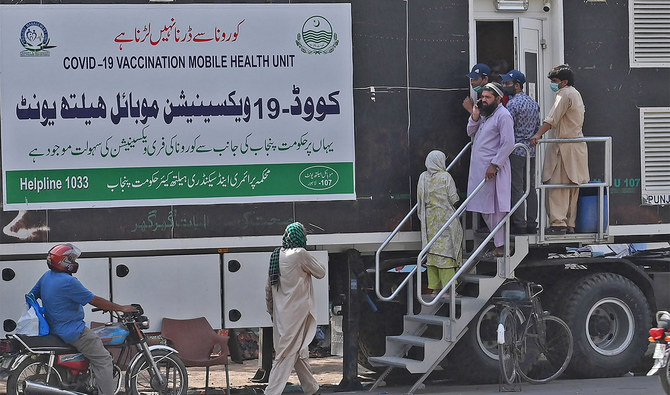
People wait for their turn to get a dose of a vaccine against the Covid-19 coronavirus outside a mobile vaccination health unit in Lahore, Pakistan, on July 7, 2021. (AFP/File)
Short Url
Updated 16 January 2024
Follow

Pakistan confirms 15 cases of JN.1 coronavirus strain

  • WHO has classified JN.1 as “variant of interest” but said current evidence showed low risk to public health from the strain
  • Pakistan has so far reported over 1.5 million cases since the start of the coronavirus pandemic in 2019, with 30,371 deaths

ISLAMABAD: Pakistan’s health ministry said on Tuesday there were 15 confirmed cases of the JN.1 coronavirus strain in the country, which the World Health Organization last month classified as a “variant of interest” but from which current evidence shows a low risk to public health.

Pakistan has reported over 1.5 million cases of the coronavirus since the start of the pandemic late in 2019, with 30,371 deaths.

“The situation is being closely monitored and in this regard Border Health Services, National and Provincial Health Authorities and labs are fully active and alert,” Caretaker Health Minister Dr. Nadeem Jan was quoted as saying in a ministry handout. 

“There is an effective screening system at international airports at all entry and exit points.”

The JN.1 variant has so far been reported in more than 60 countries.

Pakistan has administered at least 278,150,849 doses of COVID vaccines so far. Assuming every person needs two doses, that’s enough to have vaccinated about 64.2 percent of the country’s population.

Last week, Pakistan advised social distancing, wearing masks and proper sanitation and hygiene to prevent the spread of the new strain.

Screening at international borders was increased in the beginning of January while the federal government has also decided to procure an additional 500,000 vaccine doses.

JN.1 was first detected in the United States in September, according to the US Centers for Disease Control and Prevention (CDC).


UNGA adopts Pakistan-sponsored resolution focusing world attention on Palestine, Kashmir

Updated 53 min 6 sec ago
Follow

UNGA adopts Pakistan-sponsored resolution focusing world attention on Palestine, Kashmir

  • The resolution calls on countries to immediately cease foreign military intervention in and occupation of foreign countries and territories
  • Islamabad says the consensual adoption of the resolution manifests broad support for inalienable right of peoples facing foreign occupation

ISLAMABAD: The United Nations General Assembly (UNGA) has adopted a Pakistan-sponsored resolution on the peoples’ right to self-determination, Pakistan’s UN mission said on Friday, saying it reinforces the world attention to the Palestine and Kashmir issues.

The text, which was adopted by consensus, was recommended last month by the 193-member General Assembly’s Third Committee, which deals with social, humanitarian and cultural issues, according to Pakistani state media.

Co-sponsored by 65 countries, it called on countries to immediately cease foreign military intervention in and occupation of foreign countries and territories as well as acts of “repression, discrimination, and maltreatment.”

The resolution also declared the General Assembly’s firm opposition to acts of foreign military intervention, aggression and occupation, which have resulted in suppression of peoples’ right to self-determination in parts of the world.

“The consensual adoption of the resolution manifests broad international support for the inalienable right of the peoples facing colonialism, alien domination and foreign occupation,” Pakistan’s UN mission said on X. 

“For the people of Indian Illegally Occupied Jammu and Kashmir (IIOJK) and Palestine, the resolution reinforces international attention to their just and legitimate cause and their aspirations for freedom and dignity in accordance with UN Security Council resolutions.”

Pakistan, which does not recognize Israel, supports an independent Palestinian state based on “internationally agreed parameters” and pre-1967 borders, calling for an end to Israeli occupation of the Gaza Strip and the West Bank, including East Jerusalem.

Kashmir, on the other hand, has been divided between Pakistan and India since their independence from British rule in 1947. Both countries claim the Himalayan territory in its entirety but rule it in part and have fought multiple wars over it.

Islamabad has repeatedly urged New Delhi to hold a plebiscite in the disputed territory in line with the United Nations Security Council resolutions.

Ambassador Usman Jadoon, Pakistan’s deputy permanent representative to the UN, this week said the realization of self-determination is not merely a historical aspiration, but an enduring obligation.

“Recent developments in the Middle East demonstrate that lasting peace cannot be achieved through the continued denial and suppression of the legitimate right to self-determination of the Palestinian people,” he said on Thursday.

“Similarly, the UN Security Council has, through several resolutions, recognized the legitimate right of self-determination of the people of Jammu and Kashmir. A just resolution of the Jammu and Kashmir dispute remains central to the establishment of durable peace in South Asia.”