

Pakistan cuts petrol prices as inflation up 29.7% year-on-year

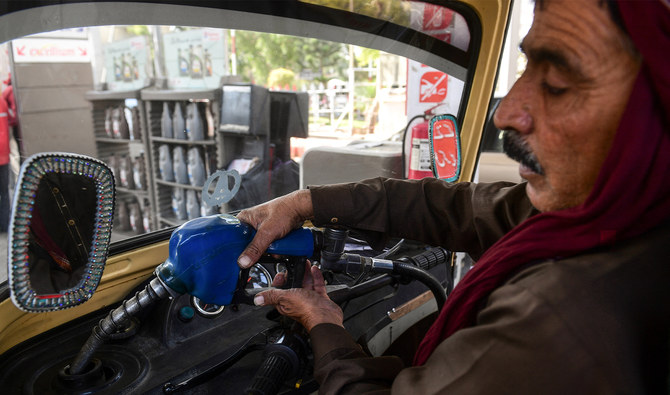
This picture taken on January 30, 2023 shows a man filling petrol in his auto-rickshaw at a gasoline station in Pakistan's port city of Karachi. (AFP/File)
Short Url
Updated 16 January 2024
Follow

Pakistan cuts petrol prices as inflation up 29.7% year-on-year

  • Petroleum and electricity prices have been key drivers of inflation in Pakistan
  • Price of petrol would drop by eight Pakistani rupees effective January 16

KARACHI: Pakistan has cut the price of petrol but maintained that of diesel, the finance ministry said in a statement late on Monday, as the South Asian nation’s consumer price index (CPI) for December rose 29.7% from a year before.

Petroleum and electricity prices have been the key drivers of inflation, with the country of 241 million people experiencing its highest ever inflation last year and its currency dipping to historic lows until a $3 billion IMF bailout averted an imminent sovereign default in July. Monthly inflation for December registered a 0.8% rise from the previous month.

But experts have said inflation in Pakistan was showing some signs of slowdown based on month on month inflation data, and expected it would decline year-on-year in January and February as local oil prices were lowered.

“Government of Pakistan has reduced Petrol price by 8 rupees, whereas price of High Speed Diesel has been maintained,” the finance ministry said on X.

The government has already achieved a Rs60 per liter petroleum levy, the maximum permissible limit under the law, on both petrol and diesel. The government had set a budget target of collecting Rs869 billion as petroleum levy during the current fiscal year under commitments made with the IMF but was hoping the collection would go beyond Rs950bn by the end of June.

At present, the government is charging about Rs82 per liter tax on both petrol and diesel. Although the general sales tax on all petroleum products is currently zero, the government is charging Rs60 per liter petroleum development levy on petrol and Rs50 each on diesel, high-octane blending component, and 95 research octane number (RON) petrol

The central bank governor said late last year Pakistan’s inflation rate would ease to around 20%-22% in the 2024 financial year, in a report issued weeks ahead of a national election it is hoped will help restore political and economic stability.

Sindh assembly passes resolution rejecting move to separate Karachi

Updated 21 February 2026
Follow

Sindh assembly passes resolution rejecting move to separate Karachi

  • Chief Minister Shah cites constitutional safeguards against altering provincial boundaries
  • Calls to separate Karachi intensified amid governance concerns after a mall fire last month

ISLAMABAD: The provincial assembly of Pakistan’s southern Sindh province on Saturday passed a resolution rejecting any move to separate Karachi, declaring its territorial integrity “non-negotiable” amid political calls to carve the city out as a separate administrative unit.

The resolution comes after fresh demands by the Muttahida Qaumi Movement (MQM) and other voices to grant Karachi provincial or federal status following governance challenges highlighted by the deadly Gul Plaza fire earlier this year that killed 80 people.

Karachi, Pakistan’s largest and most densely populated city, is the country’s main commercial hub and contributes a significant share to the national economy.

Chief Minister Syed Murad Ali Shah tabled the resolution in the assembly, condemning what he described as “divisive statements” about breaking up Sindh or detaching Karachi.

“The province that played a foundational role in the creation of Pakistan cannot allow the fragmentation of its own historic homeland,” Shah told lawmakers, adding that any attempt to divide Sindh or separate Karachi was contrary to the constitution and democratic norms.

Citing Article 239 of Pakistan’s 1973 Constitution, which requires the consent of not less than two-thirds of a provincial assembly to alter provincial boundaries, Shah said any such move could not proceed without the assembly’s approval.

“If any such move is attempted, it is this Assembly — by a two-thirds majority — that will decide,” he said.

The resolution reaffirmed that Karachi would “forever remain” an integral part of Sindh and directed the provincial government to forward the motion to the president, prime minister and parliamentary leadership for record.

Shah said the resolution was not aimed at anyone but referred to the shifting stance of MQM in the debate while warning that opposing the resolution would amount to supporting the division of Sindh.

The party has been a major political force in Karachi with a significant vote bank in the city and has frequently criticized Shah’s provincial administration over its governance of Pakistan’s largest metropolis.

Taha Ahmed Khan, a senior MQM leader, acknowledged that his party had “presented its demand openly on television channels with clear and logical arguments” to separate Karachi from Sindh.

“It is a purely constitutional debate,” he told Arab News by phone. “We are aware that the Pakistan Peoples Party, which rules the province, holds a two-thirds majority and that a new province cannot be created at this stage. But that does not mean new provinces can never be formed.”

Calls to alter Karachi’s status have periodically surfaced amid longstanding complaints over governance, infrastructure and administrative control in the megacity, though no formal proposal to redraw provincial boundaries has been introduced at the federal level.