

Key border crossing between Pakistan, Afghanistan remains closed for trade over visa restrictions

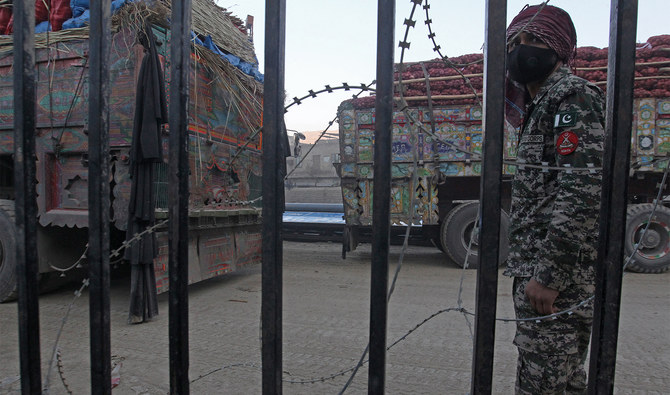
A Pakistani border policeman stands guard at the zero point Torkham border crossing between Afghanistan and Pakistan, in Nangarhar province on December 6, 2023. (AFP/File)
Short Url
Updated 15 January 2024
Follow

Key border crossing between Pakistan, Afghanistan remains closed for trade over visa restrictions

  • Crossing remains closed since Friday night in latest row over document rules for commercial vehicle drivers 
  • Torkham border crossing between the two countries is significant for trade, transit and people traveling 

PESHAWAR: Bilateral trade and business activities at the key Torkham border crossing between Pakistan and Afghanistan remained suspended for the third consecutive day on Monday, a senior police officer and customs agent confirmed, with several trucks stranded on both sides due to a latest row between the two countries over documents for commercial truck drivers.

Located in northwestern Pakistan’s Khyber District and Afghanistan’s Nangarhar province, the Torkham border crossing is significant for trade, transit, and people traveling between the two neighboring countries. 

The crossing has remained closed for trade since Friday night in the latest row over document rules for commercial vehicle drivers crossing the border. Crossings between the two countries have been temporarily shut in recent months after Islamabad last year launched a massive operation against undocumented Afghans living in Pakistan and tightened document requirements for Afghans entering the country.

“The [Torkham] border has been closed for the last three days for transit goods and heavy vehicles,” Naheed Khan, a police officer at the border, told Arab News. “But pedestrians’ movement continues on both sides of the border.”

Khan said the border was closed on Friday after Pakistani authorities restricted Afghan truck drivers and their assistants from entering the country without passports and visa documents. 

“Still the issue hasn’t been taken up for discussion on a high level,” he added.  

An Afghan customs clearing agent said Taliban border officials also barred Pakistani trucks from entering Afghanistan, escalating tensions between the neighboring countries’ border officials. 

Hajji Usman, a member of the Nangarhar Chamber of Commerce and Industry, said Torkham and Ghulam Khan, the two border crossings located in Pakistan’s Khyber and North Waziristan tribal districts, have remained closed since Friday as Pakistani authorities had imposed fresh restrictions on Afghan truck drivers from entering the country.

Long queues of vehicles loaded with perishable items such as fruits and vegetables remain stranded on both sides of the border, inflicting heavy losses on traders and both countries’ exchequer, Usman said.

“We don’t know why both sides fail to address this critical issue once and for all,” he told Arab News. “Look, today’s war isn’t fought with weapons and ammunition but you have to fight if you are economically strong. Virtually, this Torkham border is like the sword of Damocles hanging over the heads of traders and businessmen constantly,” Usman added.

Asghar Ali, a Pakistani customs clearing agent at Torkham, said trade activities were at a standstill amid fears the border could remain shut for weeks.

“Even some truckers want to divert their trucks loaded with perishable items back to Peshawar for safe storage because the border could remain shut for long,” Ali told Arab News. 

He said the border’s abrupt closure had caused trucks loaded with cement, oranges and vegetables to remain stranded on both sides as most drivers and their helpers did not possess valid passports and visas.

“Traders, businessmen and even both governments are at a loss,” Ali said. “There is always uncertainty among traders and transporters about this border which discourages traders.”

Pakistan and Afghanistan have had increasingly fraught relations in recent months, with Islamabad accusing the Taliban government of failing to root out militants staging attacks on Pakistan from Afghan soil, a claim Kabul denies.

The Torkham crossing was frequently shut last year, with tensions sometimes spilling over into armed clashes between border guards across the frontier.


Curfew extended in Gilgit-Baltistan, probe ordered after deadly Khamenei protests

Updated 03 March 2026
Follow

Curfew extended in Gilgit-Baltistan, probe ordered after deadly Khamenei protests

  • At least 15 people were killed in clashes with law enforcement agencies over the weekend in Gilgit-Baltistan
  • Government also announces a de-weaponization campaign, crackdown on hate speech and cybercrime in region

ISLAMABAD: The government in Pakistan’s Gilgit-Baltistan (GB) region on Tuesday extended a curfew in Gilgit district and ordered a judicial probe into violent protests over the killing of Iranian Supreme Leader Ali Khamenei in US-Israeli strikes last week, an official said.

At least 15 people were killed in clashes with law enforcement agencies over the weekend in GB, where protesters torched and vandalized several buildings, including United Nations regional offices, an army-run school, software technology park and a local charity building.

The violence prompted regional authorities to impose curfew in Gilgit and Skardu districts on March 2-4 as officials urged people to stay indoors and cooperate with law enforcers, amid widespread anger in Pakistan, particularly among members of the Shiite minority, over Khamenei’s killing.

On Tuesday, the GB government convened to review the situation and announced the extension of curfew in Gilgit among a number of security measures as well as ordered the establishment of a judicial commission to investigate the weekend violence in the region.

“The government has made it clear that the law will strictly take its course against elements involved in vandalism at government institutions, private properties and incidents of vandalism in Gilgit and Skardu and no kind of mischief will be tolerated,” Shabbir Mir, a GB government spokesperson, said in a statement.

“In view of the security situation, curfew will remain in force in Gilgit, while the decision to extend the curfew in Skardu will be taken keeping the ground realities and the changing situation in view.”

The statement did not specify how long the curfew will remain in place in Gilgit.

Besides the formation of the judicial commission to investigate the violent clashes, the government also decided to launch a large-scale de-weaponization campaign in the entire Gilgit district, for which relevant institutions have been directed to immediately complete all necessary arrangements, according to Mir.

In addition, a crackdown has been ordered on hate speech, spread of fake news and cybercrime.

“The aim of these decisions is to ensure the rule of law, protect the lives and property of citizens and crack down on miscreants,” he said. “Approval has also been given to immediately survey the affected infrastructure and start their restoration work on priority basis.”

Demonstrators in Pakistan’s southern port city of Karachi also stormed the US Consulate on Sunday, smashing windows and attempting to burn the building. Police responded with batons, tear gas, and gunfire, leaving 10 people dead and more than 50 injured.

Pakistani authorities have since beefed up security at US diplomatic missions across the country, including around the US consulate building in Peshawar, to avoid any further violence.