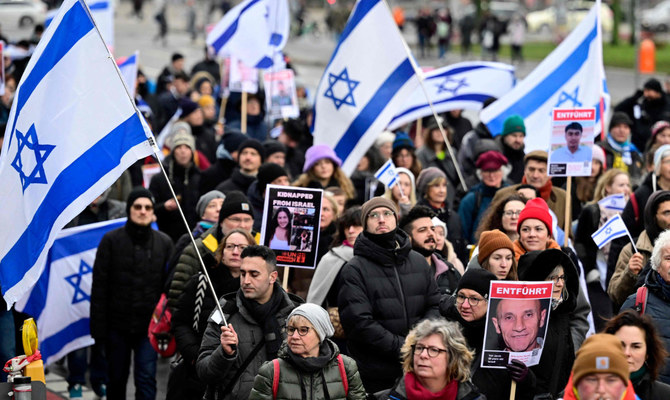
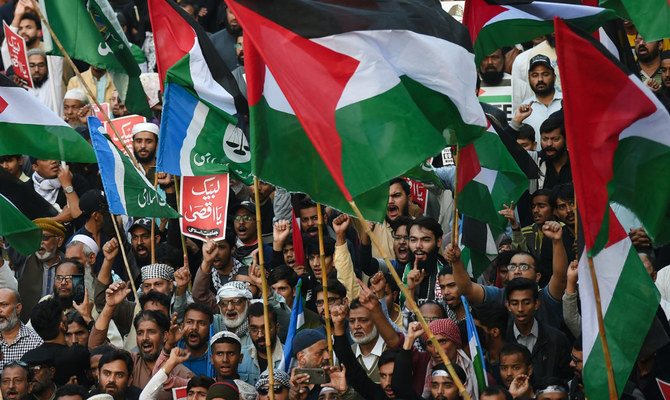
KARACHI, Pakistan: From Berlin to London and Limassol to Karachi, tens of thousands of people took to the streets Sunday to mark the 100th day of Israel’s war with Hamas. Opposing demonstrations either demanded the release of Israeli hostages held by Hamas or called for a cease-fire in Gaza.
In the southern Pakistani city of Karachi, protesters waved Palestinian flags or wore the keffiyeh, the traditional Palestinian scarf, to express their solidarity with Palestinians in a rally organized by the country’s largest religious political party, Jamaat-e-Islami.
The party’s Karachi chief, Hafiz Naeem Ur Rehman, called on the US to stop backing Israel and compensate Palestinians for their losses. He also criticized Muslim leaders and the Organization of Islamic Cooperation for not doing enough to help stop the war.
“Resolutions will not solve this problem,” Rehman said, adding that all “conscientious people” should support South Africa’s action to launch legal action against Israel for allegedly committing genocide in Gaza.
Karachi resident Ishrat Zahid took Muslim leaders to task for “peacefully sleeping in their homes (but) not even thinking about protesting.”
“This is why we have gathered here, to tell our Palestinian brothers and sisters that we are with them,” he said.
In the heart of the British capital, thousands of people chanted “Bring them home now” in a demonstration to demand the freedom of 132 remaining hostages taken by Hamas militants in the Oct. 7 attacks that also killed some 1,200 Israelis and touched off the war.
Gaza health authorities say the death toll in the enclave has already eclipsed 23,000 people, roughly 1 percent of the Palestinian territory’s population. Thousands more remain missing or badly wounded, while 80 percent of the population has been displaced.
Protesters in London held posters with photos and the words “100 days in hell” to express their solidarity with Israel.
Ayelet Svatitzky, the sister of a hostage still in captivity, warned “there is no more time” for those captured, and called for their release ahead of the 100th day since Hamas launched its attack on Israel.
“My biggest fear is, I don’t know how long it’s going to last, I don’t know how long he can hold on and I don’t know what his condition is,’’ she said of her brother Nadav Popplewell, 51, one of two UK nationals who remain hostage.
Popplewell was captured alongside his 79-year-old mother, Channah Peri. Though Peri was released during a November cease-fire, Svatitzky’s elder brother, Roi Popplewell, was found dead near his home just after the attacks.
The demonstration comes just a day after thousands of pro-Palestinian protesters demonstrated in London, Dublin and Edinburgh, calling for a permanent cease-fire in the conflict — part of a global day of action involving 30 countries.
In a reflection of ongoing tensions, members of the crowd Sunday had to wait in line to get their bags searched before entering the square. Barricades were erected on the square’s perimeter, lined by police officers and security guards.
A similar demonstration was held in Berlin, where pianist Igor Levit played a yellow piano as part of an initiative to keep the memory of the Israeli hostages alive.
Played in public places from Tel Aviv to Tokyo, the yellow grand piano aimed to bring to mind 22-year-old hostage Alon Ohel, a pianist who was abducted by Hamas militants during the Oct. 7 attack on the Nova Music Festival.
Alon’s mother Idit Ohel who was on hand for the demonstration said the piano is symbolic of “something bigger.”
“Music is something that is beyond Religion. Beyond gender. And it’s something that we can understand,” she said.
In the French capital, several hundred protesters converged in the city center holding placards with the faces of Israeli hostages, singing for their release around a large banner strewn on the ground reading, “Bring them home now!”
About 100 motorcyclists waved Israeli flags and sported stickers of Israeli hostages on their bikes as they cruised around Paris in a ride to express support for Israel. The motorcycle ride followed an earlier, pro-Israeli bicycle procession around the city with cyclists waving Israeli flags and chanting “Free the hostages.”
On Cyprus’ southern coastline outside the town of Limassol, several hundred protesters waved Palestinian flags and held placards outside the entrance of a British air force base calling for a “Free Palestine” and an end to the “siege of Gaza.”
Protesters handed authorities at RAF Akrotiri a petition demanding an end to the use of the air base as a launchpad for airstrikes in the region and the alleged transfer of arms to Israel from there.
British aircraft had taken off from RAF Akrotiri — one of two military bases that Britain maintains in Cyprus — to strike Houthi targets in Yemen in recent days.
A British Ministry of Defense spokesperson said that no UK aircraft have delivered any lethal cargo to Israel and that the UK government is “focused on getting significantly more aid to Gaza” after delivering about 96 tons of British and Cypriot aid from Cyprus to Egypt for the people in the Palestinian enclave.
In neighboring Turkiye, about 2,000 marchers waved Palestinian and Turkish flags in Istanbul while paying homage to nine Turkish soldiers who were killed in northern Iraq last week.
Similar demonstrations organized by Turkiye’s Humanitarian Relief Foundation were held in other Turkish cities. Foundation representative Osman Delibas linked the war in Gaza and hostilities in Iraq. Turkiye holds Kurdish militants in Iraq responsible for the death of its soldiers.
“Those who supported terrorist organizations and unleashed them on us are the same ones who committed genocide in Gaza,” state-run Anadolu news agency quoted Delibas as saying.
At the Vatican, Pope Francis told the faithful in St. Peter’s Square that modern warfare is “a crime against humanity” because it “sows death among civilians and destroys cities and infrastructure.” In his weekly appearance at the Vatican window overlooking the Square, the pope lamented that “arms continue to kill and destroy” when at the start of the year “we exchanged wishes for peace,” urging people not to forget those who “suffer the cruelty of war” around the world especially in Ukraine, Palestine and Israel.
In Lisbon, Portugal, ballet dancer Irina Almeida joined several thousand marchers to demand a cease-fire in Gaza as they made their way from the US to the Israeli embassies, chanting “Yes to peace” and “No to war.”
“It’s not about 100 days, it’s 75 years,” said Almeida. “This is the 21st century and this should have never happened in the history of humankind, let alone at a time when we say we are so developed.”


![]()
![]()

From Berlin to Karachi, thousands demonstrate in support of either Israel or the Palestinians
Short Url
https://arab.news/b2cdb
From Berlin to Karachi, thousands demonstrate in support of either Israel or the Palestinians
- Opposing demonstrations either demanded the release of Israeli hostages held by Hamas or called for a cease-fire in Gaza


Latest updates




© 2026 SAUDI RESEARCH & PUBLISHING COMPANY, All Rights Reserved And subject to Terms of Use Agreement.