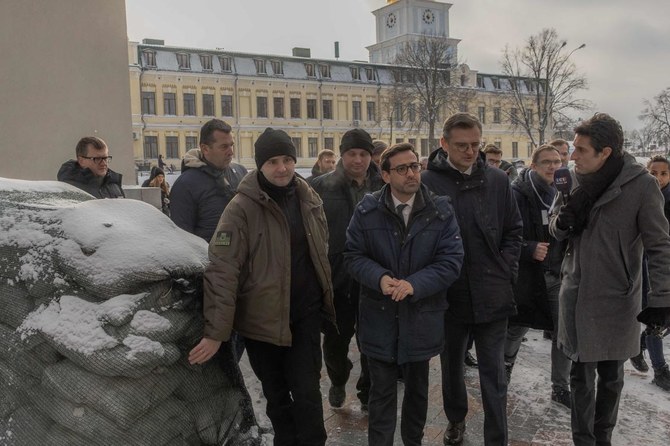
KYIV: France’s new foreign minister Stephane Sejourne on Saturday renewed his country’s support to Ukraine, choosing Kyiv for his first official visit abroad, as the war with Russia nears a second anniversary.
Sejourne arrived in Kyiv as Ukraine saw another wave of overnight strikes from Russia, which has intensified its aerial attacks recently.
The visit took place as allies struggle to secure funding, with some worrying that Kyiv could be forgotten amid new conflicts, including between Israel and Hamas.
“Despite the multiplying crisis, Ukraine is and will remain France’s priority,” Sejourne said.
The freshly-appointed foreign minister explained that “the fundamental principles of international law and the values of Europe, as well as the security interests of the French” were at stake in Ukraine.
Sejourne, 38, who unlike his predecessor Catherine Colonna has no background as a professional diplomat, had already pledged continued support.
Aid promised to Ukraine between August and October 2023 fell almost 90 percent from the same period in 2022, reaching its lowest point since the start of the war, according to a Kiel Institute survey from December.
An EU aid package worth 50 billion euros ($55 billion) has been stuck in Brussels, while the US Congress remains divided on sending additional aid to Ukraine.
“Russia hopes Ukraine and its supporters will get tired before it does. We will not falter,” Sejourne added.
But Russia, bolstering its arsenal, has geared up for a long war and reoriented its economy.
It has in recent weeks intensified its aerial assaults on the war-torn country.
Russia launched 40 missiles and drones over the country in an overnight barrage, the Ukrainian air force said.
It destroyed eight missiles and disabled over 20 devices.
“Either they fell in the fields, they were detonated in the air, or they were affected by means of radio-electronic warfare of our defense forces,” air force spokesman Yuri Ignat said on television.
Russia said it targeted places producing ammunition and drones and had hit “all designated facilities.”
Ukrainian authorities did not report any dead in the latest barrage but one civilian was wounded in the Sumy region.
In a press conference alongside Sejourne, Ukrainian Foreign Minister Dmytro Kuleba praised the minister’s “important” visit immediately after his appointment, and despite the Russian strikes.
“I am grateful to you for your courage, for the fact that he did not turn around on the way,” Kuleba said.
He added that they had “discussed the further supply of systems and missiles to protect the Ukrainian sky, as well as the supply of drones to Ukraine.”
France’s military support to Ukraine amounts to 3.2 billion euro, according to a parliamentary report published in November.
France has provided artillery and air defense means to Ukraine, Sejourne said.
“We are entering a new phase of defense cooperation” aiming to “strengthen Ukraine’s capacity to produce the weapons it needs on its own soil,” he added.
Kuleba confirmed that the two countries had agreed to “work on creating the most favorable conditions for the interaction of our defense companies” including legally.
The day before, Kyiv had seen the visit of British Prime Minister Rishi Sunak, who announced a new multibillion-dollar aid package for Ukraine and pledged London’s support for a decade.
Ukrainian President Volodymyr Zelensky hailed the “unprecedented” 10-year security cooperation agreement as well as the £2.5 billion ($3.2 billion) in new military aid earmarked for 2024.

Ukraine ‘will remain France’s priority’ despite international crisis
Short Url
https://arab.news/8wxkr
Ukraine ‘will remain France’s priority’ despite international crisis
- Sejourne arrived in Kyiv as Ukraine saw another wave of overnight strikes from Russia
- The visit took place as allies struggle to secure funding, with some worrying that Kyiv could be forgotten amid new conflicts
UK police to arrest those chanting ‘globalize the intifada’
- Pro-Palestinian groups say the move will infringe on the right to protest and misunderstands the meaning of the word
- UK police say the context surrounding the chants has changed after the Bondi Beach attack
LONDON: People publicly chanting pro-Palestinian calls to “globalize the intifada” will be arrested, UK police warned Wednesday, saying the “context had changed” in the wake of Australia’s Bondi Beach attack.
The announcement by the police forces of London and the northwest English city of Manchester swiftly prompted accusations of political repression by some campaigners.
The move follows father-and-son gunmen killing 15 people Sunday at a Hanukkah festival on the Sydney beach and an October attack on a Manchester synagogue on Yom Kippur, the holiest day of the Jewish calendar.
“We know communities are concerned about placards and chants such as ‘globalize the intifada’,” the UK capital’s Metropolitan Police and Greater Manchester Police said in a joint statement vowing to “be more assertive.”
“Violent acts have taken place, the context has changed — words have meaning and consequence. We will act decisively and make arrests.”
Jewish groups welcomed the announcement, with the UK’s Chief Rabbi Ephraim Mirvis calling it “an important step toward challenging the hateful rhetoric we have seen on our streets, which has inspired acts of violence and terror.”
But Ben Jamal, from the Palestine Solidarity Campaign, said in a statement that it infringes on the right to protest.
“The statement by the Met and GMP marks another low in the political repression of protest for Palestinian rights,” he said, ahead of a planned central London pro-Palestinian protest Wednesday evening.
He criticized the lack of consultation over the move, adding “the Arabic word intifada means shaking off or uprising against injustice.”
‘Sickening’
“It came to prominence during the first intifada which was overwhelmingly marked by peaceful protest that was brutally repressed by the Israeli state,” Jamal said.
The intifada refers to Palestinian uprisings against Israel. The first raged from 1987 to 1993, while the second flared between 2000 and 2005.
UK police have already stepped up security around the country’s synagogues, Jewish schools and community hubs in the wake of this year’s violent incidents.
Israeli Foreign Minister Gideon Saar urged Australia to act against a “surge” of antisemitism after Sunday’s atrocity, echoing similar previous demands aimed at Britain.
In a social media post, Saar branded slogans heard at pro-Palestinian protests such as “Globalize the Intifada” “Death to the IDF,” the Israeli military, as antisemitic and violent incitement.
UK Prime Minister Keir Starmer, whose wife is Jewish, denounced the weekend gun rampage in Australia as “sickening,” saying it was “an antisemitic terrorist attack against Jewish families.”
Chief prosecutor Lionel Idan said Britain’s Crown Prosecution Service (CPS) was “already working closely with police and communities to identify, charge and prosecute antisemitic hate crimes.”
“We will always look at ways we can do more,” he added.
Hate crime referrals and completed prosecutions rose by 17 percent to 15,561 in the year to June 2025, according to the CPS.
The announcement by the police forces of London and the northwest English city of Manchester swiftly prompted accusations of political repression by some campaigners.
The move follows father-and-son gunmen killing 15 people Sunday at a Hanukkah festival on the Sydney beach and an October attack on a Manchester synagogue on Yom Kippur, the holiest day of the Jewish calendar.
“We know communities are concerned about placards and chants such as ‘globalize the intifada’,” the UK capital’s Metropolitan Police and Greater Manchester Police said in a joint statement vowing to “be more assertive.”
“Violent acts have taken place, the context has changed — words have meaning and consequence. We will act decisively and make arrests.”
Jewish groups welcomed the announcement, with the UK’s Chief Rabbi Ephraim Mirvis calling it “an important step toward challenging the hateful rhetoric we have seen on our streets, which has inspired acts of violence and terror.”
But Ben Jamal, from the Palestine Solidarity Campaign, said in a statement that it infringes on the right to protest.
“The statement by the Met and GMP marks another low in the political repression of protest for Palestinian rights,” he said, ahead of a planned central London pro-Palestinian protest Wednesday evening.
He criticized the lack of consultation over the move, adding “the Arabic word intifada means shaking off or uprising against injustice.”
‘Sickening’
“It came to prominence during the first intifada which was overwhelmingly marked by peaceful protest that was brutally repressed by the Israeli state,” Jamal said.
The intifada refers to Palestinian uprisings against Israel. The first raged from 1987 to 1993, while the second flared between 2000 and 2005.
UK police have already stepped up security around the country’s synagogues, Jewish schools and community hubs in the wake of this year’s violent incidents.
Israeli Foreign Minister Gideon Saar urged Australia to act against a “surge” of antisemitism after Sunday’s atrocity, echoing similar previous demands aimed at Britain.
In a social media post, Saar branded slogans heard at pro-Palestinian protests such as “Globalize the Intifada” “Death to the IDF,” the Israeli military, as antisemitic and violent incitement.
UK Prime Minister Keir Starmer, whose wife is Jewish, denounced the weekend gun rampage in Australia as “sickening,” saying it was “an antisemitic terrorist attack against Jewish families.”
Chief prosecutor Lionel Idan said Britain’s Crown Prosecution Service (CPS) was “already working closely with police and communities to identify, charge and prosecute antisemitic hate crimes.”
“We will always look at ways we can do more,” he added.
Hate crime referrals and completed prosecutions rose by 17 percent to 15,561 in the year to June 2025, according to the CPS.
© 2025 SAUDI RESEARCH & PUBLISHING COMPANY, All Rights Reserved And subject to Terms of Use Agreement.


