

Malaysians pledge long boycott of Western brands over support for Israel

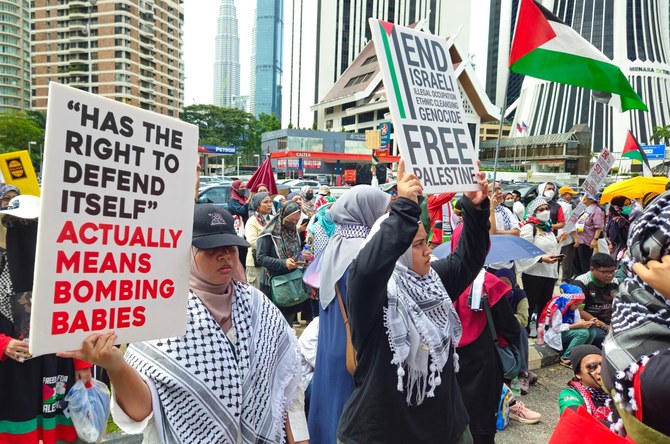
Malaysians rally in solidarity with Palestinians during Global Day of Action against Isreal's onslaught on Gaza, Kuala Lumpur on Jan. 13, 2024. (AN Photo)
Short Url
Updated 13 January 2024
Follow

Malaysians pledge long boycott of Western brands over support for Israel

  • McDonald’s has been trying to fight back against activists with a lawsuit
  • Protesters say action is their contribution to solidarity with Gaza

Kuala Lumpur: Malaysians pressed for a continued boycott of Israeli and Israel-linked goods on Saturday during a protest to demand the country ceases its ongoing assault on Gaza.

Israeli airstrikes have killed at least 23,700 people since October in the densely populated Palestinian enclave — more than one in every 100 residents.

More than 60,000 have been injured, according to Gaza’s Ministry of Health, while thousands of others remain missing under the rubble.

Most of the dead are children and women.

Malaysia has no formal relations with Israel, has long been supportive of the rights of Palestinians and their struggle for a sovereign statehood, and bars Israelis from entering its territory.

Since the beginning of the ongoing onslaught on Gaza, many of its citizens have been calling on others to stop buying into popular brands that they accuse of siding with Israel.

Hundreds of those who gathered near the US Embassy in Kuala Lumpur — as part of Global Day of Action for Gaza on Saturday — carried placards reading “To Be Silent Is To Be Complicit” and “Stop Aiding Genocide!” and said they believed in the boycott of Israel-linked products, calling it their contribution to solidarity.

“We boycott whatever products from Israel," one of the protesters, Shahidah Wana, told Arab News. “It’s a small thing but if a million people do it, it can topple an elephant.”

The rally was organized by the Malaysian chapter of the Boycott, Divestment and Sanctions movement, whose supporters rely on economic and trade pressure in opposition to Israel.

BDS Malaysia has been calling on Malaysians to stay away from popular brands such as McDonald’s, Burger King, Puma and Airbnb.

It is not known what kind of impact they have had on some of the businesses operating in the country, but McDonald’s has been trying to fight back against the movement with a lawsuit seeking 6 million ringgit ($1.3 million) in damages for alleged defamation.

The company’s lawyers alleged in December that the movement’s incitement to boycott led to a loss of profits and job cuts.

Those who attended Saturday’s rally, like Mohd. Fariz Muhammad, were adamant about their stand.

“One thing we can do is to boycott goods from Israel or linked to Israel ... This is a long process,” he said.

“This is a way for our society to educate them (the brands). Behind their products there is an agreement that must be upheld before they get their profits. They must think about the humanitarian side of things first.”

As outrage continues to rise over the growing Palestinian death toll in Gaza and destruction of the enclave, Malaysia last month barred Israeli and Israel-bound ships from docking at its ports.

Activist Jamilah Sheikh Abdullah told Arab News that she felt that the economic pressure was working.

“(Using the) economy is how we break the hold of Israel and the Americans (over Palestine),” she said.

“The economy is the tool that controls the Zionists, their livelihood. The source of income of the Zionists is affected by the BDS movement, and this is how we can break them.”


’Weak by design’ African Union gathers for summit

Updated 3 sec ago
Follow

’Weak by design’ African Union gathers for summit

ADDIS ABABA: The African Union (AU) holds its annual summit in Ethiopia this weekend at a time of genocide, myriad insurgencies and coups stretching from one end of the continent to the other, for which it has few answers.
The AU, formed in 2002, has 55 member states who are often on opposing sides of conflicts. They have routinely blocked attempts to hand real enforcement power to the AU that could constrain their action, leaving it under-funded and under-equipped.
It has missed successive deadlines to make itself self-funding — in 2020 and 2025. Today, it still relies for 64 percent of its annual budget on the United States and European Union, who are cutting back support.
Its chairman, Mahmoud Ali Youssouf, is reduced to expressing “deep concern” over the continent’s endless crises — from wars in Sudan and the Democratic Republic of Congo to insurgencies across the Sahel — but with limited scope to act.
“At a time when the AU is needed the most, it is arguably at its weakest since it was inaugurated,” said the International Crisis Group (ICG) in a recent report.

- Ignoring own rules -

With 10 military coups in Africa since 2020, the AU has been forced to ignore the rule in its charter that coup-leaders must not stand for elections. Gabon and Guinea, suspended after their coups, were reinstated this past year despite breaking that rule.
Meanwhile, there has been no “deep concern” over a string of elections marred by rigging and extreme violence.
Youssouf was quick to congratulate Tanzania’s President Samia Suluhu Hassan after she won 98 percent in a vote in October in which all leading opponents were barred or jailed and thousands of protesters were killed by security forces.
The AU praised the “openness” of an election in Burundi in June described by Human Rights Watch as “dominated by repression (and) censorship.”
The problem, said Benjamin Auge, of the French Institute of International Relations, is that few African leaders care about how they are viewed abroad as they did in the early days after independence.
“There are no longer many presidents with pan-African ambitions,” he told AFP.
“Most of the continent’s leaders are only interested in their internal problems. They certainly don’t want the AU to interfere in domestic matters,” he added.

- AU ‘supports dialogue’ -

AU representatives point out that its work stretches far beyond conflict, with bodies doing valuable work on health, development, trade and much more.
Spokesman Nuur Mohamud Sheekh told AFP that its peace efforts went unnoticed because they were measured in conflicts that were prevented.
“The AU has helped de-escalate political tensions and support dialogue before situations descend into violence,” he said, citing the work done to prevent war between Sudan and South Sudan over the flashpoint region of Abyei.
But African states show little interest in building up an organization that might constrain them.
Power remains instead with the AU Assembly, made up of individual heads of state, including the three longest-ruling non-royals in the world: Teodoro Obiang Nguema of Equatorial Guinea (46 years), Paul Biya of Cameroon (44) and Yoweri Museveni of Uganda (40).
“The African Union is weak because its members want it that way,” wrote two academics for The Conversation last year.
This weekend, the rotating presidency of the AU assembly passes to Burundi’s President Evariste Ndayishimiye, fresh from his party’s 97-percent election victory.
Coups, conflicts and rights abuses may get discussed, but the main theme is water sanitation.