

UN chief warns against escalation after US-UK strikes on Houthis

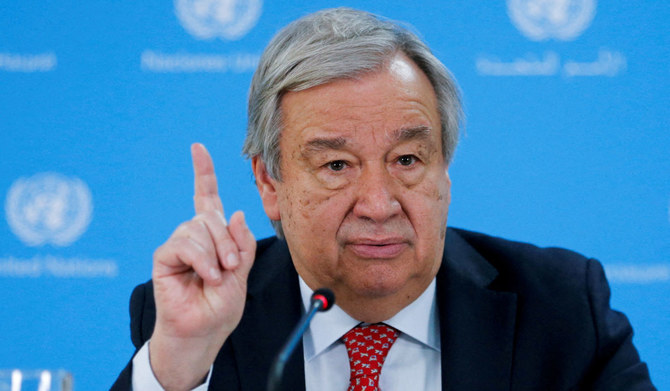
United Nations Secretary-General Antonio Guterres speaks at a press conference at the United Nations complex in Gigiri, Nairobi, Kenya May 3, 2023. (REUTERS)
Short Url
Updated 13 January 2024
Follow

UN chief warns against escalation after US-UK strikes on Houthis

  • Russia’s ambassador to the UN called the joint US-UK strikes on Yemen’s Houthis “blatant armed aggression against another country”

UNITED NATIONS, United States: United Nations Secretary-General Antonio Guterres called on all sides “not to escalate” the volatile situation in the Red Sea, his spokesman said on Friday after Washington and London launched strikes on Yemen’s Houthi rebels.
The barrage of strikes early on Friday against the Houthis, who say they are acting in solidarity with Gaza, follow weeks of disruptive rebel attacks on Red Sea shipping and have stoked fears of the Israel-Hamas war spreading regionwide.
“The Secretary-General further calls on all parties involved not to escalate even more the situation in the interest of peace and stability in the Red Sea and the wider region,” said Guterres’ spokesman Stephane Dujarric.
Later, Khaled Khiari, Assistant Secretary-General for the Middle East, told the UN Security Council “we are witnessing the cycle of violence that risks grave political security, economic and humanitarian repercussions in Yemen and the region.”
“These developments in the Red Sea and the risk of exacerbating regional tensions are alarming,” he said.
Russia’s ambassador to the UN called the joint US-UK strikes on Yemen’s Houthis “blatant armed aggression against another country.”
“These states all carried out a mass strike on Yemeni territory. I’m not talking about an attack on some group within the country but an attack on the people of the country on the whole. Aircraft were used, warships and submarines,” Vasily Nebenzya said of the US and British action, supported by allied countries.
But Washington’s ambassador to the UN Linda Thomas-Greenfield warned that no countries’ vessels were immune to the threat posed by Houthi rebels to shipping in the Red Sea.
“Whether your ship flies an American flag, or the flag of another nation... all of our ships are vulnerable,” she said.
“Without Iranian support, in violation of their obligations... the Houthis would struggle to effectively track and strike commercial vessels, navigating shipping lanes through the Red Sea.”
Britain’s ambassador to the UN Barbara Woodward said London “took limited, necessary and proportionate action in self defense.”
“This operation took particular care to minimize risks to civilians,” she said.


Indonesia sets rules limiting use of AI for schoolchildren

Updated 4 sec ago
Follow

Indonesia sets rules limiting use of AI for schoolchildren

  • Indonesian children spend about 7.5 hours daily on tablets, smartphones
  • Gen Zs make up the majority of AI users in the country of 280m people

JAKARTA: The Indonesian government introduced on Thursday a new policy regulating the use of digital technology in education, limiting access to artificial intelligence for students.

Generation Alphas and Gen Zs make up almost half of Indonesia’s online population, which reached nearly 230 million people in 2025, according to a survey conducted by the Association of Indonesian Internet Service Providers.

As Indonesian children clock around 7.5 hours of daily screen time, the joint ministerial decree seeks to boost the benefits of digital technology and AI in formal and informal educational institutions, while also protecting the youth from risks in digital spaces.

“There are a lot of factors but the number of teenagers with mental health issues are high and continue to increase, and one of the suspected triggers — that have been proven academically — is the uncontrolled, unmitigated use of digital technology,” said Pratikno, Indonesia’s Coordinating Minister for Human Development and Cultural Affairs.

“The effects on education are also concerning, such as how it weakens brain activity due to dependence on digital technology tools and reduces critical thinking and cognitive and reflective abilities. This is what we have to regulate.”

Among Indonesia’s 280 million population, around a quarter of internet users are already using AI, with Gen Zs making up about 43 percent of that segment.

The joint decree, which Pratikno described as “comprehensive” and encompasses early childhood education to higher education, was signed in Jakarta by seven ministers, including Higher Education, Science and Technology Minister Brian Yuliarto and Primary and Secondary Education Minister Abdul Mu’ti.

“This decree seeks to ensure that our children are not controlled by technology but become the masters of technology for good, that is our goal. (It prioritizes) digital wellness, (for tech to be used) wisely and intelligently,” Pratikno said.

The policy is important to support young Indonesians, many of whom are internet users from adolescence, said Communication and Digital Affairs Minister Meutya Hafid, who also signed the ministerial decree.

“Indonesia has a significant number of children using the internet. Therefore, we must ensure that they are not only a target market for the technology industry, but also able to utilize technology according to their readiness,” she said.

“Every kind of technological advance has to consider the readiness of its users, especially children.”