ISLAMABAD: Maulana Fazlur Rehman, leader of a prominent Pakistani religious party, has met Afghanistan’s interim interior minister Sirajuddin Haqqani and discussed with him internal and external stability of both countries, Rehman’s party said on Friday.
Rehman, who heads the Jamiat Ulema Islam (JUI) party, has been on a visit to Afghanistan since Jan. 7 to hold talks with Taliban officials at a time when ties between Pakistan and Afghanistan are at their lowest ebb due to the rising number of militant attacks in Pakistan.
The Pakistani cleric advocated for strong bilateral relations between both countries against the backdrop of his country’s decision to deport large numbers of “illegal immigrants,” mostly Afghans, in the wake of a surge in deadly attacks, including suicide bombings.
In his meeting with Haqqani, the JUI leader was apprised of the internal security situation of Afghanistan, his party said in a statement.
“The purpose of our visit is to bring internal and external stability in the two countries,” Rehman was quoted as telling the Afghan interior minister. “An increase in trade between the two countries will lead to peace and prosperity.”
The Afghan interior minister expressed his country’s desire to have cordial ties with Pakistan.
“[We] want to move forward through cooperation and talks between Pakistan and Afghanistan on border issues,” Haqqani was quoted as saying.
While the JUI leader, along with a delegation, held talks in Kabul, the Pakistani government distanced itself from the visit.
“Maulana Fazlur Rehman has gone to Afghanistan in a private capacity,” Mumtaz Zahra Baloch, a spokesperson of the Pakistan foreign office, said at a weekly press briefing on Thursday. “The government is not supporting his visit in any way.”
Asked if Islamabad intended to hold talks with the Pakistani Taliban, she said Pakistan was not “interested in dialogue with the TTP (Tehreek-e-Taliban Pakistan) which has carried out several attacks in the country.”
The militant group, which is said to have sanctuaries in Afghanistan, is separate from but a close ally of the Afghan Taliban.
Over the last one year, Pakistan has repeatedly asked the Afghan Taliban to prevent the TTP from using their soil to carry out attacks against Pakistan. Kabul denies the use of its territory by any militant group.

Pakistani religious party leader discusses internal, external stability with Afghan interior minister
https://arab.news/vrbwj
Pakistani religious party leader discusses internal, external stability with Afghan interior minister
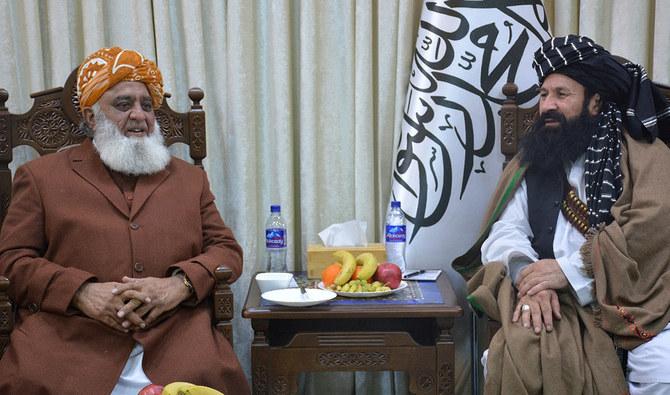
- Maulana Fazlur Rehman is on a visit to Afghanistan since Sunday where he has met top Taliban leaders
- Pakistan has chosen to distance itself from the visit, says Rehman undertook it in a ‘personal capacity’
Pakistan urges world to treat water insecurity as global risk, flags India treaty suspension
- Pakistan says it is strengthening water management but national action alone is insufficient
- India unilaterally suspended Indus Waters Treaty last year, leading to irregular river flows
ISLAMABAD: Pakistan on Tuesday urged the international community to recognize water insecurity as a “systemic global risk,” warning that disruptions in shared river basins threaten food security, livelihoods and regional stability, as it criticized India’s handling of transboundary water flows.
The call comes amid heightened tensions after India’s unilateral decision last year to hold the 1960 Indus Waters Treaty “in abeyance,” a move Islamabad says has undermined predictability in river flows and compounded climate-driven vulnerabilities downstream.
“Across regions, water insecurity has become a systemic risk, affecting food production, energy systems, public health, livelihoods and human security,” Pakistan’s Acting Permanent Representative to the United Nations, Ambassador Usman Jadoon, told a UN policy roundtable on global water stress.
“For Pakistan, this is a lived reality,” he said, describing the country as a climate-vulnerable, lower-riparian state facing floods, droughts, accelerated glacier melt, groundwater depletion and rapid population growth, all of which are placing strain on already stressed water systems.
Jadoon said Pakistan was strengthening water resilience through integrated planning, flood protection, irrigation rehabilitation, groundwater replenishment and ecosystem restoration, including initiatives such as Living Indus and Recharge Pakistan, but warned that domestic measures alone were insufficient.
He noted the Indus River Basin sustains one of the world’s largest contiguous irrigation systems, provides more than 80 percent of Pakistan’s agricultural water needs and supports the livelihoods of over 240 million people.
The Pakistani diplomat said the Indus Waters Treaty had for decades provided a framework for equitable water management, but India’s decision to suspend its operation, followed by unannounced flow disruptions and the withholding of hydrological data, had created an unprecedented challenge for Pakistan’s water security.
Pakistan has said the treaty remains legally binding and does not permit unilateral suspension or modification.
The issue has gained urgency as Pakistan continues to recover from last year’s monsoon floods, which killed more than 1,000 people and devastated farmland in Punjab, the country’s eastern breadbasket, in what officials described as severe riverine flooding.
Last month, Deputy Prime Minister Ishaq Dar said Pakistan had observed abrupt variations in river flows from India, creating uncertainty for farmers in Punjab during critical periods of the agricultural cycle.
“As we move toward the 2026 UN Water Conference, Pakistan believes the process must acknowledge water insecurity as a systemic global risk, place cooperation and respect for international water law at the center of shared water governance, and ensure that commitments translate into real protection for vulnerable downstream communities,” Jadoon said.


