


SYDNEY: Asian shares were subdued on Friday as the escalating conflict in the Red Sea region sent oil prices surging, while slightly higher-than-expected US inflation data did not dent investors’ views on early and aggressive rate cuts in the US and Europe, according to Reuters.
The rally in rates may have been helped by dovish comments from European Central Bank President Christine Lagarde who said rate cuts would occur if the central bank has certainty that inflation had fallen to the 2 percent level.
European markets are set to open higher, with EUROSTOXX 50 futures jumping 0.7 percent and FTSE futures up 0.4 percent. US stock futures were, however, slightly lower.
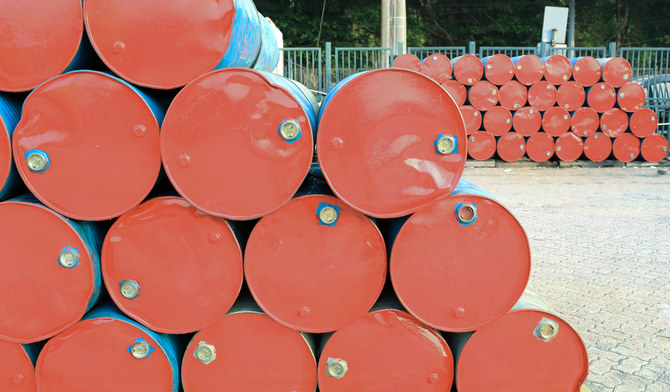
Oil climbed after the US and UK said they launched strikes from the air and sea against Houthi military targets in Yemen in response to the group’s attacks on ships in the Red Sea, a dramatic regional widening of the Israel-Hamas war in Gaza.
Brent crude futures were up $2.21, or 2.9 percent, at $79.62 a barrel at 4.50 p.m. Saudi time, while US West Texas Intermediate crude futures climbed $2.13, or 3 percent, to $74.15.
Both benchmarks were on course for a second straight weekly rise.
“I think at this stage it’s too early to tell what kind of impact it’ll have. Markets are taking a wait-and-see approach for the time being, hence we’re not seeing too much of a reaction,” said Khoon Goh, head of Asia research at ANZ in Singapore.
“If we see a massive escalation of the situation ... then the traditional flight-to-safety will see US Treasuries, safe-haven currencies like yen and Swiss franc benefit.”
Still, the intensifying conflict has kept investors cautious. MSCI’s broadest index of Asia-Pacific shares outside Japan inched 0.1 percent higher, but was still headed for a weekly drop of 0.7 percent.
Japan’s Nikkei extended its impressive gains so far this year, jumping 1.5 percent to another 34-year high on Friday, helped by solid results from Fast Retailing Co, owner of clothing brand Uniqlo.
Chinese inflation data showed the country’s economic recovery remained weak in December, with the consumer price index falling 0.3 percent from a year ago. However, separate trade data showed exports rose at a faster than expected clip last month while imports returned to growth.
China’s blue chips and Hong Kong’s Hang Seng index were mostly flat.
Overnight, Wall Street reversed earlier declines and was mostly flat on the day after data showed US consumer prices rose more than expected in December, with a closely watched core measure coming in slightly above consensus.
Andrew Lilley, chief rates strategist at Barrenjoey, said that even though the core US inflation data came in a little stronger than expected, it does not suggest a strong read on PCE, which is the Fed’s preferred gauge of inflation.
“Additionally to that, the Fed speakers that we had last night all sounded incrementally more dovish than they had previously and ... we didn’t hear such a strong pushback on the idea of a March cut from everybody who spoke,” he added.
Fed officials took few fresh signals from the inflation data, with Richmond Fed President Thomas Barkin saying it did little to clarify the path of inflation.
Futures added to the bets on an interest rate cut in March at a 73 percent probability, compared with 68 percent a day earlier. They are also pricing in around 150 basis points (bps) of easing this year.
For the ECB, euribor money market futures added as much as 10 basis points overnight. Swaps have moved to fully price in a quarter-point rate cut in April, while a total of 148 bps in easing has been priced in for this year..
Treasuries were steady in Asia after the rally, led by the short end of the curve. The two-year yield was at 4.2722 percent in Asia, having fallen 11 bps points overnight, while the 10 year was little changed at 3.9767 percent, after easing 5 bps overnight.
In the foreign exchange market, the dollar failed to make any headway from the slightly firmer-than-expected US inflation data. The dollar index was little changed at 102.27 against its major peers, after ending the previous session slightly lower.
Spot gold rose 0.4 percent to $2,035.81 an ounce.


