

San Francisco supervisors approve resolution calling for a ceasefire in Gaza on 8-3 vote

1 / 2
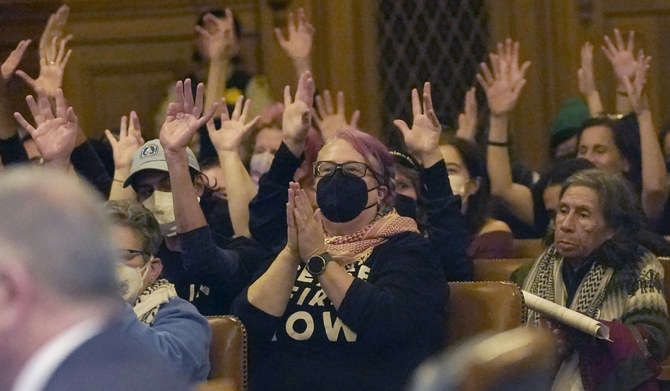
Pro-Palestinian supporters cheer after a San Francisco Board of Supervisors meeting in San Francisco, Tuesday, Jan. 9, 2024. (AP)
2 / 2
Pro-Palestinian supporters react to speakers during a San Francisco Board of Supervisors meeting in San Francisco, Tuesday, Jan. 9, 2024. (AP)
Short Url
Updated 10 January 2024
Follow

San Francisco supervisors approve resolution calling for a ceasefire in Gaza on 8-3 vote

  • The resolution approved by San Francisco condemns the Hamas attack as well as actions by the Israeli government led by Prime Minister Benjamin Netanyahu. It condemns rhetoric and attacks that are antisemitic, anti-Palestinian, Islamophobic or xenophobic

SAN FRANCISCO: Supervisors in San Francisco approved a resolution calling for an extended ceasefire in Gaza that condemns Hamas as well as the Israeli government and also urges the Biden administration to press for the release of all hostages and delivery of humanitarian aid.
Ceasefire advocates in the audience erupted into cheers and chants of “Free Palestine” after the 8-3 vote Tuesday on a last-minute compromise proposed by Aaron Peskin, president of the Board of Supervisors. It is more succinct than the original resolution.
Peskin, who is Jewish, acknowledged that no resolution would receive the board’s unanimous support and lamented that they could not use the opportunity to bridge San Franciscans on both sides of the issue.
“I don’t know that there’s any way to successfully do that,” he said, “given how deep the divisions and the hurt and the horror and the pain are.”
San Francisco joins dozens of other US cities in approving a resolution that has no legal authority but reflects pressure on local governments to speak up on the Israel-Hamas war, now entering its fourth month following a deadly Oct. 7 attack by Hamas militants.
Oakland, another Bay Area city that is politically liberal like San Francisco, unanimously approved a permanent ceasefire resolution in November after rejecting an amendment that would have added an explicit condemnation of Hamas.
But Berkeley, another San Francisco Bay Area city that is overwhelmingly liberal and inclined to side with oppressed peoples, declined to consider a resolution, with Mayor Jesse Arreguín said in a statement that such resolutions “fan the flames of hatred.”
The resolution approved by San Francisco condemns the Hamas attack as well as actions by the Israeli government led by Prime Minister Benjamin Netanyahu. It condemns rhetoric and attacks that are antisemitic, anti-Palestinian, Islamophobic or xenophobic.
The original resolution introduced by Supervisor Dean Preston in December, who is also Jewish, included the same sentiments but also had more detail of calls for a ceasefire. His bill co-sponsor was Hillary Ronen, a supervisor whose father served in the Israeli Defense Forces.
Neither version went far enough in explicitly condemning atrocities committed by Hamas, said Supervisor Matt Dorsey, who voted no. “To do otherwise, in my view, would send a dangerous and unthinkable message that terrorism works,” he said.
Ceasefire supporters in the audience booed when he brought up documentation by Hamas militants of rape, brutality and mutilation against women in their attack, prompting Peskin to admonish the crowd to “chill out and let everybody speak.”
Supervisors said the issue has sparked an avalanche of calls and emails to their offices.
Ceasefire supporters, which include Palestinians and Jewish people, have called the resolution a common-sense stand against genocide and a declaration of the value of Palestinian lives. Opponents, including people who are Jewish, have said such resolutions are one-sided and stoke antisemitism.
In an interview before the vote, Preston acknowledged that the initial board reaction to the ceasefire resolution was mixed with supervisors resistant to taking up what has become a politically loaded issue. But momentum grew as the war continued, he said.
He also said local politicians should speak up because they have constituents who are affected and those people can’t necessarily make their voices heard in Congress.
“Everyone is feeling this locally, the pain and the grief and loss,” he said. “It is a major issue not just in the daily lives of people in the Middle East, but in the daily lives of people in our city.”


Kosovo voters cast ballots in a second attempt this year to elect a government and avoid more crisis

Updated 2 sec ago
Follow

Kosovo voters cast ballots in a second attempt this year to elect a government and avoid more crisis

PRISTINA: Voters in Kosovo cast ballots on Sunday in an early parliamentary election in hopes of breaking a political deadlock that has gripped the small Balkan nation for much of this year.
The snap vote was scheduled after Prime Minister Albin Kurti’s governing Vetevendosje, or Self-Determination, party failed to form a government despite winning the most votes in a Feb. 9 election.
The deadlock marked the first time Kosovo could not form a government since it declared independence from Serbia in 2008 following a 1998-99 war that ended in a NATO intervention.
The prime minister’s party is again the favorite in the race, but it is unclear whether it will manage to muster a majority this time in the 120-member parliament, after other mainstream parties refused an alliance.
According to Kosovo’s election laws, 20 parliamentary seats are automatically assigned to ethnic Serb representatives and other minority parties.
Another inconclusive vote would further deepen the crisis. Kosovo has already not approved a budget for next year, sparking fears of possible negative effects on the already poor economy in the country of 2 million people.
Lawmakers are set to elect a new president in March as current President Vjosa Osmani’s mandate expires in early April. If this fails too, another snap election must be held.
The main opposition parties are the Democratic League of Kosovo and the Democratic Party of Kosovo. They have accused Kurti of authoritarianism and of alienating Kosovo’s US and European Union allies since he came to power in 2021.
A former political prisoner during Serbia’s rule in Kosovo, the 50-year-old Kurti has taken a tough stand in talks mediated by the European Union on normalizing relations with Belgrade. In response, the EU and the United States imposed punitive measures.
Kurti has promised to buy military equipment to boost security.
No reliable pre-election polls have been published. Kurti’s party at the previous election won around 42 percent of the votes while the two main rival parties had together around 40 percent.
Analysts say that even the slightest changes in numbers on Sunday could prove decisive for the future distribution of power but that nothing is certain.
Tensions with restive ethnic Serbs in the north exploded in clashes in 2023 when scores of NATO-led peacekeepers were injured. In a positive step, ethnic Serb mayors this month took power peacefully there after a municipal vote.
Kurti has also agreed to accept third-country migrants deported from the United States as part of tough anti-immigration measures by the administration of President Donald Trump. One migrant has arrived so far, authorities have told The Associated Press.
Kosovo is one of the six Western Balkan countries striving to eventually join the EU, but both Kosovo and Serbia have been told they must first normalize relations.