


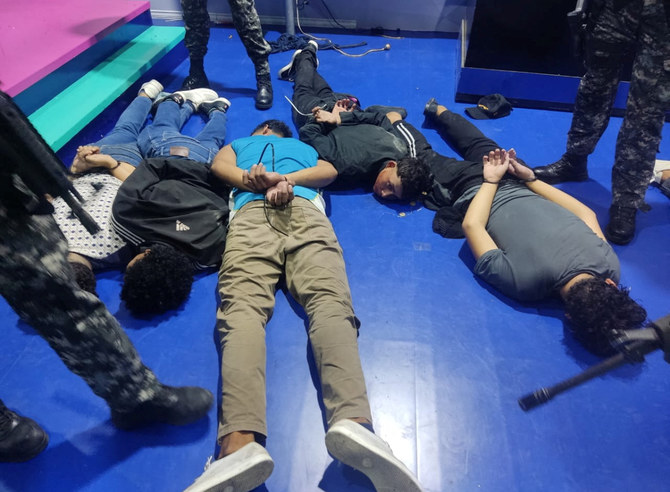
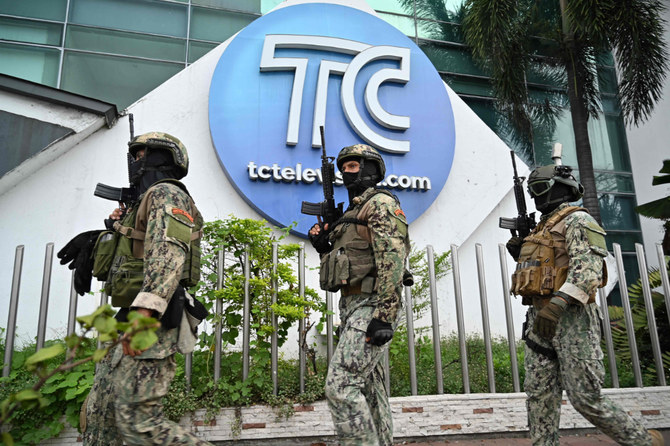

GUAYAQUIL, Ecuador: Masked men broke onto the set of a public television channel in Ecuador waving guns and explosives during a live broadcast Tuesday, and the president issued a decree declaring that the South American country had entered an “internal armed conflict.”
The men armed with pistols and what looked like sticks of dynamite entered the set of the TC Television network in the port city of Guayaquil and shouted that they had bombs. Noises similar to gunshots could be heard in the background. It was not immediately clear if any station personnel were injured.
Alina Manrique the head of news for TC Television, said she was in the control room, across from the studio, when the group of masked men entered the building. One of the men pointed a gun at her head and told her to get on the floor, Manrique said.
Some of the assailants ran from the studio and tried to hide elsewhere in the building when they realized they were surrounded by police, she said.
“I am still in shock” Manrique told The Associaed Press in a phone interview. “Everything has collapsed ... All I know is that its time to leave this country, and go very far away.”
Ecuador has been rocked by a series of attacks, including the abductions of several police officers, in the wake of a powerful gang leader’s apparent weekend escape from prison. President Daniel Noboa said Monday that he would declare a national state of emergency, a measure that lets authorities suspend people’s rights and mobilize the military in places like prisons.
Shortly after the gunmen stormed the TV station, Noboa issued another decree designating 20 drug trafficking gangs operating in the country as terrorist groups and authorizing Ecuador’s military to “neutralize” these groups within the bounds of international humanitarian law.
Ecuador’s national police chief announced a short time later that authorities had arrested all the masked intruders. Police commander César Zapata told the TV channel Teleamazonas that officers seized the guns and explosives the gunmen had with them. He didn’t say how many people were arrested.
“This is an act that should be considered as a terrorist act,” Zapata said.
The government has not said how many attacks have taken place since authorities announced that Los Choneros gang leader Adolfo Macías, alias “Fito,” was discovered missing from his cell in a low security prison Sunday. He was scheduled to be transferred to a maximum security facility that day.
Authorities also have not said who is thought to be behind the attacks, which included an explosion near the house of the president of the National Justice Court and the Monday night kidnappings of four police officers, or whether they think the actions were coordinated.
Police said one office was abducted in the capital, Quito, and three in Quevedo city.
Los Choneros is one of the Ecuadorian gangs authorities consider responsible for a spike in violence that reached a new level last year with the assassination of presidential candidate Fernando Villavicencio. The gang has links with Mexico’s Sinaloa cartel, according to authorities.
The government blamed members of the main drug gangs for a surge of violence that has engulfed the country in recent years, much of it tied to drug trafficking.
Macías’ whereabouts are unknown. Prosecutors opened an investigation and charged two guards in connection with his alleged escape, but neither the police, the corrections system, nor the federal government confirmed whether the prisoner fled the facility or might be hiding in it.
In February 2013, he escaped from a maximum security facility but was recaptured weeks later.
On Monday, Noboa decreed a national state of emergency for 60 days, allowing the authorities to suspend rights and mobilize the military in places like prisons. The government also imposed a curfew from 11 p.m. to 5 a.m.
Noboa said in a message on Instagram that he wouldn’t stop until he “brings back peace to all Ecuadorians,” and that his government had decided to confront crime. The wave of attacks began a few hours after Noboa’s announcement.
States of emergency were widely used by Noboa’s predecessor, Guillermo Lasso, as a way to confront the wave of violence that has affected the country.
Macías, who was convicted of drug trafficking, murder and organized crime, was serving a 34-year sentence in La Regional prison in the port of Guayaquil.
Experts and authorities have acknowledged that gang members practically rule from inside the prisons, and Macías was believed to have continued controlling his group from within the detention facility.


