

Indonesia to send largest-ever number of Hajj pilgrims this year

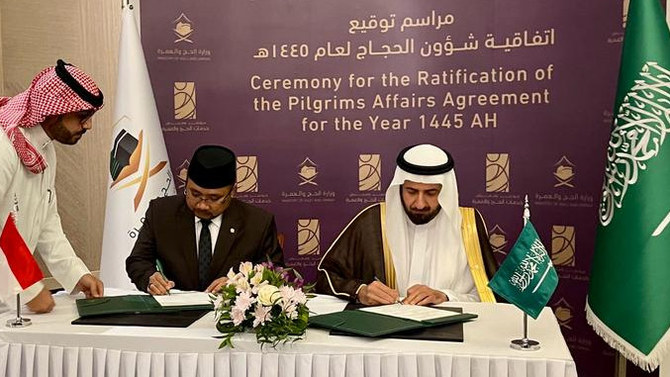
Indonesia’s Religious Affairs Minister Yaqut Cholil Qoumas and Saudi Hajj and Umrah Minister Tawfiq Al-Rabiah sign a pilgrimage agreement in Jeddah on Jan. 8, 2024. (Ministry of Religious Affairs)
Short Url
Updated 09 January 2024
Follow

Indonesia to send largest-ever number of Hajj pilgrims this year

  • 241,000 Indonesian pilgrims will perform the Hajj this year
  • New quota will help shorten the wait for elderly Indonesian pilgrims

JAKARTA: Indonesia will send its largest-ever Hajj contingent to Saudi Arabia this year, the Ministry of Religious Affairs said on Tuesday, after the Kingdom approved the 2024 quota of 241,000 Indonesian pilgrims.

Indonesia’s Religious Affairs Minister Yaqut Cholil Qoumas signed a pilgrimage agreement with Saudi Hajj and Umrah Minister Tawfiq Al-Rabiah in Jeddah on Monday, under which the world’s largest Muslim-majority country’s Hajj quota has been increased by 20,000 from 221,000 last year.

“We agreed on several things with Saudi Arabia. One of them is the number of Indonesian Hajj pilgrims who will be departing (this year), which will be 241,000 people,” Qoumas said in a statement issued on Tuesday.

“This quota is the biggest in Indonesia’s history of managing Hajj pilgrimages.”

The highest quota in previous years came before the COVID-19 pandemic, in 2019, when Saudi Arabia approved a quota of 231,000 pilgrims for Indonesia.

This year’s additional quota will help shorten the wait for some pilgrims by a few years, which is especially important for elderly pilgrims. Many in Indonesia need to wait up to 45 years for their turn, according to official estimates.

“For the government, a bigger quota is extremely important and it has always been something we fight for … this additional quota will be extremely beneficial as it will shorten the existing queue,” Masduki Baidlowi, spokesperson to Vice President Ma’ruf Amin, told Arab News.

“Many Indonesian pilgrims are getting older. If the queue becomes longer, many die before their dream of performing the Hajj comes true. That’s one issue. The second is that the older pilgrims get, the more likely they are to become sick or to fall while they are performing the pilgrimage.”

Baidlowi added that the new quota reflects a new era in Indonesia-Saudi relations, which is visible in many aspects of bilateral ties.

“We can say that relations between the governments of Saudi Arabia and Indonesia are in their golden age of diplomacy,” he said.


Hundreds of people storm US Consulate in Karachi, Pakistan

Updated 7 sec ago
Follow

Hundreds of people storm US Consulate in Karachi, Pakistan

  • Police say hundreds of people have stormed the US Consulate in Pakistan’s port city of Karachi
  • A police official said police and paramilitary forces used batons and fired tear gas to disperse the crowd Sunday
DUBAI: Hundreds of people stormed the US Consulate in Pakistan’s port city of Karachi on Sunday, smashing windows after the US and Israeli attacked Iran and killed the country’s supreme leader, police said.
Police and paramilitary forces used batons and fired tear gas to disperse the crowd, said Mohammad Jawad, a police official. At least one protester was killed and several others were wounded in clashes between protesters and security forces, he said.
The attack on the consulate came hours after Ayatollah Ali Khamenei was killed in a major attack carried out by Israel and the United States.
THIS IS A BREAKING NEWS UPDATE. AP’s earlier story follows below.
DUBAI, United Arab Emirates: Iran fired missiles at targets in Israel and Gulf Arab states Sunday after vowing massive retaliation for the killing of Supreme Leader Ayatollah Ali Khamenei by the United States and Israel, prompting US President Donald Trump to threaten Tehran against further escalation.
Iran acknowledged 86-year-old Khamenei’s death in the joint Israeli-American airstrike Saturday at his Tehran office, which has thrown the future of the Islamic Republic into question and raised the risk of regional instability.
“This is the single greatest chance for the Iranian people to take back their Country,” Trump said.
Iran’s Cabinet vowed that this “great crime will never go unanswered” and the paramilitary Revolutionary Guard threatened to launch its “most intense offensive operation” ever, targeting Israeli and American bases.
“You have crossed our red line and must pay the price,” Iran’s parliamentary speaker, Mohammad Bagher Qalibaf said in a televised address Sunday. “We will deliver such devastating blows that you yourselves will be driven to beg.”
“Iran just stated that they are going to hit very hard today, harder than they have ever hit before,” Trump fired back in a social media post. “THEY BETTER NOT DO THAT, HOWEVER, BECAUSE IF THEY DO, WE WILL HIT THEM WITH A FORCE THAT HAS NEVER BEEN SEEN BEFORE!”
As Israel and the US targeted other top officials, an airstrike on a meeting of the country’s defense council killed Iran’s army chief of staff and defense minister, alongside the head of Iran’s Revolutionary Guard and a top security adviser to Khamenei.
Gen. Abdol Rahim Mousavi and Defense Minister Gen. Aziz Nasirzadeh were killed at the meeting, along with Maj. Gen. Mohammad Pakpour took over as the Guard’s top commander after Israel killed its past commander in the 12-day war last June. The adviser, Ali Shamkhani, had long been a figurehead within Iran’s security establishment.
Iran retaliates
After the initial strikes, Iran immediately launched missiles and drones toward Israel and US military installations in Bahrain, Kuwait and Qatar. The Israeli military said Iran fired dozens of missiles at Israel, with many intercepted. The Magen David Adom rescue service said Saturday night that a woman in the Tel Aviv area died after being wounded in an Iranian missile attack.
Flights across the Middle East were disrupted, and air defense fire thudded over Dubai, the United Arab Emirates’ commercial capital, with explosions continuing into Sunday morning. Shrapnel from an Iranian missile attack on the UAE capital killed one person, state media said, and debris from aerial interceptions caused fires at the city’s main port and on the facade of the iconic Burj Al Arab hotel.
Saudi Arabia said Iran targeted its capital and eastern region in an attack that was repelled and Jordan said it “dealt with” 49 drones and ballistic missiles.
The strikes could rattle global markets, particularly if Iran makes the Strait of Hormuz unsafe for commercial traffic. A third of worldwide oil exports transported by sea passed through the strait in 2025.
The attack on Iran opened a stunning new chapter in US intervention, and carried the potential for retaliatory violence and a wider war, representing a startling flex of military might for an American president who swept into office on an “America First” platform and vowed to keep out of “forever wars.”
The killing of Khamenei in the second Trump administration assault on Iran in eight months appeared certain to create a leadership vacuum, given the absence of a known successor and because the supreme leader had final say on all major policies during his decades in power. He led Iran’s clerical establishment and the Revolutionary Guard, the two main centers of power in the governing theocracy.
Iran quickly formed a council to govern the country until a new supreme leader is chosen.
As reports trickled out about Khamenei’s death, eyewitnesses in Tehran told The Associated Press that some residents were rejoicing, cheering from rooftops, blowing whistles and letting out ululations.
Mourners raised a black flag over the Imam Reza shrine in Mashhad and the Iranian government declared 40 days of public mourning and a seven-day nationwide public holiday to commemorate Khamenei’s death.
Citing unidentified sources, the semiofficial Fars news agency reported that several relatives of Khamenei were also killed, including a daughter, son-in-law, daughter-in-law and grandchild.
Strikes were planned for months
The joint US-Israel operation, which officials say was planned for months, started Saturday during the Muslim holy fasting month of Ramadan and at the start of the Iranian workweek. It followed stilted negotiations and warnings from Trump.
The US military said targets in Iran included Revolutionary Guard command facilities, air defense systems, missile and drone launch sites, and military airfields. It reported no US casualties and minimal damage at US bases despite “hundreds of Iranian missile and drone attacks.”
Democrats decried that Trump had taken action without congressional authorization. White House spokesperson Karoline Leavitt said the administration had briefed several Republican and Democratic leaders in Congress in advance.
Tensions soared as US built up military forces
Tensions have soared in recent weeks as the Trump administration built up the largest force of American warships and aircraft in the Middle East in decades. The president insisted he wanted a deal to constrain Iran’s nuclear program while the country struggled with growing dissent following nationwide protests.
Though Trump had pronounced the Iranian nuclear program obliterated in strikes last year, the country was rebuilding infrastructure that it had lost, according to a senior US official who spoke to reporters on condition of anonymity to discuss Trump’s decision-making process. The official said intelligence showed that Iran had developed the capability to produce its own high-quality centrifuges, an important step in developing the highly enriched uranium needed for weapons.
Iran had said it hoped to avert a war, but it maintained its right to enrich uranium.
Iran has said it has not enriched since June, but it has blocked international inspectors from visiting the sites the US bombed. Satellite photos analyzed by AP have shown new activity at two of those sites, suggesting Iran is trying to assess and potentially recover material.
Attack was coordinated between Israel and US
Israel said the operation had been planned for months with the United States. Air Force pilots struck “hundreds of targets across Iran,” Israeli military chief of staff Lt. Gen. Eyal Zamir said in a statement.
Targets in the Israeli campaign included Iran’s military, symbols of government and intelligence targets, according to an official briefed on the operation, who spoke on condition of anonymity to discuss nonpublic information on the attack.
In southern Iran, at least 115 people were reported killed when a girls’ school was struck, and dozens more were wounded, the local governor told Iranian state TV. US Central Command spokesperson Capt. Tim Hawkins said he was “aware of reports” that a girls’ school was struck and that officials were looking into them.
An Iranian diplomat told the United Nations Security Council that hundreds of civilians were killed and wounded in the strikes.
Iran’s state news agency IRNA said at least 15 people were killed in the southwest, quoting the governor of the Lamerd region, Ali Alizadeh, as saying a sports hall, two residential areas and a hall near a school were hit.