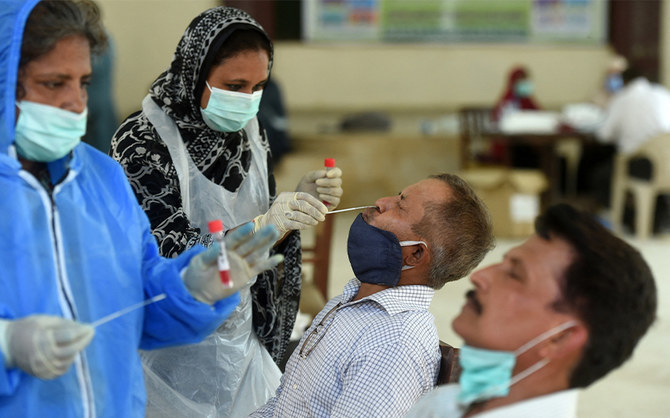
KARACHI: Two more passengers who arrived in Pakistan’s southern port city of Karachi from Saudi Arabia and the UAE tested positive for coronavirus this week, a senior health official confirmed on Sunday.
Pakistani authorities this week started testing two percent of all international travelers arriving in the South Asian country at major airports in Pakistan for a new coronavirus variant, JN-1. On January 5, the Sindh Health Department reported that two international travelers tested positive for the infection at the Jinnah International Airport in Karachi.
The World Health Organization has named JN-1 a variant of concern, indicating that it is being closely monitored, but it has not been added to the high-risk “watchlist” of strains.
“I can confirm both these cases [one from Saudi Arabia and the other from Sharjah],” Shabbir Ali Babar, Sindh Health Department spokesperson, told Arab News, adding that they had tested positive for COVID-19 on Saturday.
“Earlier this week, there were two more cases so this makes it four.”
The two passengers who had tested positive for coronavirus on Friday were allowed to leave for their hometowns in Dera Ghazi Khan in Punjab and Sanghar district in Sindh. They were advised to quarantine themselves at their residences, as per local media reports.
Symptoms of JN-1 are thought to be similar to those of other members of the omicron family of COVID-19 variants, typically starting with a sore throat, followed by congestion and a dry cough.
Pakistani airports are required to carry out fumigation of passenger lounges at least once during the day. This measure aims to ensure a clean and sanitized environment for passengers and staff, reducing the risk of virus transmission, the Pakistan Civil Aviation Authority (PCAA) said in a statement on January 5.
The airports have been further instructed to provide full cooperation to border health services staff, including facilitating their work and ensuring that all necessary protocols and guidelines are followed. These measures are part of the national efforts to control the spread of COVID-19 and protect public health, it added.


Two more passengers in Karachi test positive for coronavirus
https://arab.news/4qdeu
Two more passengers in Karachi test positive for coronavirus

- Four international passengers have tested positive for coronavirus in the last three days, confirms Sindh health official
- Pakistan this week started testing two percent of international travelers arriving at major airports for coronavirus variant, JN-1

Pakistan court orders full eye exam for jailed ex-PM Imran Khan, PTI party says
- Party says directive supports concerns over medical access in custody
- Lawyer earlier told reporters Khan’s health “is fine” after prison visit
ISLAMABAD: Pakistan’s opposition Pakistan Tehreek-e-Insaf (PTI) party said on Thursday the Supreme Court had ordered a full eye examination of jailed ex-premier Imran Khan to be completed before Feb. 16, escalating a dispute between the government and Khan’s family over his medical care in prison.
Concerns about Khan’s health have resurfaced in recent weeks after authorities confirmed he had been briefly taken from prison to a hospital in Islamabad for an eye procedure. The government said at the time his condition was stable, while PTI leaders and Khan’s family complained they had not been informed in advance and alleged he was being denied timely and independent medical access.
The issue was taken up by the Supreme Court earlier this week, which appointed senior lawyer Salman Safdar as a “friend of the court” to visit Khan at Rawalpindi’s Adiala prison and submit a written report on his living conditions.
In its statement on Thursday, PTI said the court had now directed that Khan undergo a comprehensive medical review of his eye condition.
“The Supreme Court’s order for a complete eye check-up of Imran Khan vindicates the party’s longstanding concerns about his deteriorating health and denial of timely, independent medical care in custody,” the party said, adding that he should be given “immediate” access to his personal physician.
Safdar, who met Khan in prison on Tuesday, had earlier sought to calm speculation about his condition.
“It is fine,” Safdar told reporters outside the prison when asked about Khan’s health, declining to provide further details. “I will speak about the rest in the report.”
According to a copy of an earlier court order seen by Arab News, the Supreme Court had tasked Safdar with submitting a written report regarding the “living conditions of the petitioner in jail,” noting that a previous report related to Khan’s detention at Attock jail in 2023 did not reflect his current circumstances.
In its latest statement, PTI framed the court’s directive as part of a broader legal principle.
“This is bigger than one medical test. It is about whether the rule of law applies to political opponents, or only to protect those in power,” the party said, demanding “immediate and transparent implementation of the Court’s order” and “unrestricted access to qualified specialists of his choice.”
Khan has been in jail since August 2023 in connection with multiple cases that he and his party say are politically motivated, an allegation the government denies. He was removed from the PM’s office in April 2022 through a parliamentary vote of no confidence.
There was no immediate response from the government on Thursday to PTI’s latest statement.


