

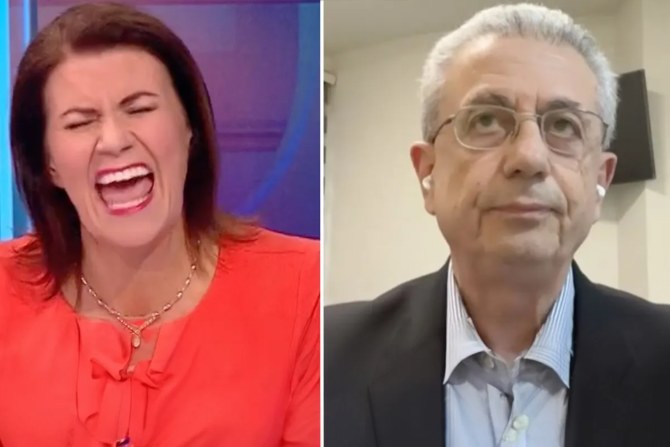

LONDON: A British journalist’s interview with a Palestinian politician has sparked anger on social media, with viewers around the world describing the presenter’s conduct as “racist” and “unprofessional,” and demanding an apology.
Talk TV’s Julia Hartley-Brewer was interviewing Member of the Palestinian Legislative Council Mustafa Barghouti on Wednesday, the day after Israel assassinated deputy Hamas chief Saleh Al-Arouri in Beirut.
In video footage of the interview, which went viral on social media in the days that followed, Hartley-Brewer repeatedly interrupts her guest and shouts at him as he talks about the rule of Israeli Prime Minister Benjamin Netanyahu.
“Do you think Israel is a democratic country? Netanyahu is destroying democracy,” Barghouti says.
Speaking over him, Hartley-Brewer says: “They have elections.”
Barghouti continues: “This man now has three, four courts against him because of four cases of corruption. This man knows if the war stops, he will go to jail.”
After further exchanges, Hartley-Brewer expresses impatience and says: “You talked about how you do not want Israel… you are saying Israel, Oct. 7 happened, you are placing that in a historical context, I understand that, please do not say that again. We do not have time for it. You have made that point five times already.”
Barghouti, who is head of the Palestinian National Initiative, responds: “I do not know what you have time for.”
Hartley-Brewer raises her voice to say: “Oh my God. For the love of God, let me finish a sentence, man. Maybe you are not used to women talking, I do not know, but I would like to finish a sentence.”
While Barghouti remains calm and composed, the broadcaster, in a still-raised voice, gives him 10 seconds to outline what he believes would have been “an acceptable reaction” to the Oct. 7 Hamas attacks on Israel.
“To end occupation and allow peace to prevail for both people,” Barghouti says.
“Brilliant,” Hartley-Brewer says, then slaps her desk and concludes by saying: “Sorry to have been a woman speaking to you.”
Shocked viewers took to social media to express their anger, describing Hartley-Brewer as “bigoted,” “racist” and “unprofessional,” and demanding an apology from Talk TV.
British newsreader India Willoughby said in a message posted on social media network X that Hartley-Brewer “is very lucky that she lives in a time period where bullies are indulged,” and noted that Barghouti had “seemed very calm.”
Julia Hartley-Brewer is a terrible broadcaster who is very lucky that she lives in a time period where bullies are indulged. The Palestinian guy seemed very calm to me. pic.twitter.com/7JMTuhBsFI
— India Willoughby (@IndiaWilloughby) January 5, 2024
Philip Proudfoot, a politics researcher, tweeted: “The level of disrespect shown to Palestinian MP Mustafa Barghouti here is beyond shocking, including an anti-Arab trope framing his struggle to explain even basic context to Julia Hartley-Brewer as driven by … misogyny.”
The level of disrespect shown to Palestinian MP Mustafa Barghouti here is beyond shocking, including an anti-Arab trope framing his struggle to explain even basic context to Julia Hartley-Brewer as driven by … misogyny.pic.twitter.com/FLVxNllrdV
— Philip Proudfoot (@PhilipProudfoot) January 5, 2024
British-Lebanese journalist Hala Jaber shared Talk TV’s clip and described the presenter as “rude, bigoted, narrow-minded, arrogant and absolutely unprofessional.”
Addressing Hartley-Brewer directly, she added: “Your performance was a disgrace to your profession.”
Rude, bigoted, narrow minded arrogant & absolutely unprofessional @JuliaHB1. To even suggest & play the woman card was as a new mow even for you.
I can assure you he knows how to speak to women more than you know how to speak to men or people in general.
Your performance was a… https://t.co/RmzJIXKAk1— Hala Jaber (@HalaJaber) January 5, 2024
Reem Kelani, who described herself as a “proud Arab woman,” urged Talk TV and Hartley-Brewer to apologize.
“Her interview with Dr. Barghouti, a man of great integrity, was a disgrace,” she wrote on X. “Hartley-Brewer also made false accusations about Dr. Barghouti’s stance towards women.”
We demand an apology from @TalkTV & Julia Hartley-Brewer @JuliaHB1 to Dr @MustafaBarghou1
Her interview with Dr Barghouti, a man of great integrity, was a disgrace
Hartley-Brewer also made false accusations about Dr Barghouti's stance towards women@ReemKelani proud Arab woman pic.twitter.com/LPS09XEBh0
— Reem Kelani #CeasefireNow (@ReemKelani) January 5, 2024
Stewart Mills, who is based in Sydney according to his X profile, wrote: “Appalling racism by Julia Hartley-Brewer.”
Demanding an apology, he said the journalist’s conduct showed “complete disrespect for a beautiful and decent man who has devoted his life to community and public health.”
Appalling racism by Julia Hartley-Brewer @JuliaHB1 with Palestinian MP Dr Mustafa Barghouti: ‘Maybe you are not used to women talking’
Complete disrespect for a beautiful & decent man who has devoted his life to community & public health
Apology requiredpic.twitter.com/8Oft84king
— Stewart Mills (@StewartMills) January 5, 2024
Columnist Reem Al-Harmi said Hartley-Brewer’s language was “condescending, patronizing, and next-level gaslighting.”
Julia Hartley yelling racism at Dr. Barghouti, “Maybe you're not used to women talking”.
This arrogant language is condescending, patronizing, and next-level gaslighting.
Have you ever seen any TV presenter challenging an Israeli official, let alone yelling at him/her? pic.twitter.com/cWPHWvY7ic
— Reem Al-Harmi ريم الحرمي (@Reem_AlHarmi) January 5, 2024


