ISLAMABAD: Pakistan’s caretaker administration has constituted a five-member cabinet committee to look into the riots that broke out last year on May 9 with the objective to identify their “mastermind, planners, facilitators and executors” and determine the role played by each one of them.
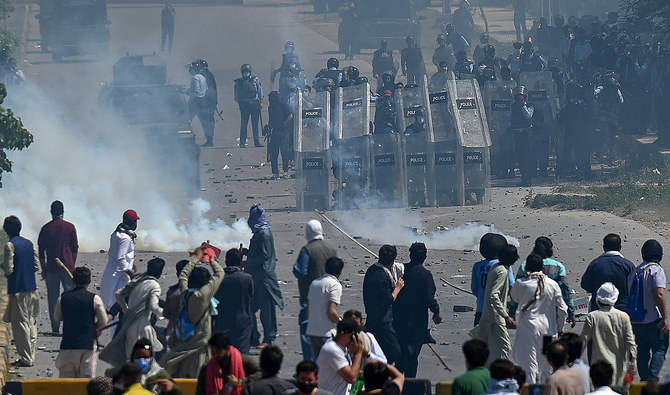
The unrest that led to vandalism and arson attacks targeting government buildings and military properties was triggered following a brief arrest of former prime minister Imran Khan from an Islamabad court on graft charges.
Subsequently, a crackdown was launched against Khan’s Pakistan Tehreek-e-Insaf (PTI) party whose national and provincial leaders were rounded up and sent to prison, prompting the political faction to distance itself from the violent developments of the day.
In a notification brought out by the Cabinet Division on Friday, the government announced the composition of the committee, saying the law minister would be its convener while ministers for interior, information and human rights would act as its members. The notification added the committee would also be joined by “any co-opted Member to address any issue emanating during the proceedings.”
“The Terms of Reference (ToRs) of the Committee are as under,” it said. “(i) To examine the events leading up to the incidents of 9th May, 2023, with a view to ascertain the identity and role of mastermind, planners, facilitators and executors; (ii) To analyze the causes, and determine responsibility for these events; (iii) To evaluate their immediate and long-term implications; (iv) To suggest preventive measures to ensure that such a breach of national security is not repeated; and (v) Recommend measures to strengthen the existing legal regime to deter such recurrences.”
The notification announced the interior ministry would provide secretarial support to the committee, which would submit its report for the cabinet’s consideration within a 14-day period.
The events of May 9 were described as the “black chapter” in Pakistan’s history by the country’s security forces.
Caretaker Prime Minister Anwaar-ul-Haq Kakar said in an interview last month that people involved in the May 9 violence should face the full force of the law.
He maintained that people with “disruptive political behavior” should not be allowed to hold public office or get “great responsibilities of the state” while adding it was his personal opinion and any decision in this connection rested with the country’s election regulatory body.
Khan, who has been accused of being behind the May 9 events, is already in a high-security prison and facing a number of serious allegations against him.
His party has said its top leaders have been sidelined by the government ahead of the national polls in February, adding that it is not getting a “level playing field” for the political contest.


![]()

Pakistan forms cabinet committee to identify ‘mastermind and planners’ of May 9 riots
Short Url
https://arab.news/r54rb
Pakistan forms cabinet committee to identify ‘mastermind and planners’ of May 9 riots
- The committee will probe the violence that broke out last year when ex-PM Khan was briefly detained on graft charges
- Caretaker Prime Minister Kakar has already said people involved in May 9 violence should face the full force of the law
Latest updates


© 2026 SAUDI RESEARCH & PUBLISHING COMPANY, All Rights Reserved And subject to Terms of Use Agreement.