WAJIMA, Japan: The death toll from a major earthquake in western Japan reached 100 Saturday, as rescue workers fought aftershocks to carefully pull people from the rubble.
Deaths had reached 98 earlier in the day, but two more deaths were reported in Anamizu, while officials in Ishikawa prefecture, the hardest-hit region, held their daily meeting to discuss strategy and damages.
Some survivors who had clung to life for days were freed from collapsed homes. A man was pulled out 72 hours after a series of powerful quakes started rattling Japan’s western coast.
The number of missing was lowered to 211 as of Saturday, after it shot up two days ago.
An older man was found alive Wednesday in a collapsed home in Suzu, one of the hardest-hit cities in Ishikawa Prefecture. His daughter called out, “Dad, dad,” as a flock of firefighters got him out on a stretcher, praising him for holding on for so long after Monday’s 7.6 magnitude earthquake.
Others were forced to wait while rescuers searched for loved ones.
Ishikawa officials said 59 of those who died were in the city of Wajima and 23 were in Suzu, while the others were reported in five neighboring towns. More than 500 people have been injured, at least 27 seriously.
The Earthquake Research Institute at the University of Tokyo found that the sandy coastline in western Japan shifted by up to 250 meters (820 feet) seaward in some places.
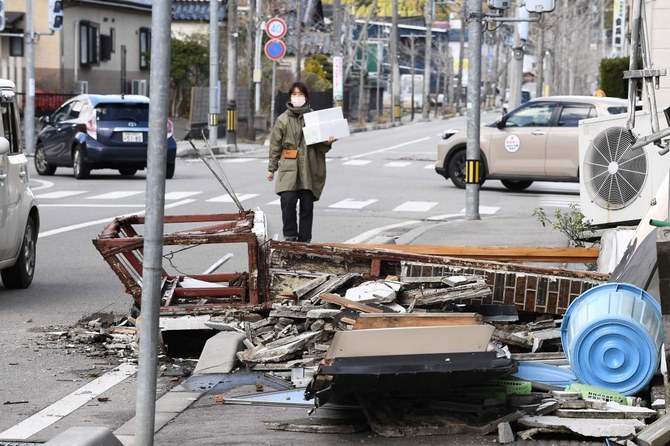
The earthquakes set off a large fire in the town of Wajima, as well as tsunamis and landslides in the region. With some routes cut off by the destruction, worries grew about communities in which water, food, blankets and medicine had yet to arrive.
The United States announced $100,000 in aid Friday, including blankets, water and medical supplies, and promised more help would come. Dodgers major leaguer Shohei Ohtani also announced aid for the Noto area, though he did not disclose the amount.
Thousands of Japanese troops have joined the effort to reach the hardest-hit spots on the Noto Peninsula, the center of the quake, connected by a narrow land strip to the rest of the main island of Honshu.
Experts warned of disease and even death at the evacuation centers that now house about 34,000 people who lost their homes, many of them older.
Masashi Tomari, a 67-year-old oyster farmer who lives in Anamizu city in Ishikawa, said it was tough sleeping on the floor with just one blanket. There was no heating until two stoves finally arrived Thursday — three days after the 7.6 quake struck.
“This is a terrible, cold place,” he said.
Tomari felt at a loss thinking about his home, where broken glass and knocked over items littered the floor. It was pitch dark at night because the area was still out of power.
But Tomari and others were already thinking about rebuilding.
Sachiko Kato, who owns a clothing shop in Anamizu, put up a yellow notice as a warning inside her store where the walls have tipped slanted, and a red one for the shed in the back that was completely flattened.
“So many stores were on this street. Now, they’re all gone. Maybe we can work hard to rebuild,” she said.
As of Friday, running water was not fully restored in Anamizu. Kato had to get water from a nearby river to flush the toilet.
Dozens of aftershocks have rattled Ishikawa and the neighboring region in the past week. Japan, with its crisscrossing fault lines, is an extremely quake-prone nation. Weather forecasts called for rain and snow over the weekend, and experts warned of more aftershocks.
The region affected by the latest quakes is famous for its craftwork, including lacquerware, knives, ceramics, candles and kimono fabric.
Tsutomu Ishikawa, who oversees a resin company called Aras that makes fashionable plates and cups, said no lives were lost around him, but the atelier was seriously damaged.
He apologized for delayed deliveries and expressed determination to pick up and rebuild, while acknowledging the challenges. “We are feeling a deep helplessness that works we created with so much love are gone.”
Sachiko Takagi, who owns a kimono shop on a street lined with picturesque stores in Wajima, said she was lucky her 80-year-old store — inherited over generations — was still standing. Others were not so lucky.
“These people do not have the energy to start something from scratch,” she said. “I really wonder what will happen to this street.”


![]()

Death toll reaches 100 as survivors are found in homes smashed by western Japan earthquakes
Short Url
https://arab.news/btpg5
Death toll reaches 100 as survivors are found in homes smashed by western Japan earthquakes
- Some survivors who had clung to life for days were freed from collapsed homes
- Others were forced to wait while rescuers searched for loved ones


Latest updates


Recommended


© 2026 SAUDI RESEARCH & PUBLISHING COMPANY, All Rights Reserved And subject to Terms of Use Agreement.