

Pakistan religious party leader warned of militant threat as security concerns rise ahead of national polls

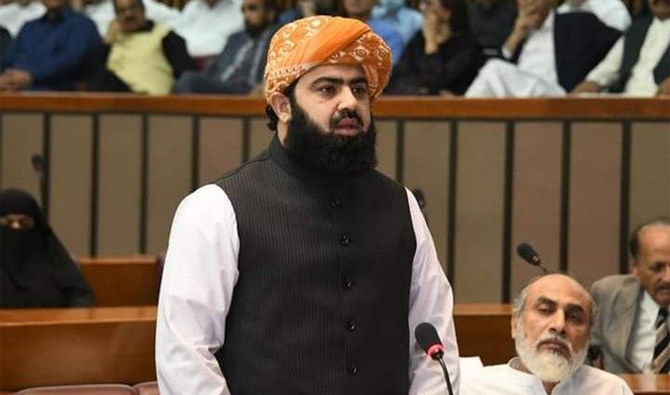
The undated picture shared on Pinterest shows Mufti Asad mehmood. (Asad mehmood JuI)
Short Url
Updated 16 January 2024
Follow

Pakistan religious party leader warned of militant threat as security concerns rise ahead of national polls

  • Police have asked JUI-F’s Maulana Asad Mahmood to keep his movements confidential, saying he can be targeted while traveling
  • Militants have targeted JUI-F in recent months, prompting it to call for election delay until peaceful environment is restored

PESHAWAR: Police in Pakistan’s northwestern Khyber Pakhtunkhwa province have advised Maulana Asad Mahmood, a top leader of Pakistan’s prominent Jamiat-e-Ulama-e-Islam (JUI-F) religious party, to avoid unnecessary travel and public gatherings due to security threats as political parties gear up for the general elections scheduled for February 8.

The JUI-F shared the security advisory addressed to Mahmood with the media on Tuesday, saying it was insufficient for the administration to merely issue such notices since it was also their responsibility to ensure a peaceful environment for political parties to conduct their election campaigns.

Maulana Fazlur Rehman, the party chief and Mahmood’s father, said earlier this week the government should consider advancing the election date to aid authorities in ensuring peaceful national polls following a shooting incident targeting his convoy on the Islamabad-Dera Ismail Khan motorway on Sunday.

“The election commission, judiciary and administration are completely responsible for not providing JUI-F with an environment to carry out election campaign,” the party spokesman, Aslam Ghauri, said in a statement while circulating the security advisory.

“We stood against terrorism with full force and should not be cornered,” he continued. “If our leadership or any worker is harmed, the responsibility will lie with the administration, election commission and judiciary.”

The police advisory released on January 1 warned that militant could target Mahmood, who served as a federal minister in the last government, at his residence or while traveling, asking him to keep his movements confidential for security reasons.

The JUI-F shared the information about it just days after the interior ministry said there were serious threats to the JUI-F chief and Awami National Party (ANP) provincial president Aimal Wali Khan.

Last September, a senior JUI-F leader Hafiz Hamdullah got injured in a blast in Balochistan’s Mastung region that also wounded 10 other people traveling with him.

Prior to that, nearly 40 JUI-F workers were killed in a suicide blast targeting a workers’ convention in Bajaur district in July last year.

Pakistan reviews austerity measures amid Middle East crisis, urges strict nationwide implementation

Updated 11 March 2026
Follow

Pakistan reviews austerity measures amid Middle East crisis, urges strict nationwide implementation

  • Deputy Prime Minister Ishaq Dar chairs review meeting of austerity steps
  • Officials briefed on salary cuts, school closures, four‑day week, petrol conservation

ISLAMABAD: Pakistan’s government on Wednesday assessed progress on a sweeping set of austerity measures introduced to mitigate the country’s economic strain from sharply rising global oil prices and supply disruptions linked to the ongoing war in the Middle East.

Prime Minister Shehbaz Sharif this week announced a series of austerity steps, including a four‑day work week for government offices, requiring 50  percent of staff to work from home, cutting fuel allowances for official vehicles by half, grounding up to 60  percent of the government fleet and closing all schools for two weeks to conserve fuel amid the global oil crisis.

The measures were unveiled in response to global oil market volatility triggered by the conflict involving the United States, Israel and Iran, which has disrupted supply routes such as the Strait of Hormuz and pushed crude prices sharply higher, straining Pakistan’s heavily import‑dependent energy sector.

“The meeting stressed the importance of strict and transparent adherence to the austerity measures, promoting fiscal responsibility and prudent use of public resources,” Deputy Prime Minister and Foreign Minister Senator Mohammad Ishaq Dar said in a statement.

He was chairing a meeting of the Committee for Monitoring and Implementation of Conservation and Additional Austerity Measures, constituted under the directions of the PM, bringing together federal and provincial officials to review execution of the broad cost‑cutting plan. 

Dar emphasized the government’s commitment to enforcing the PM’s austerity steps nationwide. The committee’s review also covered reductions in departmental expenditure, deductions from salaries of senior officials earning over Rs. 300,000 ($1,120), and coordination with provincial administrations to ensure uniform implementation of the plan.

Participants at the meeting reiterated that all ministries and divisions must continue strict monitoring and reporting, with transparent oversight mechanisms, as Pakistan navigates the economic pressures from the prolonged Middle East crisis and its fallout on global energy and trade markets.