Macron calls on Israel to avoid escalation, ‘particularly in Lebanon’

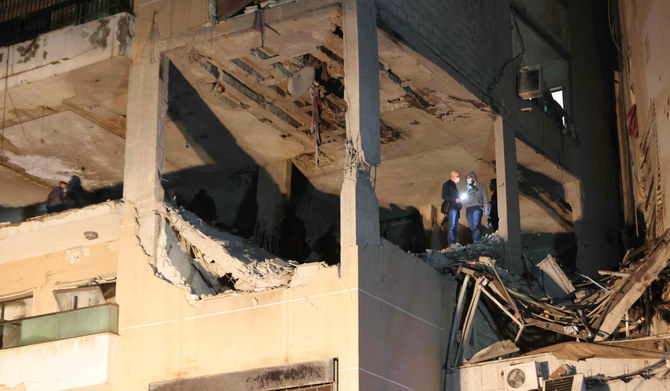
Lebanese emergency responders inspect the site of a strike, reported by Lebanese media to be an Israeli strike targeting a Hamas office, in the southern suburb of Beirut on January 2, 2024. (AFP)
Short Url
Updated 03 January 2024
Follow

Macron calls on Israel to avoid escalation, ‘particularly in Lebanon’

  • Israel regularly carries out strikes against the Hamas-allied Hezbollah movement along its shared border with Lebanon, but Aruri’s killing was the first time since the start of the war in Gaza that it has targeted the Lebanese capital

PARIS: French President Emmanuel Macron called on Israel to avoid escalation, “particularly in Lebanon,” following a strike in Beirut attributed to Israel that killed Hamas’s deputy leader, the Elysee Palace said Tuesday.
Macron, who spoke by telephone with Israeli minister and war cabinet member Benny Gantz, said “it was essential to avoid any escalatory attitude, particularly in Lebanon, and that France would continue to pass on these messages to all players directly or indirectly involved in the area,” the presidency said.
Hamas number two Saleh Al-Aruri was killed in a strike attributed to Israel in a suburb of Beirut on Tuesday evening, the Palestinian militant group and Lebanese security officials said.


French President Emmanuel Macron. (AFP)

Israel regularly carries out strikes against the Hamas-allied Hezbollah movement along its shared border with Lebanon, but Aruri’s killing was the first time since the start of the war in Gaza that it has targeted the Lebanese capital.
After the strike, Hezbollah vowed Aruri’s death would not go “unpunished,” calling it “a serious assault on Lebanon... and a dangerous development in the course of the war.”
Lebanese Prime Minister Najib Mikati also condemned the killing and said it “aims to draw Lebanon” further into the Israel-Hamas war.
In his conversation with Gantz, Macron reiterated his call for a “lasting cease-fire” between Israel and Hamas, the presidency said.
He also expressed again his “deepest concern” at the mounting civilian death toll in Gaza, as well as the humanitarian crisis unfolding inside the Palestinian territory, while at the same time reaffirming “France’s commitment to the security of Israel.”
The war in Gaza was triggered by Hamas’s bloody attack on October 7, which resulted in the death of around 1,140 people in Israel, most of them civilians, according to an AFP tally based on official Israeli figures.
After the attack, Israel launched a relentless bombardment and ground offensive against the group that has killed at least 22,185 people, mostly women and children, according to Gaza’s health ministry.


First Ramadan Friday prayers held at Jerusalem’s Al-Aqsa mosque since ceasefire

Updated 45 min 58 sec ago
Follow

First Ramadan Friday prayers held at Jerusalem’s Al-Aqsa mosque since ceasefire

  • But Israel restricted the number of Palestinians allowed to enter Israel from the West Bank to 10,000 on Friday

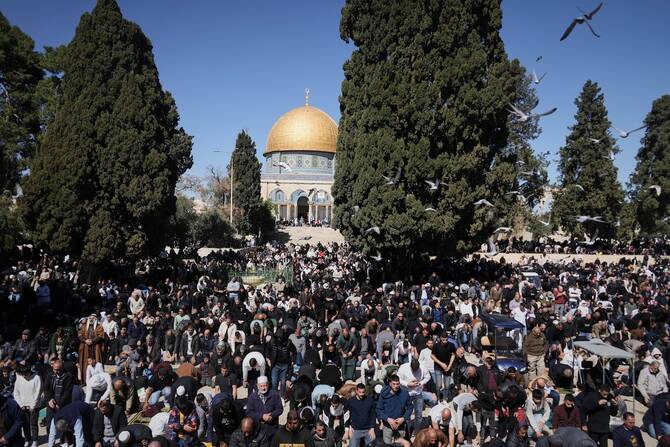
TEL AVIV, Israel: Tens of thousands of Muslims gathered under heavy security at the Al-Aqsa Mosque compound in Jerusalem for the first Friday prayers of the holy month of Ramadan, among them Palestinians who crossed into Israel from the West Bank.

The prayers at Al-Aqsa took place for the first time since a shaky ceasefire deal between Israel and Hamas went into effect in October. It was the first opportunity many had to leave the West Bank and pray at the site in Jerusalem’s Old City since Ramadan last year.

But Israel restricted the number of Palestinians allowed to enter Israel from the West Bank to 10,000 on Friday, and only allowed men over 55 and women over 50 as well as children up to 12. It has imposed similar restrictions in the past due to security concerns.

The area, which Jews call the Temple Mount, is the holiest site in Judaism and was home to the ancient biblical temples. Muslims call the site the Noble Sanctuary. Today it is home to the Al-Aqsa Mosque, the third-holiest site in Islam.

It has frequently been a flashpoint in the Israeli-Palestinian conflict.

Israeli police said more than 3,000 police officers were deployed across Jerusalem. They said their presence was not meant to show aggression or force but was aimed at providing help in case of an emergency.

Jerusalem’s Islamic Waqf, the Jordanian religious authority that administers the compound, said there were 80,000 in attendance. In normal times, Ramadan Friday prayers at Al-Aqsa can draw up to 200,000.

Ezaldeen Mustafah, a Palestinian from the West Bank, was among those lamenting the restrictions.

“We need more people than this,” Mustafah said.

Ramadan in Gaza

Many Palestinians said the month’s typically festive spirit is eluding them as they struggle with grief and losses following the two-year conflict in Gaza.

“Previously, there were mosques, but today all the mosques have been bombed,” said Ramiz Firwana, a Gaza resident who gathered with other worshippers for a Friday sermon and prayers held in schoolyard.

On Thursday evening, families sat amid the rubble and destruction for Iftar, the fast-breaking meal.

“Despite the displacement, the pain, and the destruction, we want to rejoice and live,” said Mohammad Kollab, from Khan Younis. “We are a people who want to live, we are not a people destined only for destruction and killing,” he said.

Israel’s military offensive has killed more than 72,000 Palestinians, according to Gaza’s Health Ministry, and caused widespread destruction and displaced most of the territory’s residents. Israel launched the offensive after Hamas-led militants killed some 1,200 people, mostly civilians, and took another 251 hostage in their attack on Oct. 7, 2023.

The Oct. 10 US-brokered ceasefire deal attempted to halt more than two years of war between Israel and Hamas. While the heaviest fighting has subsided, the ceasefire has seen almost daily Israeli fire.