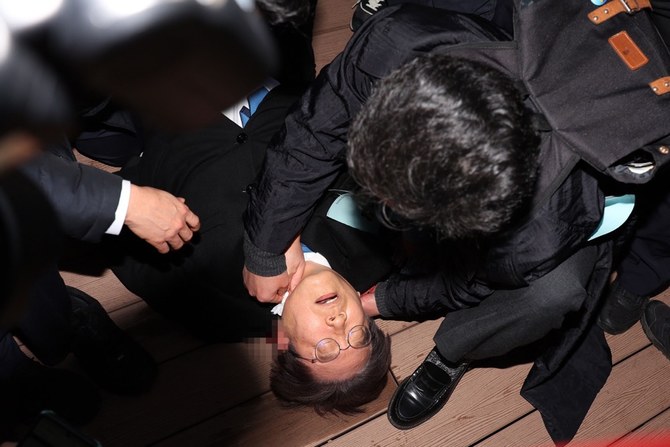
SEOUL: South Korea’s opposition Democratic Party leader Lee Jae-myung was stabbed in the neck during a visit to the southern port city of Busan on Tuesday, the Yonhap news agency reported.
Lee, who narrowly lost the 2022 presidential election, is conscious and has been transported to a local university hospital, a party official and a fire department official told Reuters.
Lee was attacked by an unidentified man while touring the site of a proposed airport, Yonhap said. The attack has left him with a gash of about 1 cm on his neck, YTN television reported.
The assailant appeared to be a man in his 50s or 60s, who wore a paper crown with Lee’s name on it, news photographs showed.
He approached Lee asking for an autograph, then suddenly lunged forward and attacked him, news reports said. The assailant was quickly subdued and arrested at the scene, Yonhap said.
Video clips on YTN television and another posted on the social media platform X showed the attack, with a man lunging at Lee with his arm stretched out. Lee grimaced and collapsed to the ground.
News photographs showed Lee lying on the ground with his eyes closed and other people pressing a handkerchief against the side of his neck.
President Yoon Suk Yeol condemned the attack, saying it was an unacceptable act, his office said. He expressed deep concern for Lee and instructed best care be given so he can make a speedy recovery, his office said.
A former governor of Gyeonggi province, Lee narrowly lost to conservative Yoon, a former chief prosecutor, in the 2022 presidential election.
Lee is currently on trial for alleged bribery stemming from a development project when he was mayor of Seongnam near Seoul. Lee has denied any wrongdoing, calling the allegations “fiction” and a “political conspiracy.”
Lee has led the main opposition party since August 2022.
South Korea’s next parliamentary elections are slated for April.
Although there are strict restrictions on gun possession, South Korea has a history of political violence involving other weapons.
Lee’s predecessor, Song Young-gil was attacked in 2022 at a public event by an assailant who swung a blunt object against his head, causing a laceration.
Then conservative opposition party leader Park Geun-hye, who later served as president, was attacked at an event in 2006 with a knife and suffered a gash on her faced that required surgery.

South Korea opposition chief stabbed in neck — media
https://arab.news/vb4cn
South Korea opposition chief stabbed in neck — media
Bangladesh sets February date for first vote since 2024 mass uprising
- At least 1,400 protesters were killed in violent crackdown under ex-PM Hasina’s rule
- Interim government promises ‘all necessary support’ for upcoming elections
DHAKA: Bangladesh will hold national elections on Feb. 12, its chief election commissioner has announced, setting the timeline for the nation’s first vote since a student-led uprising that ousted long-serving Prime Minister Sheikh Hasina.
Hasina, whose Awami League party-led government was marred by allegations of human rights violations, rigged elections and corruption, was removed from office in August last year after 15 uninterrupted years in power.
Bangladesh has since been led by interim leader Muhammad Yunus, a Nobel Prize-winning economist, who took over governance after Hasina fled to India, where she is now in self-exile.
In a televised address on Thursday, chief election commissioner A.M.M. Nasir Uddin confirmed the voting date to elect 300 lawmakers and said a national referendum on political reforms would also be held on the same day.
“It’s a relief for the voters; it’s a relief for the country. It’s a relief for the investors, it’s a relief for the development partners and for the political parties and the people who did a massive job in July 2024 by sacrificing their lives and limbs to oust a tyranny,” said Prof. A.S.M. Amanullah, political analyst and vice chancellor of the National University in Dhaka.
Mass protests that broke out in 2024 began in early July as peaceful demonstrations, triggered by the reinstatement of a quota system for the allocation of civil service positions.
Two weeks later, they were met with a communications blackout and a violent crackdown by security forces.
A special tribunal in Dhaka found Hasina guilty of allowing lethal force to be used against the protesters, at least 1,400 people of whom died, according to estimates from the UN’s human rights office.
After a months-long trial, she was sentenced to death in November for crimes against humanity.
The February elections will take place in the aftermath of Hasina’s reign, with the Yunus-led administration banning all activities of Awami League, meaning the former ruling party would not be able to join the race next year.
Minor political tensions now revolve around the more than 40 million voters of the Awami League, as the public speculate “how they would move, in which party they would support or whether they would remain silent,” Amanullah said.
“(But) if you consider other than Awami League, if we consider the other political parties, I think the other political parties are sufficient, you know, to make the next poll participatory, and free and fair.”
Bangladesh last held elections in January 2024, which saw Hasina return to office for a fourth consecutive term. That vote was boycotted by the country’s main opposition parties, which accused her administration of rigging the polls.
“There is a growing demand within the society and in the community that they would cast their first vote after almost 15, 16 years. And that would be an (occasion) of big national celebration,” Amanullah said.
In February, more than 127.6 million Bangladeshis will be eligible to cast their vote. It will be Bangladesh’s 13th election since the country gained independence in 1971.
The long-awaited election process now begins with the filing of nominations from Dec. 12 to 29, which will then be reviewed over the following six days. The last date for withdrawing nominations is Jan. 20.
After the voting date was announced, Yunus pledged to “provide all necessary support” to encourage festivity, participation and fairness in the upcoming polls.
“After the historic mass uprising (last year), the country is now moving toward a new path,” he said in a statement. “This election and referendum will consolidate that trajectory, prioritize the will of the people and further strengthen the foundation of a new Bangladesh.”
For Malaika Nur, a 24-year-old Dhaka University student who took part in the 2024 protests, the elections are an opportunity for young people to formally take part in politics.
“Young people have been showing much interest in politics since July 2024. They showed us how the youth can reshape a country’s political condition. If they have a few seats in the parliament, it can be a game-changer for the future of politics in Bangladesh,” she said.
“I hope this election will be different from the last three elections held in the previous regime. There will be a festive mood, people will cast their valuable votes and will get to choose their representative … I hope the elected government will ensure safety and basic rights of every citizen, and will hold fair elections in the future and will not become another fascist.”


