


WAJIMA, Japan: Japanese rescuers scrambled to search for survivors Wednesday as authorities warned of landslides and heavy rain after a powerful earthquake that killed at least 62 people.
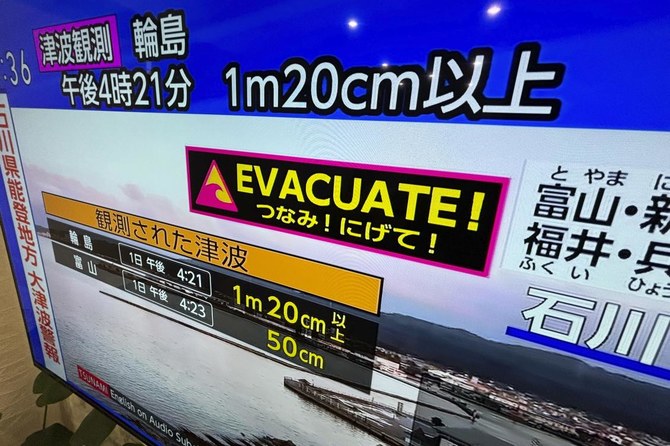
The 7.5 magnitude quake on January 1 that rattled Ishikawa prefecture on the main island of Honshu triggered tsunami waves more than a meter high, sparked a major fire and tore apart roads.
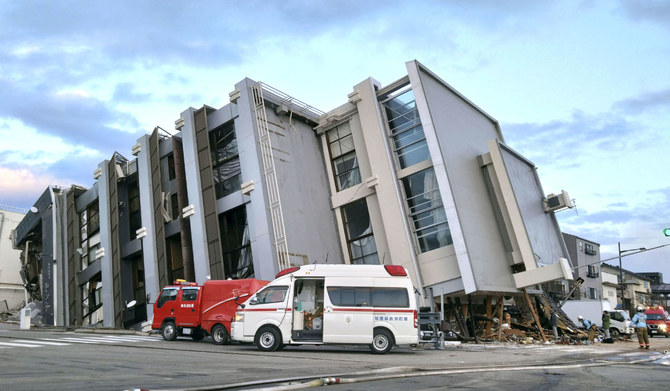
The Noto Peninsula of the prefecture was most severely hit, with several hundred buildings ravaged by fire and houses flattened.
The regional government announced late Tuesday that 55 people had been confirmed dead and 22 severely injured.
But the toll was expected to climb as rescuers battle aftershocks and poor weather to comb through rubble.
More than 31,800 people were in shelters, they added.
Prime Minister Fumio Kishida’s government was due to hold a meeting of an emergency task force Wednesday morning to discuss responses.
Kishida reiterated Tuesday night that “it’s a race against time” given how many people may have been caught in the collapsed buildings, according to public broadcaster NHK.
The operation was given extra urgency as the Japan Meteorological Agency (JMA) issued a heavy rain warning for Noto.
“Be on the lookout for landslides until the evening of Wednesday,” the agency said.
In the coastal city of Suzu, mayor Masuhiro Izumiya said there were “almost no houses standing.”
“About 90 percent of the houses (in the town) are completely or almost completely destroyed... the situation is really catastrophic,” he said according to broadcaster TBS.
A woman at a shelter in the town of Shika told TV Asahi that she “hasn’t been able to sleep” due to aftershocks.
“I’ve been scared because we don’t know when the next quake will hit,” she said.
Nearly 34,000 households were still without power in Ishikawa prefecture, the local utility said.
Many cities were without running water.
Shinkansen bullet trains and highways have resumed operations after several thousand people were stranded, some for almost 24 hours.
The US Geological Survey said the quake had a magnitude of 7.5, while the JMA measured it at 7.6, triggering a major tsunami warning.
The powerful quake was one of more than 210 to shake the region through Tuesday evening, the JMA said.
Japan lifted all tsunami warnings after waves at least 1.2 meters (four feet) high hit the city of Wajima and a series of smaller tsunamis were reported elsewhere.
Japan experiences hundreds of earthquakes every year and the vast majority cause no damage.
The number of earthquakes in the Noto Peninsula region has been steadily increasing since 2018, a Japanese government report said last year.
The country is haunted by a massive 9.0 magnitude undersea quake off northeastern Japan in 2011 which triggered a tsunami that left around 18,500 people dead or missing.
It also swamped the Fukushima atomic plant, causing one of the world’s worst nuclear disasters.


