

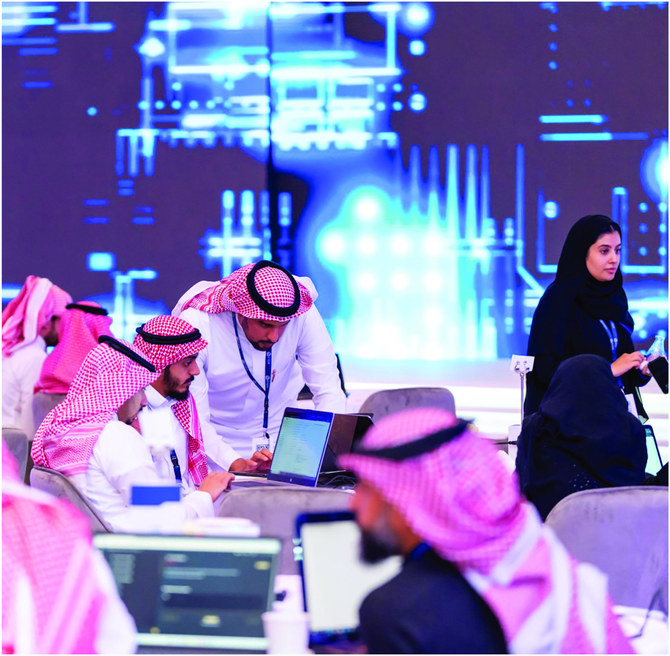

CAIRO: Saudi Arabia’s startup ecosystem flourished in 2023 with the venture capital sector reaching new heights.
The entrepreneurial environment in the Kingdom charted a new course for economic prosperity, positioning Saudi Arabia as a leading country in the region’s burgeoning startup scene.
The year was marked by robust participation from startups, venture capitalists, government bodies, and various stakeholders, all contributing significantly to the enhancement of the Kingdom’s startup ecosystem.
This collective effort was characterized by a surge in investments and a range of initiatives aimed at fostering growth and innovation across the sector.
A record-breaking year
In an interview with Arab News, Philip Bahoshy, founder of venture data platform MAGNiTT, shed light on the remarkable growth trajectory of Saudi Arabia’s venture ecosystem.
He highlighted the advancements the Kingdom has made over the years and expressed optimism that the momentum would continue in 2024 and investments are likely to surpass 2023 figures.
Reflecting on the evolution of the sector, Bahoshy remarked: “If you go back to 2018, only $50 million were invested in local tech companies. This year, we’re on track to exceed last year’s investment total of $1 billion. This phenomenal growth is a direct result of the active involvement at the government level.”
Bahoshy stated that the Kingdom is expected to be the only country to see an increase in funding year on year.
National alignment
He credited the Kingdom’s Ministry of Communications and Information Technology with the phenomenal growth of the ecosystem.
Bahoshy also highlighted key initiatives such as LEAP, the Saudi Unicorns program, and the National Technology Development Program. These initiatives have been pivotal in encouraging startups to establish their presence in the Kingdom.
The top executive noted that entities like Saudi Venture Capital and Jada Funds of Funds have made significant strides this year, contributing to the growth of the ecosystem.
“There is clearly a national push toward tech venture as an asset class,” Bahoshy stated. He concluded by asserting that the Kingdom is poised to end the year as the leading venture ecosystem in the Middle East and North Africa region, underscoring the national commitment to nurturing and expanding the tech venture sector.
Rising talent
The evolution of venture capital in the Kingdom has had a profound impact not only on the nation’s economic stature but also on the cultivation of its talent pool.
The year 2023’s growth in venture capital investment has created a fertile environment for innovation and entrepreneurship, enabling local talent to thrive and contribute significantly to the diversification and dynamism of the Saudi economy.
Bahoshy noted that Saudi Arabia’s talent pool is experiencing organic growth, further enhanced by the influx of international talent.
This increase is attributed to the expansion and relocation of more companies to the Kingdom, attracting a diverse range of skills and expertise.
A year ahead
Saudi Arabia’s venture capital sector in 2023 has surpassed expectations, demonstrating resilience and growth even amid global economic challenges.
Bahoshy, analyzing the Kingdom’s venture ecosystem, anticipates that this upward trajectory will extend into 2024.
He commented: “Considering the Saudi ecosystem’s robust performance in a turbulent economic climate, there’s a strong indication that 2024 could mirror, if not exceed, the success of 2023.”
He highlighted the importance of interest rates as a key factor influencing venture capital performance.
With predictions pointing toward a potential decline in US interest rates in 2024, Bahoshy believes such a scenario will significantly enhance the investment environment.
A decrease in interest rates, according to Bahoshy, could lead to not just an uptick in regional investments but also a resurgence in international funding. This would mark a notable shift from the slowdown observed in 2023.
He also foresees that while both Saudi Arabia and the UAE are likely to experience concurrent growth in 2024, a broader upward trend across MENA nations is expected by 2025, signaling a region-wide boost in the venture capital sector.
The Kingdom’s firm position
Talking to Arab News, Mohammed Al-Zubi, founder of Saudi-based Nama Ventures, emphasized Saudi Arabia’s role as a key player in the MENA region’s startup ecosystem.
Al-Zubi stated: “Saudi Arabia has consistently been a pivotal market in the MENA region, which is why Nama Ventures chose Riyadh as its base. This year, however, has truly cemented the Kingdom’s status as the prime location for launching entrepreneurial ventures targeting the MENA market.”
He further highlighted the strength and progress of Saudi Arabia’s entrepreneurial landscape, particularly in the face of challenging economic conditions.
The entrepreneur elaborated: “The Kingdom’s entrepreneurial scene has demonstrated remarkable resilience amid the broader macroeconomic downturn. More impressively, it has shown substantial growth and maturity, which is clearly evident in the performance figures and investment trends we’ve seen.”
Echoing Bahoshy’s views, Al-Zubi described 2023 as a challenging yet transformative period for entrepreneurs in the Kingdom. He noted that the beginning of the year saw a tightening in funding, compelling entrepreneurs to adopt drastic measures for survival.
“2023 has been a rollercoaster for MENA entrepreneurs. We’ve shifted from a pre-2023 mindset of prioritizing growth at all costs to adopting strategies focused on surviving to fight another day,” Al-Zubi said.
“With funding becoming scarce, entrepreneurs had to downsize to sustain and remain competitive. Our advice to our portfolio companies was to prioritize sustainability over aggressive growth,” Al-Zubi explained.
As the year draws to a close, Al-Zubi observed an upturn in the market. “As we approach the year’s end, there are emerging signs of improved liquidity in the market. This change indicates that entrepreneurs should now start focusing on achieving sustainable growth as we move into 2024,” he added.
This shift marks a crucial turning point for the Kingdom’s entrepreneurial landscape, signaling a move toward more balanced and sustainable business strategies.
Sectoral outlook
The projected growth trajectory of Saudi Arabia is expected to encompass a broad range of sectors, with a particular emphasis on those experiencing high demand.
Bahoshy views the continuing expansion of e-commerce and logistics as a given. However, he also foresees a significant surge in the fintech sector, indicating a diverse growth pattern across various industries.
Concurrently, Al-Zubi offered a different perspective. “At Nama, we see the potential to disrupt traditional businesses in many areas, particularly in the MENA region and Saudi Arabia. That’s why, we maintain a sector-agnostic approach.”
“We believe technology will act as a major disruptor across all sectors. In 2023, our investments spanned logistics, and food tech, among others, and we plan to stick to our strategy in 2024, positioning ourselves as the go-to early-stage, sector-agnostic fund,” he stated.


