

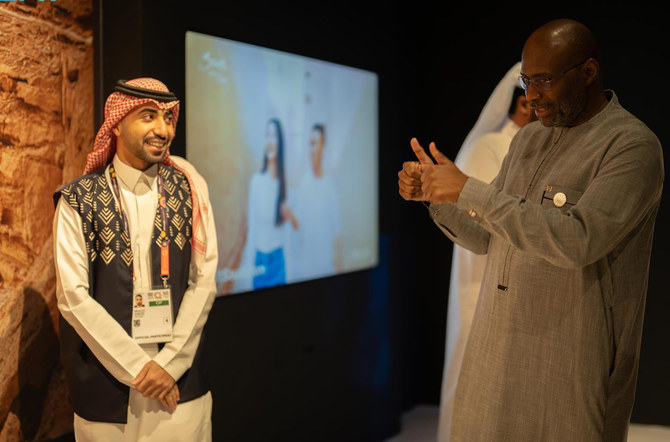
Saudi Arabia showcases ‘green future’ at Doha expo

Saudi Arabia is participating in the Expo 2023 Doha Horticultural Exhibition, which is being held under the slogan “Green Desert, Better Environment.” (SPA)
Short Url
Updated 30 December 2023
Follow

Saudi Arabia showcases ‘green future’ at Doha expo

  • Kingdom’s pavilion welcomes visitors in seven languages to enhance communication and strengthen relations

RIYADH: Saudi Arabia is participating in the Expo 2023 Doha Horticultural Exhibition, which is being held under the slogan “Green Desert, Better Environment.”

The six-month exhibition, organized for the first time in the Middle East, will continue until March 28. It showcases the latest innovations in horticulture and environmental sustainability.

The Saudi pavilion at the expo showcases the Kingdom’s “natural richness,” drawing visitors from around the world. The officials welcome visitors in seven languages to enhance communication and cultural understanding and strengthen international relations between the Kingdom and the world.

Saleh bin Dakhil, the general supervisor of the Kingdom’s pavilion, said that the Saudi organizers welcome visitors in Arabic, English, French, Italian, Spanish, Japanese and Persian.

He noted that this aims to provide a welcoming environment to visitors by receiving them in their native and preferred languages, and to explain the initiatives and projects implemented by the Kingdom in several fields.


(SPA)

Bin Dakhil explained that the pavilion seeks to promote understanding and cultural communication between visitors and Saudi representatives, providing an opportunity for everyone to learn about the Kingdom’s advancement.

He noted that the pavilion is constantly offering integrated interactive experiences to enhance visitors’ understanding of Saudi Arabia’s diverse nature and various cultures, through accompanying activities and events. In addition, it introduces the ambitious Saudi initiatives towards a “green future” in multiple languages as communication is an integral part of enhancing cultural communication and civilizational exchange.

Bin Dakhil stressed that using various languages encouraged visitors to ask questions and inquire about the exhibition’s four axes: modern agriculture, technology and innovation, environmental awareness, and sustainability.

He indicated that the pavilion is an opportunity for visitors to learn about Saudi Arabia’s natural terrain, the most prominent current initiatives and projects and the role of Saudi Vision 2030 in shaping the future, by promoting environmental prosperity and enhancing the Kingdom’s vegetation cover. In addition, the pavilion offers the chance to learn about the most prominent environmental and sustainability programs.

Bin Dakhil said that the pavilion also features an interactive area offering the thousands of visitors an inspiring experience of traditional arts and folk dances.

Around 80 countries, authorities, non-governmental organizations, international experts, private sector companies, universities and research laboratories are participating in the event, which aims to develop mechanisms and means that support the agricultural sector in desert regions and promote the use of modern technologies for resource sustainability.


Winter ushers in cool comforts, eases fasting in Saudi Arabia

Updated 6 sec ago
Follow

Winter ushers in cool comforts, eases fasting in Saudi Arabia

  • As temperatures dip, many describe this year’s Ramadan as less physically demanding than those of previous years

RIYADH: This year, Ramadan is being observed in winter in Saudi Arabia and much of the region, bringing cooler temperatures and shorter fasting hours.

In Riyadh, temperatures have ranged from 8-20 C, while parts of the Northern Borders region have recorded lows of 3 C. The milder weather coincides with the holy month, which this year falls from mid-February to mid-March.

Because the Islamic Hijri calendar is around 11 days shorter than the Gregorian year, Ramadan shifts each year, becoming gradually earlier. Cloudy skies and intermittent rain have also kept temperatures low in parts of the Kingdom and forecasts indicate continued cool conditions.

Cloudy skies and intermittent rain have also kept temperatures low in parts of the Kingdom and forecasts indicate continued cool conditions. (SPA)

According to the National Center for Meteorology: “Starting Tuesday until the end of the current week, the cold weather will continue in the northern regions, while temperatures will drop from Wednesday in the regions of Riyadh, Qassim, and the Eastern Province.”

The forecast added that thunderstorms accompanied by hail may occur in parts of Eastern Region, Riyadh, Najran, Jazan, Aseer and Baha. Fog may also form. Rain showers are expected in parts of Northern Borders, Al-Jouf, Hail, Qassim and Madinah.

HIGHLIGHTS

• According to the National Center for Meteorology, cold weather will continue in the northern regions until the end of the current week.

• Temperatures will drop from Wednesday in the regions of Riyadh, Qassim, and the Eastern Province, the forecast added.

• Rain showers are expected in parts of Northern Borders, Al- Jouf, Hail, Qassim and Madinah.

For many residents, the cooler weather has made fasting from dawn to sunset more manageable compared with previous years when Ramadan fell during the peak summer heat.

“Ramadan in winter offers a more comfortable fasting experience, characterized by shorter daylight hours and cooler temperatures, which significantly reduce hunger, dehydration and fatigue,” Nafisa Usman, an Indian homemaker who has lived in Riyadh for more than two decades, told Arab News.

Cloudy skies and intermittent rain have also kept temperatures low in parts of the Kingdom and forecasts indicate continued cool conditions. (SPA)

Although last year had pleasant weather for much of the holy month, prior to that Muslims had endured the challenge of fasting during long, hot summer days.

Thamr Al-Otaibi, a property dealer in the capital, said shorter days allowed people to break their fast earlier and avoid prolonged exposure to high temperatures.

“This pleasant weather is a welcome change, as it lightens the physical burden of fasting,” he added. “The cool weather also enables engaging in outdoor activities during the day as well as after the iftar. It was a tough task during the summer.”

An overcast sky and rain in parts of Saudi Arabia, including the capital, on Tuesday ushered in cool comforts during Ramadan. (AN photo by Rashid Hassan)

Mohammed Asghar, a Pakistani taxi driver in Riyadh, said: “Fasting in winter is (easier), particularly for those of us who cannot always stop for iftar due to the nature of our work. This pleasant weather, warm days, cool nights, not only makes fasting less daunting but also improves our overall well-being, making the spiritual journey more engaging.”

Shahid Anwar, a safety manager, echoed that view, saying fasting at outdoor work sites was much easier in the current conditions.

“The confluence of spiritual reflection and favorable weather makes Ramadan a uniquely enjoyable experience,” he added. “The nights are particularly lively, with traditional decorations and treats drawing more people outdoors than in the hotter days during the summer.”

With milder temperatures, some community groups have opted to hold outdoor iftars, such as the annual gathering of AMUOBA Riyadh, an alumni association of India’s Aligarh Muslim University.