KARACHI: The share of digital payments in retail transactions in Pakistan has increased by 6% to 80% on a year-on-year basis, the Pakistani central bank said on Saturday.
The State Bank of Pakistan (SBP) made the revelation in its quarterly payments system report for the first quarter (Q1, July-September) of the fiscal year 2023-24, which highlighted key advancements within the country’s payment ecosystem.
Digital payments accounted for 74% of retail transactions of the banking system in the same quarter last year, according to the SBP report.
The share of over-the-counter (OTC) transactions was 20% in retail transactions in Q1 of FY 2023-24, which was 87 percent by value and indicated customer preference for OTC channels for high-value transactions.
“Retail transactions mainly comprised of funds transfers (37%), cash withdrawals (36%), purchases at POS (point of sale) & e-commerce platforms (10%), bill payments & mobile top-ups (7%), cash/cheque deposits (7%) and 3% rest of the payments,” the report read.
“Funds transfers was the most prevailing transaction on digital channels by volume, while on OTC, cash/cheque deposits was the most prominent transaction mode.”
As of quarter-end, there were 33 banks, 11 microfinance banks (MFBs), four electronic money institutions (EMIs) and five payment service providers/system operators (PSPs/PSOs) that provided payment services across the country, according to the central bank.
In addition, real-time gross settlement system (RTGS) and the Raast instant payment system, both operated by the SBP, further enriched the country’s payments infrastructure, while 16 banks and MFBs extended their offerings to branchless banking (BB) services thereby expanding the accessibility of the financial services.
There were 17.0 million mobile banking users, 10.3 million Internet banking users, 2.4 million e-wallet holders (issued by EMIs) and 61.3 million m-wallet holders (issued by BB service providers) by the end of quarter. Alongside this, there were 54.3 million payment cards issued to customers, of which 79% were debit cards, 17 percent were social welfare cards and 4% were credit cards.
“In terms of volume, Large Value Payments (LVPs) settled by RTGS was 1.4 million amounting to PKR 199 trillion, whereas, retail transactions processed by banks, MFBs and EMIs during the quarter was 702 million with value of almost PKR 134 trillion,” the report read further.
“Retail transactions mainly comprised of funds transfers (37%), cash withdrawals (36%), purchases at POS & e-commerce platforms (10%), bill payments & mobile top-ups (7%), cash/cheque deposits (7%) and 3% rest of the payments. Funds transfers was the most prevailing transaction on digital channels by volume, while on OTC, cash/cheque deposits was the most prominent transaction mode.”
All these retail transactions were facilitated by a payment network provided by the banks, MFBs and EMIs, according to the SBP. This included a network of 17,768 bank branches, 18,117 ATMs, 118,444 POS terminals and 7,310 registered e-commerce merchants.


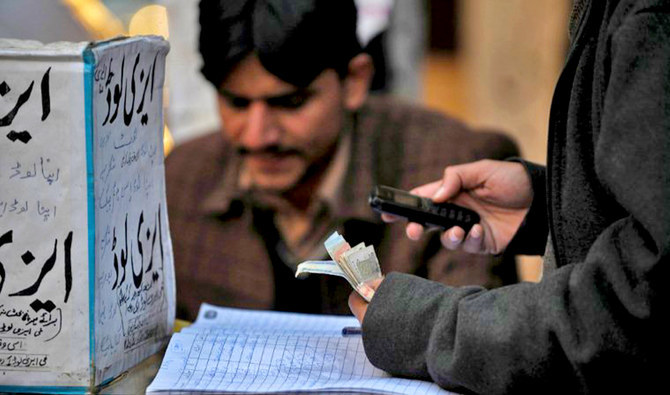
Pakistan digital payments in retail transactions grow by 6% year on year — central bank
https://arab.news/nvue2
Pakistan digital payments in retail transactions grow by 6% year on year — central bank

- These transactions comprised funds transfers, cash withdrawals, purchases and bill payments
- Funds transfers was the most prevailing transaction on digital channels by volume, report says

Pakistan top court appoints senior lawyer to inspect Imran Khan’s jail conditions
- Top court names ‘friend of the court’ amid renewed concerns over ex-PM’s health
- Move follows dispute over jail access to Khan, questions over his treatment in custody
ISLAMABAD: Pakistan’s Supreme Court on Tuesday appointed a senior lawyer as a “friend of the court” to visit jailed former prime minister Imran Khan and submit a report on his current living conditions, following renewed concerns raised by his family and party about his health and treatment in prison.
The decision came a day after the court declined a request by Latif Khosa, a lawyer affiliated with Khan’s Pakistan Tehreek-e-Insaf (PTI) party, to meet the former premier without prior notice to the government. The court later issued a notice to the government and resumed hearings on the matter on Tuesday.
According to a copy of the court order seen by Arab News, the Supreme Court appointed Barrister Salman Safdar, Advocate Supreme Court, to carry out the inspection.
“Barrister Salman Safdar, ASC, is appointed as a friend of the Court to visit the petitioner at the Central Prison, Rawalpindi today and submit a written report regarding the ‘living conditions of the petitioner in jail,’” the order said.
The court noted that a report on Khan’s prison conditions had already been submitted in response to an earlier order, but that it related to his detention in 2023 at Attock jail and did not reflect his current incarceration.
“In this regard, a report regarding the present living conditions of the petitioner shall be submitted,” the order said.
The attorney general assured the court that Safdar would be granted full access to meet Khan and inspect his detention conditions.
“Barrister Salman Safdar, ASC, shall be provided full access to meet the petitioner and inspect his living conditions,” the order added, directing that the report be submitted by Wednesday.
Speaking to reporters after the hearing, Safdar, who has represented Khan in the past, said the court had entrusted him with an independent responsibility.
“The court has assigned me a duty as a friend of the court, which we refer to as amicus, in which the court places its trust and confidence in you,” he said.
He added that he would visit Khan at 2pm on Tuesday at Rawalpindi’s Adiala Prison.
Khan, who was removed from office through a parliamentary vote of no confidence in April 2022, has been in custody since August 2023 in a series of cases that he and his party say are politically motivated, an allegation the government denies.
Concerns over Khan’s health resurfaced last month after the government confirmed that he had been briefly taken from prison to a hospital in Islamabad for an eye procedure. Authorities said his condition was stable, while PTI leaders said they were not informed in advance and demanded greater transparency.
Khan and his wife, Bushra Bibi, have been convicted in multiple corruption cases. In January 2025, an accountability court sentenced Khan to 14 years in prison in the Al-Qadir Trust land corruption case. In December 2025, a special court handed Khan and Bibi 17-year sentences each in the Toshakhana-2 case involving alleged misuse of state gifts. Appeals in both cases are ongoing.
Khan insists all cases are political motivated and aimed at keeping him and his party out of power. The government rejects the allegation.


