KYIV: Russia launched a massive air attack over Ukraine on Friday, killing at least 30 people and wounding over a hundred across the country in the fiercest assault since the first days of the war nearly two years ago.
Schools, a maternity hospital, shopping arcades and blocks of flats were among the buildings hit in the barrage, said Ukrainian officials.
The attacks — which also saw a Russian missile passing through Polish airspace — triggered international condemnation and fresh promises of military support to Ukraine, which has been fighting off invading Russian troops since late February 2022.
“Today Russia hit us with almost everything it has in its arsenal,” President Volodymyr Zelensky said.
Ukraine’s military estimated that Russia had fired 158 missiles and drones on Ukraine and 114 of them had been destroyed.
Air force spokesman Yuriy Ignat told AFP that this was a “record number” of missiles and “the most massive missile attack” of the war, excluding the early days of constant bombardment.
Russia tried to overwhelm Ukraine’s air defenses across most major cities, launching a wave of Shahed attack drones followed by missiles of numerous types fired from planes and from Russian-controlled territory.
Interior Minister Igor Klymenko announced on Telegram: “As of now, 30 people have been killed and more than 160 wounded as a result of Russia’s massive attack on Ukrainian territory in the morning.”
Russia’s army said it had “carried out 50 group strikes and one massive strike” on military facilities in Ukraine over the past week, adding that “all targets were hit.”
Poland reported that a Russian missile passed through its airspace.
“Everything indicates that a Russian missile entered Polish airspace... It also left,” said General Wieslaw Kukula, chief of the general staff of the Polish armed forces.
After speaking to Polish President Andrzej Duda, NATO chief Jens Stoltenberg said the alliance “stands in solidarity” with Poland, adding: “NATO remains vigilant.”
In the face of sustained Russian assaults, Ukraine is urging Western allies to maintain military support.
Ukraine presidential aide Andriy Yermak said Kyiv needed “more support and strength to stop this terror.”
US President Joe Biden called on Congress to overcome its division to approve new aid for Ukraine, after Washington released its final package of weaponry under existing agreements still to be renewed by Congress.
“Unless Congress takes urgent action in the new year, we will not be able to continue sending the weapons and vital air defense systems Ukraine needs to protect its people,” Biden said in a statement.
“Congress must step up and act without any further delay.”
Britain announced it would send hundreds more air-defense missiles to Kyiv, after Prime Minister Rishi Sunak declared that “We must continue to stand with Ukraine — for as long as it takes.”
The European Union’s foreign policy chief Josep Borrell described it as “yet another cowardly and indiscriminate” attack on civilians.
The strikes targeted at least six Ukrainian regions including Kharkiv in the northeast, Lviv in the west, Dnipro in the east and Odesa in the south.
In the capital Kyiv seven people were killed, according to Mayor Vitali Klitschko, with damage to the building of Lukyanivska metro station located near the Artyom arms factory that Russia said it targeted early in the war.
Work was still ongoing to rescue people stuck under the rubble of the warehouse in the Shevchenko district in the afternoon, according to the city administration.
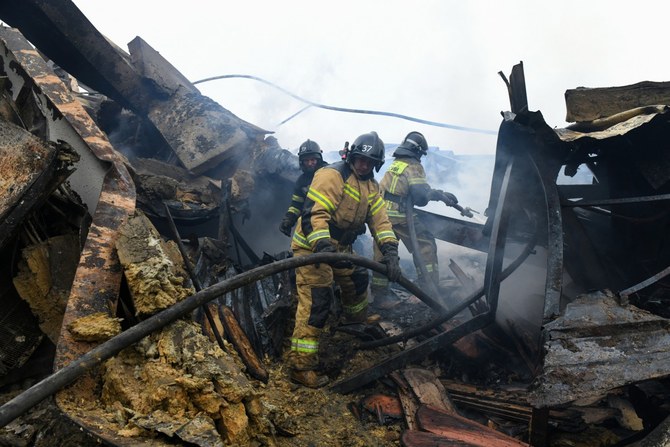
AFP journalists in Kyiv earlier saw firefighters wearing oxygen masks tackling a fire a 3,000 square meters (32,300 square feet) warehouse in the northern Podil district.
Damage to civilian facilities was also reported in other parts of the country.
The northeastern city of Kharkiv faced around 20 strikes, killing three employees at a civilian enterprise and wounding 11, governor said Oleg Synegubov.
In Dnipro in southern Ukraine, the health ministry said a maternity hospital had been “severely damaged” but the staff and patients had managed to shelter in time.
Six were killed and 28 wounded said Sergiy Lysak, the governor of the Dnipropetrovsk region where a shopping mall, private houses and administrative buildings were hit.
Lysak said there were 12 women in labor at the maternity hospital and four newborns when it was struck.
In Zaporizhzhia, on the shores on the Dnipro river, governor Yuriy Malashko reported seven dead and 13 wounded.
In the Odesa region, which has seen renewed attacks since the summer, four people were killed.
Earlier in the day, an AFP photographer saw firefighters extinguishing a blaze in a high-rise building, smoke pouring out of a hole blown in the facade, and the air thick with dust.
Strikes over Lviv in the West of Ukraine are much more rare, but the region was not spared on Friday.
One person was killed and 15 wounded as high-rise blocks of flats and two schools were damaged, the interior ministry said.
Zelensky said he had visited the town of Avdiivka in eastern Ukraine, which has become a key battle site since Ukraine’s counteroffensive failed to pierce through Russia’s defensive lines.
“This is one of the most difficult areas of the front line,” he wrote on Telegram, along with a video of him in front of a sign with the name of the town, giving medals to soldiers.
“I thank all those who are at the first line (of fire) for their service, for this year during which the entire country survived thanks to its soldiers,” he said.

‘Massive’ Russian strikes kill at least 30 across Ukraine
Short Url
https://arab.news/2p2wz
‘Massive’ Russian strikes kill at least 30 across Ukraine
- Kharkiv’s regional military administration said Russia made about 10 strikes on the city
DR Congo city residents forced to adapt during year of M23 rule
- Around one million Goma residents were holed up in their homes on Jan. 26, 2025, when the Congolese army and its allies were forced to pull out of the provincial capital
GOMA, DR Congo: They were caught under a barrage of fire and became trapped with “nowhere to go” after their city in the eastern Democratic Republic of Congo fell under the M23 armed group’s control a year ago.
Around one million Goma residents were holed up in their homes on January 26, 2025, when the Congolese army and its allies were forced to pull out of the provincial capital.
Hundreds of Rwandan soldiers had just poured across the border to fight alongside the M23 in a lightning offensive to seize the lakeside city.
Thousands of people were killed in the intense clashes.
Janvier Kamundu, whose name has been changed for security reasons, was sheltering from the fighting at home with his wife and children.
“Suddenly I heard my wife cry out. She fell, hit by a stray bullet,” he recalled.
Neighbors braved the gunfire to come and help, and a vehicle was found to transport his wife to hospital, ultimately saving her life.
Hospitals were overwhelmed with the wounded and bodies covered in white bags piled up at the morgues.
“She is slowly recovering, but it isn’t easy — she has a lot of wounds around her stomach,” Kamundu said.
Oppressive quiet
A year on, Goma residents endure “constant oppression” by the M23 group, government spokesman Patrick Muyaya said.
In the weeks that followed its capture, the streets emptied out at nightfall and the buzz evaporated from the bars that had once offered some respite in a region scarred by three decades of conflict.
Escaped prisoners, militia fighters and soldiers who had evaded capture roamed the city after dark, breaking into homes and threatening residents.
With the police and court system no longer functioning, the M23 eventually began to systematically cordon off neighborhoods in search of criminals.
By late May, several hundred men were sitting on the dark volcanic gravel covering the streets of Murambi village on Goma’s northern outskirts, watched over by members of the M23.
Local leaders and families are ordered to identify those they recognize as upstanding citizens. The others are detained.
Rough justice
But on the street, anyone deemed suspicious looking drew the M23’s ire.
People spoke of those who had been hauled off to the city sports stadium serving as an open-air prison for wearing dirty clothes or having an untidy beard.
An M23 spokesman invited reporters on several occasions to view the results of the operation — detainees separated into categories.
Desperate families crowded at the entrance, pleading to get their relatives released.
Those not cleared by testimony deemed reliable ended up at secret detention sites. NGO reports denounced torture and summary executions.
But, in time, residents and observers agreed that Goma’s streets were returning to relative safety.
With no independent justice system in place, opponents of the M23 faced repression, some accused of being in cahoots with the pro-government militia.
In October, the armed group — whose declared aim is to overthrow the government and end corruption — began appointing magistrates, but observers indicated there was little impartiality.
Despite parallel peace efforts backed by the United States and Qatar, the M23 launched a new offensive on the strategic town of Uvira near the Burundi border in December.
“These events have shown that the Rwandan president is not at all comfortable with peace processes,” Muyaya, the government spokesman, said.
‘Ideological training’
Most civil society representatives and rights campaigners had fled Goma before the M23 entered.
Civilians and former government combatants were forcibly recruited by the M23, which announced it had 7,000 new members in its ranks in September.
At the same time, the group began to impose taxes to finance its war effort but the city, already on its knees, has had no functioning banks for a year after the government ordered their closure to cut off the rebellion’s funding.
The airport remains inaccessible and trade between Goma and areas under government control has dwindled.
Civil servants were among the first to feel the blow of such cuts.
“There were about 200 agents here; around 20 left to work” in government-held areas, urban planning officer Claude Mumbere said.
“The others are here doing nothing,” added the officer, whose name has also been modified for security reasons.
Some had to undergo “ideological training” provided by the M23.
Mother-of-three Madeleine Mubuto’s husband lost his job.
“We had set aside a small amount of money at home that helped us at first, but after a year almost all of it is used up,” she said.
In the absence of cash, Rwanda’s currency is now used at Goma’s markets.
“Many are wondering how long this situation is going to last,” Kamundu said, adding: “We adapt because we have nowhere to go.”
Around one million Goma residents were holed up in their homes on January 26, 2025, when the Congolese army and its allies were forced to pull out of the provincial capital.
Hundreds of Rwandan soldiers had just poured across the border to fight alongside the M23 in a lightning offensive to seize the lakeside city.
Thousands of people were killed in the intense clashes.
Janvier Kamundu, whose name has been changed for security reasons, was sheltering from the fighting at home with his wife and children.
“Suddenly I heard my wife cry out. She fell, hit by a stray bullet,” he recalled.
Neighbors braved the gunfire to come and help, and a vehicle was found to transport his wife to hospital, ultimately saving her life.
Hospitals were overwhelmed with the wounded and bodies covered in white bags piled up at the morgues.
“She is slowly recovering, but it isn’t easy — she has a lot of wounds around her stomach,” Kamundu said.
Oppressive quiet
A year on, Goma residents endure “constant oppression” by the M23 group, government spokesman Patrick Muyaya said.
In the weeks that followed its capture, the streets emptied out at nightfall and the buzz evaporated from the bars that had once offered some respite in a region scarred by three decades of conflict.
Escaped prisoners, militia fighters and soldiers who had evaded capture roamed the city after dark, breaking into homes and threatening residents.
With the police and court system no longer functioning, the M23 eventually began to systematically cordon off neighborhoods in search of criminals.
By late May, several hundred men were sitting on the dark volcanic gravel covering the streets of Murambi village on Goma’s northern outskirts, watched over by members of the M23.
Local leaders and families are ordered to identify those they recognize as upstanding citizens. The others are detained.
Rough justice
But on the street, anyone deemed suspicious looking drew the M23’s ire.
People spoke of those who had been hauled off to the city sports stadium serving as an open-air prison for wearing dirty clothes or having an untidy beard.
An M23 spokesman invited reporters on several occasions to view the results of the operation — detainees separated into categories.
Desperate families crowded at the entrance, pleading to get their relatives released.
Those not cleared by testimony deemed reliable ended up at secret detention sites. NGO reports denounced torture and summary executions.
But, in time, residents and observers agreed that Goma’s streets were returning to relative safety.
With no independent justice system in place, opponents of the M23 faced repression, some accused of being in cahoots with the pro-government militia.
In October, the armed group — whose declared aim is to overthrow the government and end corruption — began appointing magistrates, but observers indicated there was little impartiality.
Despite parallel peace efforts backed by the United States and Qatar, the M23 launched a new offensive on the strategic town of Uvira near the Burundi border in December.
“These events have shown that the Rwandan president is not at all comfortable with peace processes,” Muyaya, the government spokesman, said.
‘Ideological training’
Most civil society representatives and rights campaigners had fled Goma before the M23 entered.
Civilians and former government combatants were forcibly recruited by the M23, which announced it had 7,000 new members in its ranks in September.
At the same time, the group began to impose taxes to finance its war effort but the city, already on its knees, has had no functioning banks for a year after the government ordered their closure to cut off the rebellion’s funding.
The airport remains inaccessible and trade between Goma and areas under government control has dwindled.
Civil servants were among the first to feel the blow of such cuts.
“There were about 200 agents here; around 20 left to work” in government-held areas, urban planning officer Claude Mumbere said.
“The others are here doing nothing,” added the officer, whose name has also been modified for security reasons.
Some had to undergo “ideological training” provided by the M23.
Mother-of-three Madeleine Mubuto’s husband lost his job.
“We had set aside a small amount of money at home that helped us at first, but after a year almost all of it is used up,” she said.
In the absence of cash, Rwanda’s currency is now used at Goma’s markets.
“Many are wondering how long this situation is going to last,” Kamundu said, adding: “We adapt because we have nowhere to go.”
© 2026 SAUDI RESEARCH & PUBLISHING COMPANY, All Rights Reserved And subject to Terms of Use Agreement.


