More than 63,000 applicants succeed as Pakistan announces Hajj 2024 draw results

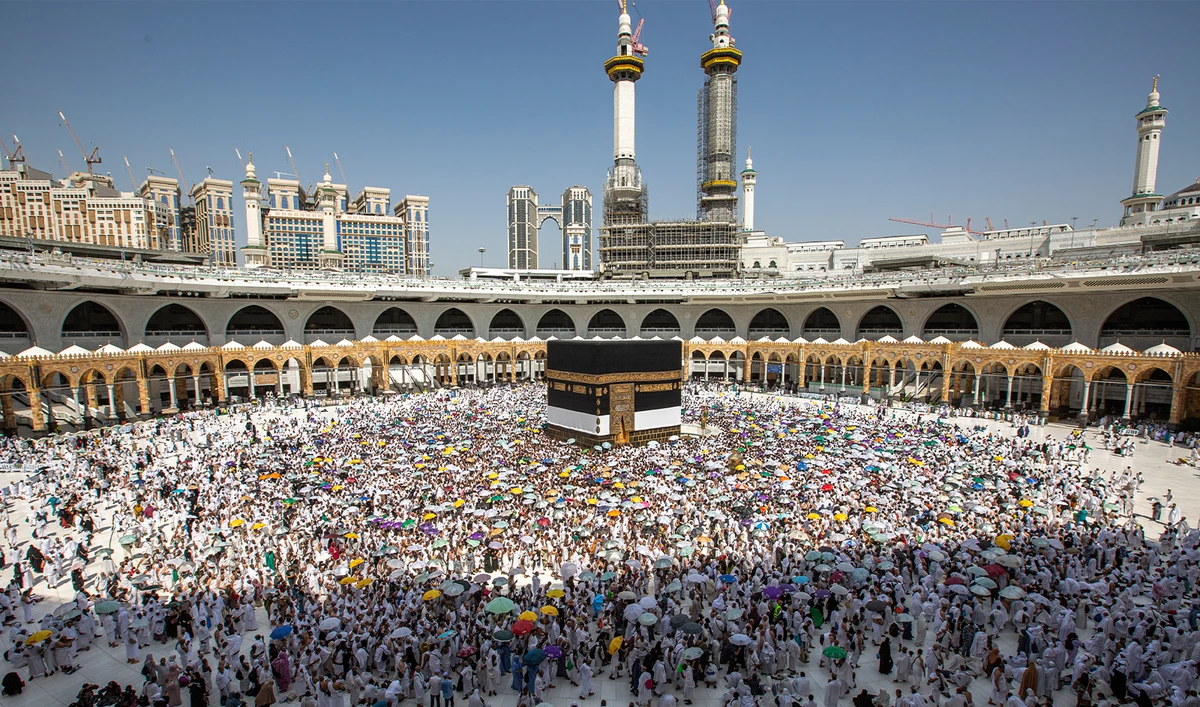
Muslim pilgrims gather around the Kaaba at the Grand Mosque in Makkah, Saudi Arabia on June 28, 2023 on the final day of Hajj. (AFP/File)
Short Url
Updated 29 December 2023
Follow

More than 63,000 applicants succeed as Pakistan announces Hajj 2024 draw results

  • The draw for Hajj 2024 applications under the government's scheme was held on Thursday
  • Applications for a Hajj sponsorship scheme for overseas Pakistanis can be filed till Dec. 31

ISLAMABAD: Pakistan's Caretaker Religious Affairs Minister Aneeq Ahmed announced on Thursday results of a draw for Hajj 2024, Pakistani state media reported, with more than 63,000 applicants selected for the next year's pilgrimage under the government scheme. 

Hajj is an annual Islamic pilgrimage that requires every Muslim adult to undertake a journey to the holy sites in Makkah at least once in their life, if they are physically and financially capable to do so.  

The Pakistani religious affairs ministry holds a ballot every year to select successful Hajj applicants for the sacred journey.   

"According to detail, 69,438 applications were received under Regular Hajj Scheme and 63,805 of them remained successful in the balloting," the state-run Radio Pakistan broadcaster reported, citing the religious affairs minister. 

"A waiting list of unsuccessful 5,633 applicants has been prepared as per their cities of departure." 

Applications for the government's Hajj sponsorship scheme can be filed until December 31, according to the Pakistani religious affairs ministry. 

The Hajj sponsorship scheme was introduced by the government this year, allowing overseas Pakistanis to apply for Hajj or sponsor someone in Pakistan for the journey by paying in US dollars.  

In return, applicants would not have to participate in the balloting process for the pilgrimage.  

Saudi Arabia restored Pakistan’s pre-coronavirus Hajj quota of 179,210 pilgrims this year and lifted the upper age limit of 65 years to perform the pilgrimage.  

More than 81,000 Pakistani pilgrims performed Hajj under the government scheme in 2023 while the rest used private tour operators. 

Pakistan terms climate change, demographic pressures as ‘pressing existential risks’

Updated 4 sec ago
Follow

Pakistan terms climate change, demographic pressures as ‘pressing existential risks’

  • Pakistan has suffered frequent climate change-induced disasters, including floods this year that killed over 1,000
  • Pakistan finmin highlights stabilization measures at Doha Forum, discusses economic cooperation with Qatar 

ISLAMABAD: Pakistan’s Finance Minister Muhammad Aurangzeb on Saturday described climate change and demographic pressures as “pressing existential risks” facing the country, calling for urgent climate financing. 

The finance minister was speaking as a member of a high-level panel at the 23rd edition of the Doha Forum, which is being held from Dec. 6–7 in the Qatari capital. Aurangzeb was invited as a speaker on the discussion titled: ‘Global Trade Tensions: Economic Impact and Policy Responses in MENA.’

“He reaffirmed that while Pakistan remained vigilant in the face of geopolitical uncertainty, the more pressing existential risks were climate change and demographic pressures,” the Finance Division said. 

Pakistan has suffered repeated climate disasters in recent years, most notably the 2022 super-floods that submerged one-third of the country, displaced millions and caused an estimated $30 billion in losses. 

This year’s floods killed over 1,000 people and caused at least $2.9 billion in damages to agriculture and infrastructure. Scientists say Pakistan remains among the world’s most climate-vulnerable nations despite contributing less than 1 percent of global greenhouse-gas emissions.

Aurangzeb has previously said climate change and Pakistan’s fast-rising population are the only two factors that can hinder the South Asian country’s efforts to become a $3 trillion economy in the future. 

The finance minister noted that this year’s floods in Pakistan had shaved at least 0.5 percent off GDP growth, calling for urgent climate financing and investment in resilient infrastructure. 

When asked about Pakistan’s fiscal resilience and capability to absorb external shocks, Aurangzeb said Islamabad had rebuilt fiscal buffers. He pointed out that both the primary fiscal balance and current account had returned to surplus, supported significantly by strong remittance inflows of $18–20 billion annually from the Middle East and North Africa (MENA) and Gulf Cooperation Council (GCC) regions. 

Separately, Aurangzeb met his Qatari counterpart Ali Bin Ahmed Al Kuwari to discuss bilateral cooperation. 

“Both sides reaffirmed their commitment to strengthening economic ties, particularly by maximizing opportunities created through the newly concluded GCC–Pakistan Free Trade Agreement, expanding trade flows, and deepening energy cooperation, including long-term LNG collaboration,” the finance ministry said. 

The two also discussed collaboration on digital infrastructure, skills development and regulatory reform. They agreed to establish structured mechanisms to continue joint work in trade diversification, technology, climate resilience, and investment facilitation, the finance ministry said.