In Germany, local politics holds up weapons for Ukraine

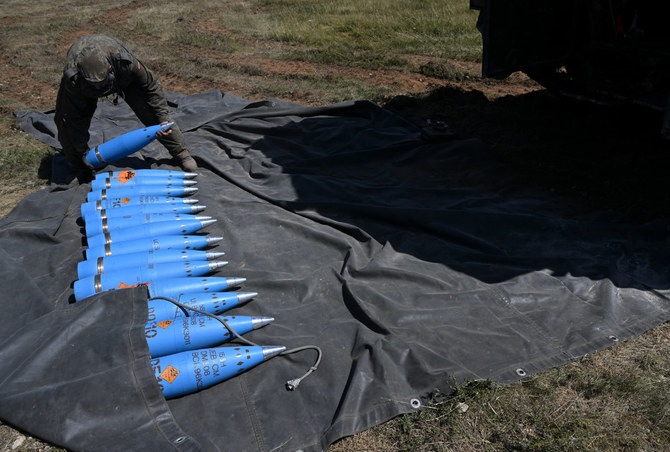
A German Army soldier prepares practice ammunition for a self-propelled howitzer 2000 tank during NATO artillery exercise in southern Germany on July 20, 2022. (AFP/File)
Short Url
Updated 28 December 2023
Follow

In Germany, local politics holds up weapons for Ukraine

  • A dispute with a city council has hampered plans by arms giant Diehl Defense to expand production of munitions parts 
  • The EU has pledged to provide Ukraine with 1M artillery rounds by March 2024 to aid in the fight against Russia

FRANKFURT, Germany: Europe’s efforts to boost arms production and help Ukraine to fend off Russia’s invasion are facing an unexpected obstacle in a German local government.
The city council in Troisdorf, which has a population close to 80,000, has for the time being blocked plans put forward by a major arms company to expand production locally.
Citing development needs, the “no” by the western municipality near Cologne is calling into question the European Union’s ability to manufacture more weapons at a crucial time.
Earlier this year, the 27-member EU pledged to step up supplies of much-needed artillery shells to Ukraine as Kyiv’s forces faced shortfalls.
The mayor of Troisdorf rarely has a role to play in international politics, but the local official was called to account by German Defense Minister Boris Pistorius in parliament in early December for holding up the project.
Recognizing the risks, the popular minister urged local and regional authorities to work to speed up the rate of arms production.
“The pressure (...) is great because in Europe and in Germany there is a real bottleneck on ammunition,” Pistorius told MPs.
For weeks, Troisdorf has been at loggerheads with arms giant Diehl Defense, whose local factory produces the ignition devices needed for large quantities of explosives, such as rockets and missile charges.
These parts are used in the manufacture of the Iris-T air defense system, three of which have been delivered by the German government to Ukraine.

The Troisdorf site is an important link in Europe’s objectives to back Ukraine, as Kyiv urges its allies to supply it with more munitions at a time when it is struggling to repel the Russian offensive.
The EU has pledged to provide Ukraine with one million artillery rounds by March 2024 to aid in Kyiv’s fight against Russia.
To date, it has delivered about 300,000 rounds from its own stocks, now depleted.
German industry’s share of the EU plan should eventually reach 300,000 to 400,000 shells a year, more than three times the production at the time of the Russian invasion of Ukraine in early 2022, industry sources told AFP.
But Diehl Defense now sees the future of its Troisdorf site in serious jeopardy after the city decided to claim part of the business park where the group’s subsidiary DynITEC is based.
The arms manufacturer wanted to buy the land, which had been put up for sale by the former Dynamit Nobel weapons company, so that it could expand its production capacity.
For its part, the local authority is planning to convert the site, which is the size of 50 football pitches and ideally located near the city center, into homes and offices.
“By calling the Troisdorf site into question, the Federal Republic of Germany’s defense capability is being undermined,” warned Thomas Bodenmueller, a member of the Diehl Defense board of directors, in response.

A broad spectrum of city councillors, from the conservative mayor Alexander Biber to the ecologist Greens and far-left Die Linke — roughly two-thirds of the council — refused to sacrifice such a large area in the city center.
This is because, according to the local authorities, the production of explosives and combat devices requires huge protective zones around the factory which cannot be built on for safety reasons.
For Marie-Agnes Strack-Zimmermann, chair of the Bundestag lower house’s defense committee and a staunch backer of Ukraine, the position of Troisdorf’s mayor “is quite simply irresponsible.”
“This is about Ukraine, but also and above all about Germany’s security,” she told AFP.
For the time being, Biber remains unmoved.
Despite mediation meetings in the run-up to the Christmas holidays, no compromise has yet been found and he is not alone in his resistance.
Earlier this year, the Rheinmetall group, another flagship of the German arms industry, said it would not build a new ammunition powder factory in the Saxony region of eastern Germany.
The project had caused concern among the local population and with public acceptance lacking, Rheinmetall moved the project to another location in Bavaria.
While experts say Kyiv needs three million rounds of ammunition a year, Pistorius warned last month that the EU would likely fail to reach its March target of delivering even one million desperately needed howitzer rounds.


Afghanistan’s historic Ariana Cinema torn down to make way for shopping center

Updated 5 sec ago
Follow

Afghanistan’s historic Ariana Cinema torn down to make way for shopping center

KABUL: Through the decades, downtown Kabul’s Ariana Cinema had weathered revolution and war, emerging battered and bruised but still standing to entertain Afghans with Bollywood movies and American action flicks. Now, it is no more.
On Dec. 16, demolition crews began to tear down the historic cinema, which first opened its doors to moviegoers in the early 1960s. A week later, there was nothing left.
“It’s not just a building made of bricks and cement that is being destroyed, but the Afghan cinema lovers who resisted and continued their art despite the hardships and severe security problems,” Afghan film director and actor Amir Shah Talash told The Associated Press. “Unfortunately, all the signs of historical Afghanistan are being destroyed.”
Hearing about the Ariana Cinema’s destruction was “very painful and sad news for me,” said Talash, who has been active in Afghanistan’s film industry since 2004 but has been living in France since the Taliban’s takeover of Afghanistan.
Taliban bans most forms of art and entertainment
Afghanistan’s Taliban government, which seized power in 2021 in the wake of the chaotic withdrawal of US and NATO troops, has imposed a harsh interpretation of Islamic law which has introduced a raft of restrictions, including bans on most forms of entertainment such as films and music.
Shortly after taking over, the new government ordered all cinemas to stop operating. On May 13 this year, it announced the dissolution of the Afghan Film Administration. The Ariana, built on municipal land by a busy traffic roundabout was shuttered and remained in limbo.
But Kabul authorities later decided the cinema, with its stylish marquee and plush red seats, had to make way for a new shopping complex.
“Cinemas themselves are a kind of commercial activity, and that area was a completely commercial area and had the potential for a good market there,” Kabul Municipality spokesman Niamatullah Barakzai said.
The municipality aims to develop the land it owns “to generate good income from its resources and bring positive changes in the city,” he added.
The Ariana Cinema opens in the liberalizing 1960s
The Ariana opened in 1963, its sleek architecture mirroring the modernizing spirit the then-ruling monarchy was trying to bring to the deeply traditional nation.
But Afghanistan was soon plunged into conflict. The Soviets invaded in 1979, and by the late 1980s war raged across the country, as Soviet-backed President Najibullah’s government fought an American-backed coalition of warlords and Islamic militants. He was toppled in 1992, but a bloody civil war ensued.
The Ariana suffered heavy damage and lay in ruins for years. In 1996, the Taliban took over Kabul, and whatever cinemas in the city had survived were shuttered.
A new — but temporary — lease of life
The Ariana was given a new lease of life after the Taliban’s 2001 ouster by the US-led invasion, with the French government helping to rebuild it in 2004.
Indian films were particularly popular, as were action movies, while the Ariana also began playing Afghan movies resulting from a revival of the domestic film industry.
For Talash, the film director and actor, it was his childhood visits to the Ariana with his brothers that sparked his interest in movies.
“It was from this cinema that I fell in love with film and turned to this art form,” he said. Eventually, one of his own films was screened in the Ariana, “which is one of the unforgettable memories for me.”
The cinema was a cultural gathering place for Kabul residents who would go there to “relieve their sorrows and problems and to calm their minds and hearts,” Talash said. “But now, a very important part of Kabul has been taken away. In this new era, we are regressing, which is very sad.”
But art, he said, doesn’t just reside in buildings. There is still hope.
“The future looks difficult, but it is not completely dark,” Talash said. “Buildings may collapse, but art lives on in the minds and hearts of people.”
In neighboring Pakistan, authorities imposed heavy taxes on Indian films to curb imports and then banned them outright after the 1965 war between India and Pakistan over the disputed Himalayan region of Kashmir. Bollywood fans from Pakistan would travel to Kabul instead to watch the popular movies.
Among them was Sohaib Romi, a Pakistani film enthusiast and art lover, who recalled watching the Indian film “Samjhauta,” or “Compromise,” at the Ariana in 1974 with his uncle.
For him, the loss is personal. “My memories are buried in the rubble of the Ariana Cinema,” he said.