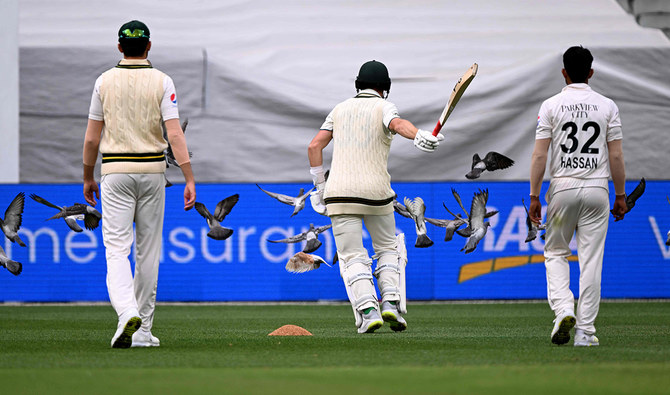
MELBOURNE: Pat Cummins and Nathan Lyon put Australia in the driving seat of the second Test at the Melbourne Cricket Ground on Wednesday to leave Pakistan tottering at 194-6, still 124 runs behind on day two.
At stumps, Mohammad Rizwan was on 29 and Aamer Jamal not out two after Cummins took the crucial wickets of Abdullah Shafique (62) and Babar Azam (one), then Agha Salman (five).
Lyon chipped in by removing Imam-ul-Haq (10) and Shan Masood (54), while Josh Hazlewood bowled Saud Shakeel for nine as Pakistan’s dream of a first Test win in Australia since 1995 faded.
The visitors had claimed seven wickets in the morning session on a pitch offering seam and swing, restricting the hosts to 318.
Aamer Jamal spearheaded Pakistan’s charge with 3-64 after Australia resumed on 187-3 after being sent into bat, with Marnus Labuschagne top-scoring on 63.
Openers Haq and Shafique made a positive start in reply, surviving a series of loud appeals.
But veteran spinner Lyon, fresh from taking his 500th wicket during the first Test in Perth, finally earned a reward when Haq edged to Labuschagne at slip.
Undeterred, Pakistan upped the run rate after tea with Masood hitting Lyon for six and Shafique reaching his first Test 50 in Australia, and fifth overall, with a four off Mitchell Starc.
But their 90-run partnership was broken by Cummins, who showed sharp reflexes to stick out his left hand for a catch off his own bowling to end Shafique’s stay.
Fired up, he then clean bowled danger man Azam before Lyon returned to claim his second wicket when Masood miscued and Mitchell Marsh did well to hold a catch with the sun in his eyes.
Hazlewood took care of Shakeel before Cummins brought himself back and accounted for Salman, caught by wicketkeeper Alex Carey to leave Pakistan in trouble.
Labuschagne had been a rock on day one, digging in for an overnight 44 off 120 balls.
He padded up again alongside Travis Head on nine with the sun shining, smacking a boundary off Shaheen Shah Afridi in the opening over to signal Australia’s intent.
The explosive Head drove Hasan Ali to the ropes off his first ball and followed it up with another in the same over to quickly get in the groove.
But his flair cost him on 17, lashing at a wide Afridi delivery that took a thick edge and was well collected by Salman in the slips.
At the other end, Labuschagne kept plugging away to bring up his 17th Test half-century.
Marsh was given out twice in successive balls during a fiery Ali over while on seven by West Indian umpire Joel Wilson. He reviewed both decisions — for lbw and caught behind — and survived.
But just as the match appeared to be slipping away from Pakistan, Jamal bagged the wicket of Labuschagne, who edged to Shafique at slip.
Carey and Starc quickly followed as Pakistan cashed in with a new ball, before Marsh holed out to Jamal off Mir Hamza on 41 and the tail folded.
Australia won the first Test of the three-match series in Perth by 360 runs.


Australia take control of second Test as Pakistan flounder

https://arab.news/6qtdx
Australia take control of second Test as Pakistan flounder

- Pakistan claimed seven wickets in the morning session on a pitch offering swing, restricting Australia to 318
- Pakistan were tottering at 194 for 6 at stumps after losing the crucial wickets of Abdullah Shafique, Babar Azam

Pakistani on trial in US says Trump, Biden were possible targets in Iran-linked assassination plot
- Asif Merchant, who paid money to hitmen, tells court Iranian contact named three potential targets
- The Pakistani national says he anticipated getting arrested, acted out of fear for his relatives in Iran
NEW YORK: The allegation sounded like the stuff of spy movies: A Pakistani businessman trying to hire hit men, even handing them $5,000 in cash, to kill a US politician on behalf of Iran ‘s powerful paramilitary Revolutionary Guard.
It was true, and potential targets of the 2024 scheme included now-President Donald Trump, then-President Joe Biden and former presidential candidate and ex-UN Ambassador Nikki Haley, the man told jurors at his attempted terrorism trial in New York on Wednesday. But he insisted his actions were driven by fear for loved ones in Iran, and he figured he’d be apprehended before anything came of the scheme.
“My family was under threat, and I had to do this,” the defendant, Asif Merchant, testified through an Urdu interpreter. “I was not wanting to do this so willingly.”
Merchant said he had anticipated getting arrested before anyone was killed, intended to cooperate with the US government and had hoped that would help him get a green card.
US authorities were, indeed, on to him — the supposed hit men he paid were actually undercover FBI agents — and he was arrested on July 12, 2024, a day before an unrelated attempt on Trump’s life in Butler, Pennsylvania. Merchant did sit for voluntary FBI interviews, but he ultimately ended up with a trial, not a cooperation deal.
“You traveled to the United States for the purpose of hiring Mafia members to kill a politician, correct?” Assistant US Attorney Nina Gupta asked during her turn questioning Merchant Wednesday in a Brooklyn federal court.
“That’s right,” Merchant replied, his demeanor as matter-of-fact as his testimony was unusual.
The trial is unfolding amid the less than week-old Iran war, which killed Iranian Supreme Leader Ayatollah Ali Khamenei in a strike that Trump summed up as “I got him before he got me.” Jurors are instructed to ignore news pertaining to the case.
The Iranian government has denied plotting to kill Trump or other US officials.
Merchant, 47, had a roughly 20-year banking career in Pakistan before getting involved in an array of businesses: clothing, car sales, banana exports, insulation imports. He openly has two families, one in Pakistan and the other in Iran — where, he said, he was introduced around the end of 2022 to a Revolutionary Guard intelligence operative. They initially spoke about getting involved in a hawala, an informal money transfer system, Merchant said.
Merchant testified that his periodic visits to the US for his garment business piqued the interest of his Revolutionary Guard contact, who trained him on countersurveillance techniques.
The US deems the Revolutionary Guard a “foreign terrorist organization.” Formally called the Islamic Revolutionary Guard Corps, the force has been prominent in Iran under Khamenei.
Merchant said the handler told him to seek US residents interested in working for Iran. Then came another assignment: Look for a criminal to arrange protests, steal things, do some money laundering, “and maybe have somebody murdered,” Merchant recalled.
“He did not tell me exactly who it is, but he told me — he named three people: Donald Trump, Joe Biden and Nikki Haley,” he added.
After US immigration agents pulled Merchant aside at the Houston airport in April 2024, searched his possessions and asked about his travels to Iran, he concluded that he was under surveillance. But still he researched Trump rally locations, sketched out a plot for a shooting at a political rally, lined up the supposed hit men and scrambled together $5,000 from a cousin to pay them a “token of appreciation.”
He even reported back to his Revolutionary Guard contact, sending observations — fake, Merchant said — tucked into a book that he shipped to Iran through a series of intermediaries.
Merchant said he “had no other option” than to play along because the handler had indicated that he knew who Merchant’s Iranian relatives were and where they lived.
In a court filing this week, prosecutors noted that Merchant didn’t seek out law enforcement to help with his purported predicament before he was arrested. He testified that he couldn’t turn to authorities because his handler had people watching him.
Prosecutors also said that in his FBI interviews, Merchant “neglected to mention any facts that could have supported” an argument that he acted under duress.
Merchant told jurors Wednesday that he didn’t think agents would believe his story, because their questions suggested “they think that I’m some type of super-spy.”
“And are you a super-spy?” defense lawyer Avraham Moskowitz asked.
“No,” Merchant said. “Absolutely not.”


