Iraq slams US after deadly strikes targeting pro-Iran forces

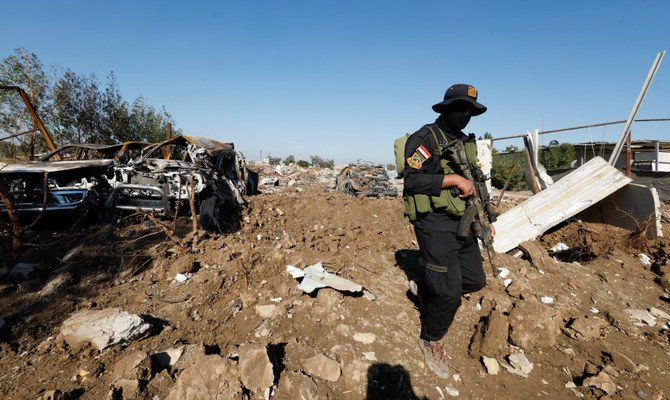
An official in Iraq’s Interior Ministry said a strike had targeted a Hashd Al-Shaabi site in Hilla, the capital of Babylon province. (Reuters)
Short Url
Updated 26 December 2023
Follow

Iraq slams US after deadly strikes targeting pro-Iran forces

  • Iraq says the latest US strikes killed one member of the security forces and wounded 18 other people, including civilians

BAGHDAD: US air strikes targeting a pro-Iranian group in Iraq on Tuesday claimed at least one life, drawing an angry response from Baghdad as regional tensions spike amid the Israel-Hamas war.

The US has repeatedly targeted sites used by Iran and its proxy forces in Iraq and Syria in response to dozens of attacks on American and allied forces in the region since the October 7 outbreak of the war.

Iraq said the latest US strikes killed one member of the security forces and wounded 18 other people, including civilians.

In a statement, it warned that such attacks “infringe upon Iraq’s sovereignty and are deemed unacceptable under any circumstances or justification.”

“Iraqi military sites were targeted by the American side justifying the act as a response,” the Iraqi government said, adding it “resulted in the martyrdom of one service member and the injury of 18 others, including civilians.”

“This constitutes a clear hostile act.

“It runs counter to the pursuit of enduring mutual interests in establishing security and stability, and it opposes the declared intention of the American side to enhance relations with Iraq.”

Questioned by AFP, an official in Iraq’s Interior Ministry said a strike had targeted a Hashd Al-Shaabi site in Hilla, the capital of Babylon province.

One person was killed and 20 others wounded, the official said, giving a higher injured toll than the government.

Four others were wounded in a second strike in Wassit province. The casualty toll was confirmed by security sources in both Babylon and Wassit provinces.

US Defense Secretary Lloyd Austin said earlier American forces had carried out strikes on three sites used by pro-Iran groups in Iraq in response to a series of attacks on US personnel.

“US military forces conducted necessary and proportionate strikes on three facilities used by Kataeb Hezbollah and affiliated groups in Iraq,” Austin said in a statement.

The Iran-backed Kataeb Hezbollah, or Hezbollah Brigades, forms part of the Hashed Al-Shaabi, a coalition of former paramilitary forces that are now integrated into Iraq’s regular armed forces.

The group was designated a “terrorist organization” by the US State Department in 2009.

“These precision strikes are a response to a series of attacks against US personnel in Iraq and Syria by Iranian-sponsored militias, including an attack by Iran-affiliated Kataeb Hezbollah and affiliated groups on Irbil Air Base” on Monday, Austin said.

That attack wounded three US military personnel, one critically, US National Security Council spokesperson Adrienne Watson said.

US President Joe Biden was briefed on the attack — which was carried out with a one-way attack drone — and directed the US strikes in a call with Austin and other national security officials after ordering the defense department to prepare a response, the statement said.

Biden “places no higher priority than the protection of American personnel serving in harm’s way. The United States will act at a time and in a manner of our choosing should these attacks continue,” the statement added.

The drone attack was claimed by the Islamic Resistance in Iraq, a loose formation of armed groups affiliated with the Hashed Al-Shaabi.

A tally by US military officials has counted 103 attacks against its troops in Iraq and Syria since October 17, most of which have been claimed by the Islamic Resistance in Iraq, which opposes US support for Israel in its war against Hamas in the Gaza Strip.

The US has about 2,500 soldiers deployed in Iraq and around 900 in Syria, as part of efforts to prevent a resurgence of the Daesh group.



Sudan’s prime minister takes his peace plan to the UN, but US urges humanitarian truce now

Updated 57 min 20 sec ago
Follow

Sudan’s prime minister takes his peace plan to the UN, but US urges humanitarian truce now

  • Sudan’s prime minister is proposing a wide-ranging peace initiative to end a nearly 1,000-day war with a rival paramilitary force
  • It seems unlikely the RSF would support the proposal, which would essentially give government forces a victory and take away their military power

UNITED NATIONS: Sudan’s prime minister on Monday proposed a wide-ranging peace initiative to end a nearly 1,000-day war with a rival paramilitary force, but the United States urged both sides to accept the Trump administration’s call for an immediate humanitarian truce.
Kamil Idris, who heads Sudan’s transitional civilian government, told the Security Council his plan calls for a ceasefire monitored by the United Nations, African Union and Arab League, and the withdrawal of paramilitary forces from all areas they occupy, their placement in supervised camps and their disarmament.
Sudan plunged into chaos in April 2023 when a power struggle between the military and the powerful paramilitary Rapid Support Forces exploded into open fighting, with widespread mass killings and rapes, and ethnically motivated violence. This has amounted to war crimes and crimes against humanity, according to the UN and international rights groups.
It seemed highly unlikely the RSF would support the prime minister’s proposal, which would essentially give government forces a victory and take away their military power.
In an indirect reference to the truce supported by the US and key mediators Saudi Arabia, Egypt and the United Arab Emirates, known as the Quad, Idris stressed to the UN Security Council that the government’s proposal is “homemade — not imposed on us.”
In early November, the Rapid Support Forces agreed to a humanitarian truce. At that time, a Sudanese military official told The Associated Press the army welcomed the Quad’s proposal but would only agree to a truce when the RSF completely withdraws from civilian areas and gives up their weapons — key provisions in the plan Idris put forward on Monday.
Idris said unless the paramilitary forces were confined to camps, a truce had “no chance for success.” He challenged the 15 members of the Security Council to back his proposal.
“This initiative can mark the moment when Sudan steps back from the edge and the international community — You! You! — stood on the right side of history,” the Sudanese prime minister said. He said the council should “be remembered not as a witness to collapse, but as a partner in recovery.”
US deputy ambassador Jeffrey Bartos, who spoke to the council before Idris, said the Trump administration has offered a humanitarian truce as a way forward and “We urge both belligerents to accept this plan without preconditions immediately.”
Bartos said the Trump administration strongly condemns the horrific violence across Darfur and the Kordofan region — and the atrocities committed by both the Sudanese Armed Forces and the Rapid Support Forces, who must be held accountable.
UAE Ambassador Mohamed Abushahab, a member of the Quad, said there is an immediate opportunity to implement the humanitarian truce and get aid to Sudanese civilians in desperate need.
“Lessons of history and present realities make it clear that unilateral efforts by either of the warring parties are not sustainable and will only prolong the war,” he warned.
Abushahab said a humanitarian truce must be followed by a permanent ceasefire “and a pathway toward civilian rule independent of the warring parties.”
UN Assistant Secretary-General for political affairs Khaled Khiari reflected escalating council concerns about the Sudan war, which has been fueled by the continuing supply of increasingly sophisticated weapons.
He criticized unnamed countries that refuse to stop supplying weapons, and both government and paramilitary forces for remaining unwilling to compromise or de-escalate.
“While they were able to stop fighting to preserve oil revenues, they have so far failed to do the same to protect their population,” Khiari said. “The backers of both sides must use their influence to help stop the slaughter, not to cause further devastation.”
The devastating war in Sudan has killed more than 40,000 people according to UN figures, but aid groups say the true number could be many times higher. The conflict has created the world’s largest humanitarian crisis, with over 14 million people displaced, disease outbreaks and famine spreading in parts of the country.