ISLAMABAD: Pakistan suffered a staggering 29 suicide attacks this year, the highest since 2014, a leading Islamabad-based think tank said in its report on Sunday, raising alarm over the “disturbing” surge in militant attacks across the country.
Pakistan has been gripped with militant attacks since November 2022, when a fragile truce between the Pakistani Taliban and the state broke down.
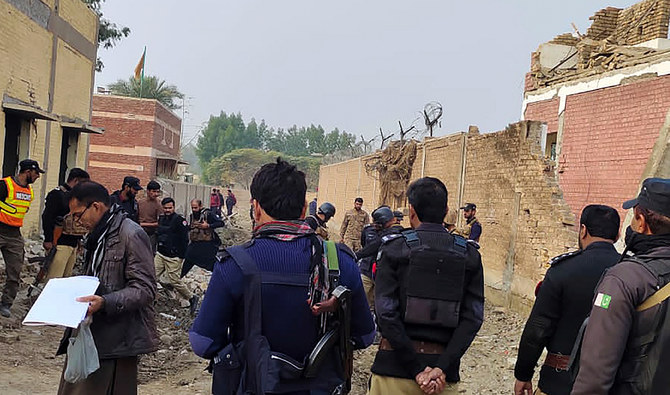
Pakistan’s northwestern Khyber Pakhtunkhwa province, which shares a lengthy border with neighboring Afghanistan, has been hit hardest by militancy. A suicide attack inside a police compound in Peshawar earlier this year killed over 80 people and injured scores of others.
“In 2023, the country experienced a disturbing surge in such [suicide] attacks, reaching the highest level since 2014,” a press release issued by the Pakistan Institute for Conflict and Security Studies (PICSS) said.
“A staggering 29 suicide attacks were reported, resulting in the tragic loss of 329 lives and leaving 582 individuals injured.”
The last time Pakistan reported more people killed from suicide attacks was in 2013, when 683 people lost their lives in 47 suicide bombings, the report said.
Compared to last year, Pakistan saw a “distressing” 93 percent increase in the number of suicide attacks, a 226 percent rise in resultant deaths, and an alarming 101 percent surge in the number of injured, the PICSS said.
“Furthermore, the share of suicide attacks in the total number of attacks escalated from 3.9 percent in 2022 to 4.7 percent in 2023, underscoring the severity of the situation,” the media release said.
Khyber Pakhtunkhwa suffered the most suicide attacks this year, 23, the report said, adding that 254 people were killed and 512 injured in the province. Thirteen of the 23 suicide attacks took place in the erstwhile Federally Administered Tribal Areas (FATA) causing 85 deaths and 206 injuries.
Pakistan’s southwestern Balochistan province faced five suicide attacks, causing 67 deaths and 52 injuries, while the southern Sindh province witnessed one suicide attack that resulted in eight deaths and 18 injuries, the report said.
“The unsettling data further reveals that security forces were the primary targets of these attacks, with civilians constituting the second-largest victim category,” PICSS said.
It said 48 percent of the total deaths and 58 percent of the total injuries this year were inflicted upon security forces personnel.
The surge in militant attacks in Pakistan’s western frontiers has strained Islamabad’s ties with Kabul. Pakistan has called on Afghanistan to rein in militants that it alleges are using Afghan soil to launch attacks on Pakistan.
The Afghan Taliban deny Pakistan’s allegations and have repeatedly assured Islamabad it would not allow its soil to be used for attacks against any country.


Pakistan witnessed highest number of suicide attacks this year since 2014 — report
https://arab.news/bcxnj
Pakistan witnessed highest number of suicide attacks this year since 2014 — report

- Pakistan suffered 29 suicide attacks in 2023 resulting in 329 deaths, 582 injured, says Islamabad-based think tank
- Pakistan’s northwestern Khyber Pakhtunkhwa province suffered 23 out of the 29 attacks this year, the report said

Islamic military coalition, Pakistan to deepen cooperation to combat ‘terrorism’ — Pakistani military
- Islamic Military Counter Terrorism Coalition is a 43-member alliance that includes Pakistan, Saudi Arabia, Egypt, Jordan, UAE and other nations
- The Pakistani military statement comes after a meeting between IMCTC secretary-general and the chief of Pakistani defense forces in Rawalpindi
ISLAMABAD: Pakistan and the Islamic Military Counter Terrorism Coalition (IMCTC) have reaffirmed their commitment to deepening cooperation, including intelligence sharing and capacity building, to jointly combat “terrorism” and “extremism,” the Pakistani military said on Monday.
The IMCTC is a 43-member military alliance that was formed on Saudi Arabia’s initiative in Dec. 2015 to consolidate Muslim countries’ efforts in countering “terrorism.”
A 17-member IMCTC delegation is visiting Pakistan from Feb. 2-6 to conduct a training at National University of Sciences and Technology on “Re-integration and Rehabilitation of Extremist Elements,” according to the Pakistani military.
On Monday, IMCTC Secretary-General Maj. Gen. Mohammed bin Saeed Al-Moghedi held a meeting with Chief of Pakistani Defense Forces Field Marshal Asim Munir to discuss cooperation among IMCTC member states.
“During the meeting, matters of mutual interest were discussed, with particular emphasis on regional security dynamics and enhanced cooperation in counter-terrorism efforts,” the Inter-Services Public Relations (ISPR), the Pakistani military’s media wing, said in a statement.
“Both sides reaffirmed their shared commitment to combating terrorism and extremism through collaborative strategies, intelligence sharing, and capacity building among member states.”
The IMCTC features Pakistan, Saudi Arabia, Türkiye, Afghanistan, Egypt, Jordan, Qatar, Palestine, UAE, Bangladesh and other nations. In 2017, Pakistan’s former army chief Gen. (retd) Raheel Sharif was appointed as the IMCTC commander-in-chief.
During discussions with Major General Al-Moghedi, Field Marshal Munir appreciated the role of IMCTC in fostering stability and promoting coordinated counterterrorism initiatives across the Islamic world, according to the ISPR.
The IMCTC secretary-general acknowledged Pakistan’s significant contributions and sacrifices in the fight against militancy and lauded the professionalism of Pakistan’s armed forces.
“The meeting underscored the resolve of both sides to further strengthen institutional collaboration for peace, stability, and security in the region,” the ISPR added.
Pakistan enjoys cordial ties with most Muslim countries around the world, particularly Gulf Cooperation Council countries. In Sept. 2025, Pakistan signed a landmark defense pact with Saudi Arabia according to which an act of aggression against one country will be treated as an act of aggression against both.


