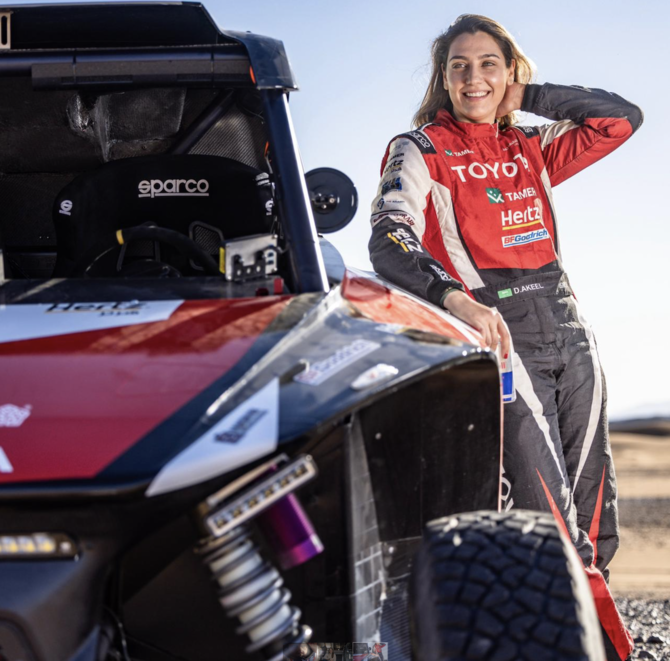


JEDDAH: As the countdown to the biggest rally event of the year continues, Saudi driver Dania Akeel feels excited and eager to take on the challenge of the Dakar Rally 2024 for the third time in her racing career.
The 45th edition of the Dakar Rally will be held Jan. 5-19 in Saudi Arabia.
Akeel told Arab News she had gone to Austria to prepare for the Dakar Rally, while Red Bull and the Athlete Performance Center, a hub dedicated to pushing athletes to their limits and beyond, had also helped.
She affirmed her full fitness and said she feels more motivated than ever to secure a positive result at the legendary event.
“The whole reason for being (in Austria) is to find my weak points and receive a plan and a report to develop and to strengthen not only my body but mind as well,” Akeel said. “And it’s really nice to be around a bunch of people who really enjoy what they do.”
After driving a T3 car, Akeel switched to a new car for this year’s edition. “I’ve recently changed cars. I was using a T3 car as well but it was a Can-Am. So, it was a great car to learn on and I enjoyed it a lot,” she explained.
“I’ve recently switched to a car that has a sequential gearbox and that means that you are shifting constantly during the stage and this was a skill I wanted to add to my skill set because the bigger classes like T1 and the main category of the event, all of those cars have a sequential gearbox and I wanted to pick up the skill in the T3 category with the lightweight prototypes.”
Akeel had already tested out the car recently at the Rally Du Maroc, and performed really well. “It was really engaging to have this new layer involved where you’re constantly shifting gears up and down. It adds a different stimulant.”
Every athlete who walks through the APC’s doors is treated as their own singular case. The center offers a comprehensive, long-term program that covers physical, mental, and social development. This holistic approach ensures that the athlete not only reaches their peak performance but also maintains and regains it, even after injuries.
“So, in my case as a cross country driver,” Akeel said, “you’re not looking to build an insane level of muscle. You’re thinking more about durability, endurance, but you also have to be strong enough to handle the car and to feel comfortable over long distances.”
Akeel herself lives by the idea of if you “can allow yourself to be a student at any age, then it’s easier to enrich your life, by picking up new activities, new hobbies, new skills.
“When it comes to the mental performance, I found (the training) really interesting. For example, today we worked on reaction times; they have these sets of light that measure how quick you are to tap the right ones, with which arm. Then they have these mental games where you have to throw a ball in the air, in the meantime, catch the second ball that’s thrown at you. They look at multitasking, they try to expand your perception, spatial awareness, they try to stimulate your mind to interact with your surroundings, to do multiple things at the same time.”
With main facilities in Salzburg and Los Angeles and a network that extends globally, the APC provides athletes with the opportunity to train and develop under the best conditions, no matter where they are in the world.
Dania reiterated that it’s “just a really good place to improve, to grow, and to socialize.”
She said: “You’ve got to have a really good overall performance, and maybe on our own time we would focus on the things we enjoy more, find easier. But when you go to APC, you have to do different things and you see the effect in the racing, and once you do it’s motivating to keep building on that and keep improving. And that’s one of the things that I really appreciate about working with Red Bull.”
Akeel’s journey to Austria and her training at the APC epitomizes the synergy between an athlete’s dedication and the unwavering support of organizations like Red Bull.
As she prepares for the Dakar Rally, her story serves as an inspiration to all aspiring athletes, showing that with the right backup and a commitment to excellence, anything is possible. And Akeel’s future in motorsports is undoubtedly a thrilling one to watch.
In her first attempt at the Dakar, Akeel finished a creditable eighth in her class in the 2022 race, while she finished in 28th in the T3 group in 2023.
The 2024 Dakar Rally covers 14 stages through the desert of Saudi Arabia before. This year’s edition features a new 48-hour, 584 km “Chrono Stage” where competitors will be split across eight different bivouacs overnight.