

A humanitarian aid bridge of solidarity from London to Gaza

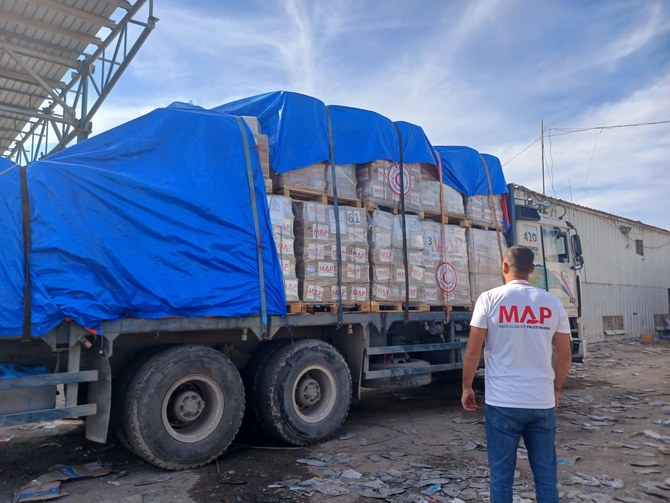
MAP's second convoy of five trucks carrying drugs and medical supplies with $500,000 entering Gaza via the Rafah Crossing. (Supplied/MAP)
Short Url
Updated 24 December 2023
Follow

A humanitarian aid bridge of solidarity from London to Gaza

  • British aid group collects $1 million in essential medical aid bound for Gaza
  • Global outcry and aid efforts rise as Gaza faces devastating war aftermath

JEDDAH: For over two months, the world has watched in utter horror as more than 20,000 Palestinians have been killed, over 50,000 injured and millions displaced in the Gaza Strip due to Israel’s relentless bombardment. The situation spiraled out of control in the early days of the war and the enclave’s already frail healthcare system collapsed almost immediately. But hope is on the way.

One hospital after another went out of service as missiles struck some of Gaza’s largest and most specialized facilities, bringing doctors and health care workers to their knees trying to save the lives of the injured. The scenes have become ever so prevalent now; bodies of children charred or riddled with shrapnel, body parts collected in bags and lifeless victims laying on floors as stretchers are needed for the living. The scenes coming from Gaza cannot be more horrid.

For the past few months, overwhelmed doctors treating victims needed to resort to performing surgeries and amputations without anesthesia, disinfectant or drugs. With no end in sight, supplies have dwindled and less than a quarter of the enclave’s 35-36 hospitals and 72 primary healthcare centers are in operation, but the international community has not abandoned the people of Gaza.

Coinciding with the season of giving, hundreds of aid groups and charities, and millions of people have protested the war on Gaza and gathered funds to help Palestinians.

Responding to the emergency, London-based charity Medical Aid for Palestinians launched a campaign to collect and deliver medical aid. Officials told Arab News that the charity is working with the Health Ministry in Gaza and delivering medical aid to its warehouses. The aid is then distributed to facilities in southern and central Gaza, including Nasser Hospital and European Gaza Hospital in Khan Younis, Shuhada Al-Aqsa Hospital in the Middle Area and Abu Yousef Al-Najjar Hospital in Rafah.


Responding to the emergency, London-based charity Medical Aid for Palestinians launched a campaign to collect and deliver medical aid. (Supplied/MAP)

So far, more than $1 million worth of medical supplies have been gathered and a second convoy has been dispatched to deliver over $500,000 worth of essential aid to hospitals in Gaza’s south.

“Fourteen trucks have already been sent into Gaza, and we plan on sending more,” Fikr Shalltoot, MAP’s Gaza director, told Arab News. “Two food trucks are queuing right now and we hope this will cross within the next few days. These trucks include food, water and some non-food items including mattresses and blankets, and this is mainly to support the team in Gaza and distribute to those in need in the shelters.”

The charity is now procuring medical supplies for trauma and primary healthcare centers specializing in hematology, oncology and hemodialysis, among others. About 15 trucks are expected to bring the much-needed aid to Gaza.

MAP is also cooperating with a number of organizations including Save the Children, IRC and Shelterbox to forward drugs and medical supplies to Al-Arish. The charity’s team on the ground will be responsible for delivering the aid through Rafah and distributing it to different hospitals inside Gaza.

“We’re closely coordinating with the Egyptian Red Crescent society and they’ve kept us informed with the movement of the trucks passing through Rafah, in order to relay to our team on the ground to meet the trucks at the Palestinian side. They’ll then either deliver to the key warehouses or directly to the hospitals,” Shalltoot said.

“We’re also working with other healthcare centers not affiliated with the Ministry of Health including the Palestinian Medical Relief Society, Culture and Free Thought Association, Abdel-Shafi Association and a number of other health care centers and local NGOs in order to support the provision of primary healthcare at the shelters and locations where the internally displaced people are.”

In the UK, MAP is continuing to focus on influencing decision-makers through sustained advocacy and campaigning. The charity’s goal is to secure a swift and lasting ceasefire.

MAP is engaging with both the UK government and opposition parties within Britain, calling on its supporters to reach out to MPs and urge for a definitive end to Israel’s hostilities.


Washington presses Syria to shift from Chinese telecom systems

Updated 26 February 2026
Follow

Washington presses Syria to shift from Chinese telecom systems

  • Syria is exploring the possibility of procuring Chinese technology
  • It was unclear whether the United States ⁠pledged financial or logistical support to Syria to do so

DAMASCUS: The United States has warned Syria against relying on Chinese technology in its telecommunications sector, arguing it conflicts with US interests and threatens US national security, according to three sources familiar with the matter.
The message was conveyed during an unreported meeting between a US State Department team and Syrian Communications Minister Abdulsalam Haykal in San Francisco on Tuesday. Washington has been coordinating closely with Damascus since 2024, when Syria’s now President Ahmed Al-Sharaa ousted longtime leader Bashar Assad, who had a strategic partnership with China.
Syria is exploring the possibility of procuring Chinese technology to support its telecommunications towers and the infrastructure of local Internet service providers, according to a Syrian businessman involved in the procurement talks.
“The US side asked for clarity on the ministry’s plans regarding Chinese telecom equipment,” said ⁠another source briefed on ⁠the talks.
But Syrian officials said infrastructure development projects were time-critical and that Damascus was seeking greater vendor diversity, the source added.
SYRIAN OFFICIALS CITE US EXPORT CONTROLS AS TELECOMS BARRIER
Syria is open to partnering with US firms but the matter was urgent and export controls and “over-compliance” remained an issue, according to person familiar with the meeting in San Francisco.
A US diplomat familiar with the discussions told Reuters that the US State Department “clearly urged Syrians to use American technology or technology from allied countries in the telecoms sector.”
It was unclear whether the United States ⁠pledged financial or logistical support to Syria to do so.
Responding to Reuters questions, a US State Department spokesperson said: “We urge countries to prioritize national security and privacy over lower-priced equipment and services in all critical infrastructure procurement. If it seems too good to be true, it probably is.”
The spokesperson added that Chinese intelligence and security services “can legally compel Chinese citizens and companies to share sensitive data or grant unauthorized access to their customers’ systems” and promises by Chinese companies to protect customers’ privacy were “entirely inconsistent with China’s own laws and well-established practices.”
China has repeatedly rejected allegations of it using technology for spying purposes.
The Syrian Ministry of telecommunications told Reuters any decisions related to equipment and infrastructure are made “in accordance with national technical and security standards, ensuring data protection and service continuity.”
The ministry said it is also prioritizing the diversification of partnerships and technology sources to ⁠serve the national interest.
Syria’s telecom ⁠infrastructure has relied heavily on Chinese technology due to US sanctions imposed on successive Assad governments over the civil war that grew from a crackdown on anti-government protests in 2011.
Huawei technology accounts for more than 50 percent of the infrastructure of Syriatel and MTN, the country’s only telecom operators, according to a senior source at one of the companies and documents reviewed by Reuters. Huawei did not immediately respond to a request for comment.
Syria is seeking to develop its private telecommunications sector, devastated by 14 years of war, by attracting foreign investment.
In early February, Saudi Arabia’s largest telecom operator, STC, announced it would invest $800 million to “strengthen telecommunications infrastructure and connect Syria regionally and internationally through a fiber-optic network extending over 4,500 kilometers.”
The ministry of telecommunications says that US restrictions “hinder the availability of many American technologies and services in the Syrian market,” emphasizing that it welcomes expanding cooperation with US companies when these restrictions are lifted.
Syria has inadequate telecommunications infrastructure, with network coverage weak outside city centers and connection speeds in many areas barely exceeding a few kilobits per second.