

Pakistan’s election regulator strips ex-PM Khan’s party off bat symbol ahead of polls

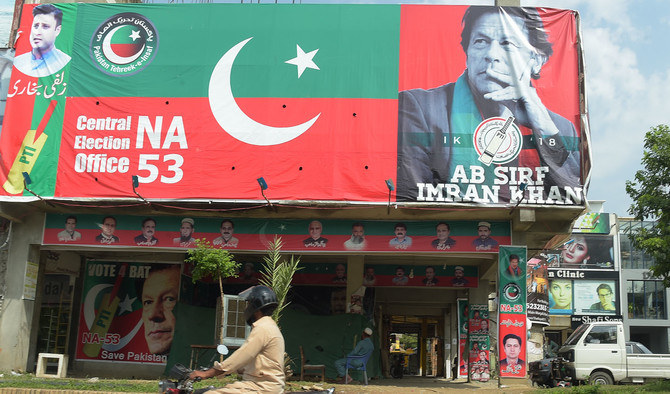
In this file photograph, taken on July 26, 2018, a Pakistani motorcyclist rides past a billboard featuring an image of cricketer-turned-politician Imran Khan, head of the Pakistan Tehreek-e-Insaf party in Islamabad. (AFP/File)
Short Url
Updated 22 December 2023
Follow

Pakistan’s election regulator strips ex-PM Khan’s party off bat symbol ahead of polls

  • Election commission declares PTI’s intraparty elections null and void, says party ineligible to obtain its election symbol, a cricket bat
  • Political analysts term judgment as “unusual” and a huge setback to the party, though it can still appeal against the ECP’s decision

ISLAMABAD: Pakistan’s election regulator on Friday stripped former prime minister Imran Khan’s Pakistan Tehreek-e-Insaf (PTI) party of its iconic election symbol, a cricket bat, less than two months before Pakistan heads to the polls, with analysts saying the move would hurt the party’s chances of winning seats in the upcoming elections.
The judgment came days after a disgruntled PTI leader, Akbar S. Babar, challenged the PTI’s intraparty elections in the Election Commission of Pakistan (ECP), urging the watchdog to declare the exercise null and void for violating rules. Babar said the PTI had neither displayed a final list of candidates nor was any paperwork done for the polls.
The ECP last month declared null and void the PTI’s intraparty elections held in June 2022. It gave the party 20 days to hold fresh elections to become eligible for the bat symbol that it had applied for. The PTI held the intraparty polls on December 3, electing Barrister Gohar Khan as its chairman along with other office bearers and submitted the certificate to the election commission for the bat symbol.
The bat is reflective of Khan’s past as a successful cricketer. The former prime minister led Pakistan to their only 50-over World Cup win in 1992, propelling him to an unrivaled position among Pakistan’s cricket greats.
A five-member ECP bench headed by Chief Election Commissioner Sikandar Sultan Raja reserved the judgment this Friday after hearing arguments from both sides—the PTI and petitioners that challenged the intraparty polls.
“It is held that PTI has not complied with our directions rendered therein order dated 23rd November 2023 and failed to hold intraparty election in accordance with PTI’s prevailing Constitution 2019 and the Election Act, 2017, and Election Rules, 2017,” the ECP said in its 11-page verdict.
“Therefore, the certificate dated 4th December 2023 and Form 65 filed by the alleged Chairman, is hereby regretted and rejected accordingly,” it added.
“The provisions of Section 215 of the Election Act, 2017 are hereby invoked and PTI is hereby declared ineligible to obtain, the Election Symbol, for which they have applied for.”
Khan’s party criticized the verdict, terming it a “disgusting and shameful” attempt to keep the PTI away from elections.

Political analysts said the move would hurt the PTI’s chances of winning seats in the upcoming general elections.
“The ECP scrutiny of the PTI intraparty polls was a good thing for internal democracy of the political parties,” Amir Zia, a political analyst, told Arab News.
“But stripping it off the election symbol is quite unusual and surprising.”
He said the judgment would reek of “discrimination” against the PTI as the election commission has not scrutinized the intraparty polls of at least 174 other parties registered with it.
“The PTI can still challenge the judgment in the superior judiciary for relief, otherwise this would be a huge setback to it ahead of the elections,” Zia said.
Political analyst Zaigham Khan said the election symbol of any political party is like a trademark, and that people associate with it.
“The electoral symbol of any party would be an intangible asset of any political party and depriving PTI of it ahead of elections would not be received well by the public at large,” Khan told Arab News.
He said the PTI would not be allotted any election symbol after the ECP’s verdict, due to which its candidates would be considered “independents.”
“This means the PTI would not be eligible for a share in the reserved seats for women and minorities in national and provincial assemblies regardless of victory of its candidates in the general elections,” he said.
Khan, who is serving a three-year sentence at Rawalpindi’s Adiala jail after he was convicted by a trial court on graft charges, has accused Pakistan’s powerful military, the ECP, and his political rivals of colluding to keep him and the PTI away from elections. He denies any wrongdoing and says the charges against him are politically motivated.
Pakistan’s military, the ECP, and the caretaker government have strongly rejected his allegations.


IMF warns against policy slippage amid weak recovery as it clears $1.2 billion for Pakistan

Updated 11 December 2025
Follow

IMF warns against policy slippage amid weak recovery as it clears $1.2 billion for Pakistan

  • Pakistan rebuilt reserves, cut its deficit and slowed inflation sharply over the past one year
  • Fund says climate shocks, energy debt, stalled reforms threaten stability despite recent gains

ISLAMABAD: Pakistan’s economic recovery remains fragile despite a year of painful stabilization measures that helped pull the country back from the brink of default, the International Monetary Fund (IMF) warned on Thursday, after it approved a fresh $1.2 billion disbursement under its ongoing loan program.

The approval covers the second review of Pakistan’s Extended Fund Facility (EFF) and the first review of its climate-focused Resilience and Sustainability Facility (RSF), bringing total disbursements since last year to about $3.3 billion.

Pakistan entered the IMF program in September 2024 after years of weak revenues, soaring fiscal deficits, import controls, currency depletion and repeated climate shocks left the economy close to external default. A smaller stopgap arrangement earlier that year helped avert immediate default, but the current 37-month program was designed to restore macroeconomic stability through strict monetary tightening, currency adjustments, subsidy rationalization and aggressive revenue measures.

The IMF’s new review shows that Pakistan has delivered significant gains since then. Growth recovered to 3 percent last year after shrinking the year before. Inflation fell from over 23 percent to low single digits before rising again after this year’s floods. The current account posted its first surplus in 14 years, helped by stronger remittances and a sharp reduction in imports. And the government delivered a primary budget surplus of 1.3 percent of GDP, a key program requirement. Foreign exchange reserves, which had dropped dangerously low in 2023, rose from US$9.4 billion to US$14.5 billion by June.

“Pakistan’s reform implementation under the EFF arrangement has helped preserve macroeconomic stability in the face of several recent shocks,” IMF Deputy Managing Director Nigel Clarke said in a statement after the Board meeting.

But he warned that Islamabad must “maintain prudent policies” and accelerate reforms needed for private-sector-led and sustainable growth.

The Fund noted that the 2025 monsoon floods, affecting nearly seven million people, damaging housing, livestock and key crops, and displacing more than four million, have set back the recovery. The IMF now expects GDP growth in FY26 to be slightly lower and forecasts inflation to rise to 8–10 percent in the coming months as food prices adjust.

The review warns Pakistan against relaxing monetary or fiscal discipline prematurely. It urges the State Bank to keep policy “appropriately tight,” allow exchange-rate flexibility and improve communication. Islamabad must also continue raising revenues, broadening the tax base and protecting social spending, the Fund said.

Despite the progress, Pakistan’s structural weaknesses remain severe.

Power-sector circular debt stands at about $5.7 billion, and gas-sector arrears have climbed to $11.3 billion despite tariff adjustments. Reform of state-owned enterprises has slowed, including delays in privatizing loss-making electricity distributors and Pakistan International Airlines. Key governance and anti-corruption reforms have also been pushed back.

The IMF welcomed Pakistan’s expansion of its flagship Benazir Income Support Program, which raises cash transfers for low-income families and expands coverage, saying social protection is essential as climate shocks intensify. But it warned that high public debt, about 72 percent of GDP, thin external buffers and climate exposure leave the country vulnerable if reform momentum weakens.

The Fund said Pakistan’s challenge now is to convert short-term stabilization into sustained recovery after years of economic volatility, with its ability to maintain discipline, rather than the size of external financing alone, determining the durability of its gains.