Khawaja insists armband was not political after ICC reprimand

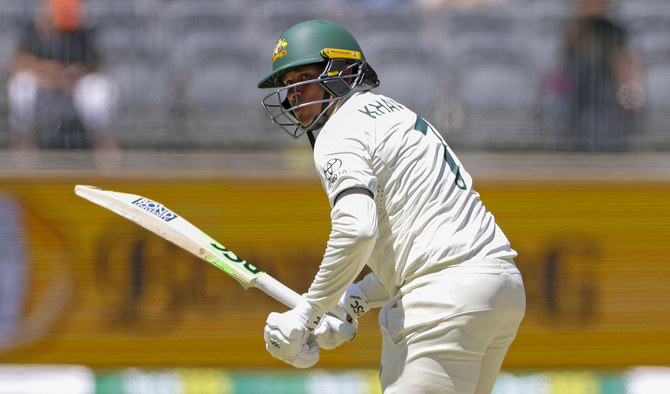
Usman Khawaja of Australia bats on the first day of the first cricket test between Australia and Pakistan in Perth, Australia, on December 14, 2023. (AAP Image via AP, File)
Short Url
Updated 22 December 2023
Follow

Khawaja insists armband was not political after ICC reprimand

  • 36-year-old donned armband during team's 360-run victory in Perth, a move seen as in support of people in Gaza
  • Says he told the ICC during the match it was for a personal bereavement and had no hidden meaning

MELBOURNE: Australia's Usman Khawaja said Friday that a black armband he wore in the first Test against Pakistan was for a "personal bereavement" and not politically motivated, after the star batter was reprimanded by the International Cricket Council (ICC).
The 36-year-old donned the armband during the team's 360-run victory in Perth, a move seen at the time as support for people in Gaza, where thousands have been killed.
He had wanted to wear shoes emblazoned with the hand-written slogans "Freedom is a human right" and "All lives are equal" during the match, saying he had been hit hard by the Israel-Hamas conflict.
But Khawaja, who is Muslim, was told that it flouted ICC rules on messages that relate to politics, religion or race.
He covered the messages with tape and wore the armband.
Khawaja insisted he told the ICC during the match that it was for a personal bereavement and no hidden meaning.
However, the ICC said it breached their clothing and equipment regulations.
"Usman displayed a personal message (armband) during the first Test match against Pakistan without seeking the prior approval of Cricket Australia and the ICC to display it, as required in the regulations for personal messages," the ICC said late Thursday.
"This is a breach under the category of an 'other breach' and the sanction for a first offence is a reprimand."
Khawaja said he would not wear an armband during the second Test in Melbourne next week, but remained defiant.
"No, I'm not wearing it again. As I said to the ICC, the armband was for a personal bereavement," he told reporters in Melbourne.
"The armband was different to my shoes. The shoes were very obvious. At the end of the day I didn't wear the shoes. I respected the rules and procedures and left it at that."
He added that being reprimanded for the armband "makes no sense" and pointed to other players who had previously put stickers on their bats and names on their shoes without approval and escaped punishment, urging the ICC to be more consistent.
"I will just be asking and contesting that they (ICC) make it fair for everyone and they have consistency in how they officiate. That's all I ask for, and from my point of view, that consistency hasn't been done yet," he said.


EU, Pakistan sign €60 million loan agreement for clean drinking water in Karachi

Updated 17 December 2025
Follow

EU, Pakistan sign €60 million loan agreement for clean drinking water in Karachi

  • Project will finance rehabilitation, construction of water treatment facilities in Karachi city, says European Investment Bank
  • As per a report in 2023, 90 percent of water samples collected from various places in city was deemed unfit for drinking

ISLAMABAD: The European Investment Bank (EIB) and Pakistan’s government on Wednesday signed a €60 million loan agreement, the first between the two sides in a decade, to support the delivery of clean drinking water in Karachi, the EU said in a statement. 

The Karachi Water Infrastructure Framework, approved in August this year by the EIB, will finance the rehabilitation and construction of water treatment facilities in Pakistan’s most populous city of Karachi to increase safe water supply and improve water security. 

The agreement was signed between the two sides at the sidelines of the 15th Pak-EU Joint Commission in Brussels, state broadcaster Radio Pakistan reported. 

“Today, the @EIB signed its first loan agreement with Pakistan in a decade: a €60 million loan supporting the delivery of clean drinking water for #Karachi,” the EU said on social media platform X. 

Radio Pakistan said the agreement reflects Pakistan’s commitment to modernize essential urban services and promote climate-resilient infrastructure.

“The declaration demonstrates the continued momentum in Pakistan-EU cooperation and highlights shared priorities in sustainable development, public service delivery, and climate and environmental resilience,” it said. 

Karachi has a chronic clean drinking water problem. As per a Karachi Water and Sewerage Corporation (KWSC) study conducted in 2023, 90 percent of water from samples collected from various places in the city was deemed unsafe for drinking purposes, contaminated with E. coli, coliform bacteria, and other harmful pathogens. 

The problem has forced most residents of the city to get their water through drilled motor-operated wells (known as ‘bores’), even as groundwater in the coastal city tends to be salty and unfit for human consumption.

Other options for residents include either buying unfiltered water from private water tanker operators, who fill up at a network of legal and illegal water hydrants across the city, or buying it from reverse osmosis plants that they visit to fill up bottles or have delivered to their homes.

The EU provides Pakistan about €100 million annually in grants for development and cooperation. This includes efforts to achieve green inclusive growth, increase education and employment skills, promote good governance, human rights, rule of law and ensure sustainable management of natural resources.