

Israel strike kills head of Gaza side of border crossing: Hamas

1 / 4
Israeli soldiers stand guard as trucks carrying humanitarian aid move at the Israeli side of the Kerem Shalom border crossing with the southern Gaza Strip amid the ongoing conflict between Israel and Hamas. (File/AFP)
2 / 4
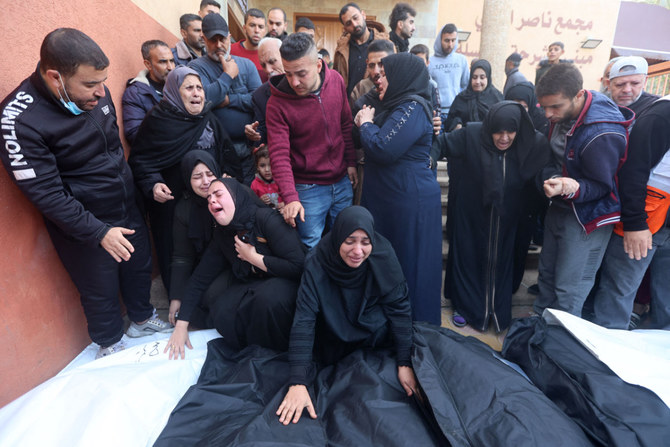
People mourn over the bodies of relatives, killed in Israeli bombardment, at Nasser hospital in Khan Yunis in the southern Gaza Strip on December 20, 2023. (AFP)
3 / 4
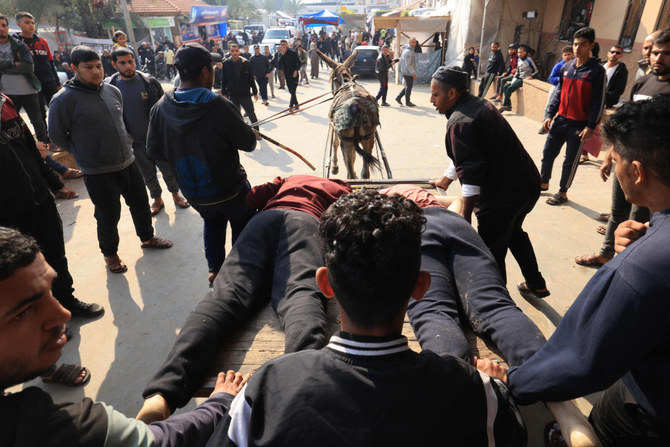
Palestinians use a donkey-drawn cart to transport bodies of victims okf Israeli bombardment to Nasser hospital in Khan Yunis in the southern Gaza Strip on December 17, 2023. (AFP)
4 / 4
A picture taken from Rafah shows smoke billowing following Israeli bombardment in Khan Yunis in the southern Gaza Strip on December 20, 2023. (AFP)
Short Url
Updated 21 December 2023
Follow

Israel strike kills head of Gaza side of border crossing: Hamas

  • Israel releases maps showing new Khan Yunis areas that had been marked for evacuation
  • Hopes high that Israel and Hamas could be inching toward another truce and hostage release deal

GAZA STRIP, Palestinian Territories: An Israeli strike killed the head of the Palestinian side of the Kerem Shalom border crossing on Thursday, Hamas authorities in the Gaza Strip said.
Crossing director Bassem Ghaben and three other people were killed as Israeli aircraft targeted the infrastructure, the crossings authority and the health ministry in the Hamas-ruled Palestinian territory said.
The Israeli army and COGAT, the defense ministry body responsible for Palestinian civil affairs, did not immediately respond to requests from AFP for comment.
After weeks of pressure, Israel approved the temporary reopening of the Kerem Shalom crossing on Friday to enable aid to be delivered directly to Gaza, rather than through the Rafah crossing from Egypt.

The Israeli army said Thursday it bombed scores of targets in the Gaza Strip as diplomats pressed on with efforts to halt the fighting that Hamas says has killed 20,000 people in the Palestinian territory.
United Nations relief chief Martin Griffiths called the surging death toll a “tragic and shameful milestone” as the UN Security Council was to again discuss a draft resolution calling for a pause in the bloodiest ever Gaza war.
The army said its aircraft had struck another 230 targets in besieged Gaza over the past day, including a rocket launch site and a compound in the southern city of Khan Yunis, while ground forces had found weapons inside a school in Jabalia near Gaza City.
The war began when Hamas attacked Israel on October 7, killing around 1,140 people, mostly civilians, and abducting about 250, according to an AFP tally based on Israeli figures.
The Hamas government’s media office said Wednesday at least 20,000 people had been killed in the Palestinian territory, with 8,000 children and 6,200 women among the dead.
In the far-southern city of Rafah, a center for many internally displaced Palestinians, fireballs and smoke rose after explosions on Wednesday.
“I wish for a complete cease-fire, and to put an end to the series of deaths and suffering,” said one resident, Kassem Shurrab, 25. “It’s been more than 75 days.”

Truce talks
Hopes that Israel and Hamas could be inching toward another truce and hostage release deal have risen this week as the head of the Palestinian militant group visited Egypt and talks were held in Europe.
Mossad director David Barnea held a “positive meeting” in Warsaw with CIA chief Bill Burns and Qatari Prime Minister Sheikh Mohammed bin Abdulrahman Al Thani, a source familiar with the talks told AFP.
Qatar-based Hamas chief Ismail Haniyeh visited Egypt on Wednesday for talks with the country’s intelligence chief Abbas Kamel.
However, the stated positions of Israel and Hamas remain far apart.
A Hamas official told AFP that “a total ceasefire and a retreat of the Israeli occupation army from the Gaza Strip are a precondition for any serious negotiation” on a hostage-prisoner swap.
Israeli Prime Minister Benjamin Netanyahu said there could be no cease-fire in Gaza before the “elimination” of Hamas.
And US President Joe Biden said of a fresh hostage release deal: “There’s no expectation at this point. But we are pushing it.”
Qatar, backed by Egypt and the United States, last month helped broker a first week-long truce that saw 80 Israeli hostages freed in exchange for 240 Palestinian prisoners.
One former hostage, Ofir Engel, 18, returned to Kibbutz Be’eri alongside families of other captives and gathered at the burnt remains of their former homes.
“They abused us mentally,” he recounted of his captivity. “One of the most difficult moments was when terrorists moved us in complete darkness with lots of booms.
“I was there. Every moment hostages are there it’s dangerous. They have no time. Why do I get to be here and they don’t? They have to come back home. Now.”

Human rights violations
The UN human rights office in Ramallah said it had received reports that Israeli troops had “summarily killed” at least 11 unarmed Palestinian men in a Gaza neighborhood this week.
The incident “raises alarm about the possible commission of a war crime,” it said, adding the men were killed in front of their family members in Al-Rimal area of Gaza City.
The Israeli authorities did not immediately comment when contacted by AFP.
Israel said its troops had uncovered a tunnel network used by Hamas leaders including Yahya Sinwar, the Gaza leader of the militant group.
The military released footage it said showed the “large network” around Gaza City’s Palestine Square linking hideouts and residences.
Israel’s army said three soldiers were killed on Wednesday, bringing the death toll of its forces to 137 in the Gaza Strip since ground operations began in late October.
An AFPTV live camera on Wednesday filmed two bombs hitting Rafah, where many of the territory’s estimated 1.9 million displaced have fled.
The Hamas health ministry said Israeli strikes killed at least 12 Palestinians when houses and a mosque in Rafah were hit. It said later at least 30 more people were killed in an Israeli strike that hit two houses east of Khan Yunis.
Crowds swarmed the rubble, digging with shovels and a backhoe to try to free the victims. One blackened body lay under a blue blanket on the blood-soaked ground.
“Enough, enough of this,” Samar Abu Luli, a woman in Rafah, said after Israeli strikes on the city’s Al-Shabura neighborhood.
“We have lost everything and we can’t take it anymore.”

UN to vote
The UN Security Council was due to try once again Thursday to pass a resolution calling for a halt in fighting after previous efforts to win Washington’s backing fell short.
Israel has rejected the term “ceasefire,” and Washington has used its veto twice to thwart resolutions opposed by Israel since the start of the war.
The United Arab Emirates is sponsoring a draft resolution which has already been watered down to secure compromise, according to a draft version seen by AFP.
It calls for “the urgent suspension of hostilities to allow safe and unhindered humanitarian access, and for urgent steps toward a sustainable cessation of hostilities.”
The war has sparked fears of regional escalation, with exchanges of fire over the Lebanon border, and missiles from Iran-backed Yemeni rebels disrupting Red Sea shipping.
Israel said Thursday one of its fighter jets and artillery had struck Iran-backed Hezbollah militants overnight in response to incoming fire.
An Israeli strike killed a woman in her eighties in a south Lebanon village early Thursday, Lebanese state media said, with rescuers confirming the death to AFP.
Yemen’s Iran-backed Houthi militia, who have launched missiles and drones at cargo ships in the Red Sea, warned Wednesday that they would strike back if attacked by US forces.
The United States has been building up a multinational naval task force to protect vessels from the Houthi attacks, carried out in solidarity with Palestinians in Gaza.


Israel’s settler movement takes victory lap as a sparse outpost becomes a settlement within a month

Updated 21 January 2026
Follow

Israel’s settler movement takes victory lap as a sparse outpost becomes a settlement within a month

  • Smotrich, who has been in charge of Israeli settlement policy for the past three years, has overseen an aggressive construction and expansion binge aimed at dismantling any remaining hopes of establishing a Palestinian state in the occupied West Bank

YATZIV SETTLEMENT, West Bank: Celebratory music blasting from loudspeakers mixed with the sounds of construction, almost drowning out calls to prayer from a mosque in the Palestinian town across this West Bank valley.
Orthodox Jewish women in colorful head coverings, with babies on their hips, shared platters of fresh vegetables as soldiers encircled the hilltop, keeping guard.
The scene Monday reflected the culmination of Israeli settlers’ long campaign to turn this site, overlooking the Palestinian town of Beit Sahour, into a settlement. Over the years, they fended off plans to build a hospital for Palestinian children on the land, always holding tight to the hope the land would one day become theirs.
That moment is now, they say.
Smotrich goes on settlement spree
After two decades of efforts, it took just a month for their new settlement, called “Yatziv,” to go from an unauthorized outpost of a few mobile homes to a fully recognized settlement. Fittingly, the new settlement’s name means “stable” in Hebrew.
“We are standing stable here in Israel,” Finance Minister and settler leader Bezalel Smotrich told The Associated Press at Monday’s inauguration ceremony. “We’re going to be here forever. We will never establish a Palestinian state here.”
With leaders like Smotrich holding key positions in Israel’s government and establishing close ties with the Trump administration, settlers are feeling the wind at their backs.
Smotrich, who has been in charge of Israeli settlement policy for the past three years, has overseen an aggressive construction and expansion binge aimed at dismantling any remaining hopes of establishing a Palestinian state in the occupied West Bank.
While most of the world considers the settlements illegal, their impact on the ground is clear, with Palestinians saying the ever-expanding construction hems them in and makes it nearly impossible to establish a viable independent state. The Palestinians seek the West Bank, captured by Israel in 1967, as part of a future state.
With Netanyahu and Trump, settlers feel emboldened
Settlers had long set their sights on the hilltop, thanks to its position in a line of settlements surrounding Jerusalem and because they said it was significant to Jewish history. But they put up the boxy prefab homes in November because days earlier, Palestinian attackers had stabbed an Israeli to death at a nearby junction.
The attack created an impetus to justify the settlement, the local settlement council chair, Yaron Rosenthal, told AP. With the election of Israel’s far-right government in late 2022, Trump’s return to office last year and the November attack, conditions were ripe for settlers to make their move, Rosenthal said.
“We understood that there was an opportunity,” he said. “But we didn’t know it would happen so quickly.”
“Now there is the right political constellation for this to happen.”
Smotrich announced approval of the outpost, along with 18 others, on Dec. 21. That capped 20 years of effort, said Nadia Matar, a settler activist.
“Shdema was nearly lost to us,” said Matar, using the name of an Israeli military base at the site. “What prevented that outcome was perseverance.”
Back in 2006, settlers were infuriated upon hearing that Israel’s government was in talks with the US to build a Palestinian children’s hospital on the land, said Hagit Ofran, a director at Peace Now, an anti-settlement watchdog group, especially as the US Agency for International Development was funding a “peace park” at the base of the hill.
The mayor of Beit Sahour urged the US Consulate to pressure Israel to begin hospital construction, while settlers began weekly demonstrations at the site calling on Israel to quash the project, according to consulate files obtained through WikiLeaks.
It was “interesting” that settlers had “no religious, legal, or ... security claim to that land,” wrote consulate staffer Matt Fuller at the time, in an email he shared with the AP. “They just don’t want the Palestinians to have it — and for a hospital no less — a hospital that would mean fewer permits for entry to Jerusalem for treatment.”
The hospital was never built. The site was converted into a military base after the Netanyahu government came to power in 2009. From there, settlers quickly established a foothold by creating makeshift cultural center at the site, putting on lectures, readings and exhibits
Speaking to the AP, Ehud Olmert, the Israeli prime minister at the time the hospital was under discussion, said that was the tipping point.
“Once it is military installation, it is easier than to change its status into a new outpost, a new settlement and so on,” he said.
Olmert said Netanyahu — who has served as prime minister nearly uninterrupted since then — was “committed to entirely different political directions from the ones that I had,” he said. “They didn’t think about cooperation with the Palestinians.”
Palestinians say the land is theirs
The continued legalization of settlements and spiking settler violence — which rose by 27 percent in 2025, according to Israel’s military — have cemented a fearful status quo for West Bank Palestinians.
The land now home to Yatziv was originally owned by Palestinians from Beit Sahour, said the town’s mayor, Elias Isseid.
“These lands have been owned by families from Beit Sahour since ancient times,” he said.
Isseid worries more land loss is to come. Yatziv is the latest in a line of Israeli settlements to pop up around Beit Sahour, all of which are connected by a main highway that runs to Jerusalem without entering Palestinian villages. The new settlement “poses a great danger to our children, our families,” he said.
A bypass road, complete with a new yellow gate, climbs up to Yatziv. The peace park stands empty.