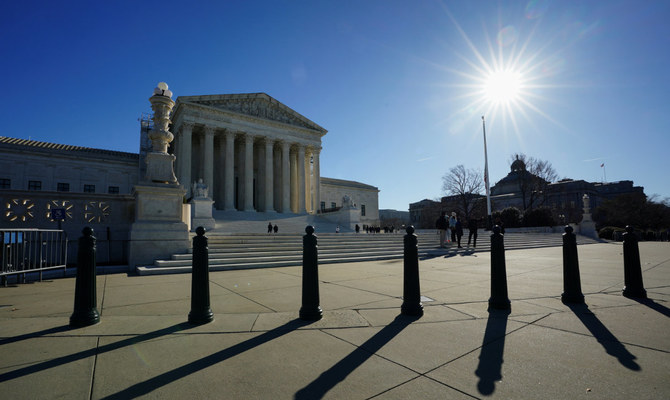
WASHINGTON: The US Supreme Court played a critical role in deciding the 2000 presidential election when it halted a vote recount in Florida with Republican George W. Bush holding a razor-thin edge over Democrat Al Gore.
The stage is set for the nation’s highest court to figure prominently again in a White House race as it mulls a pair of cases involving Donald Trump, the frontrunner for the 2024 Republican presidential nomination.
The Colorado Supreme Court ruled on Tuesday that the former president had incited an insurrection — the January 6, 2021 attack on the US Capitol by his supporters — and was therefore ineligible to hold the office again.
The ruling is likely to end up in the Supreme Court, which is already considering whether to examine a claim by Trump’s lawyers that he has “absolute immunity” from prosecution for actions taken while he was in the White House.
The 77-year-old Trump is currently scheduled to go on trial in Washington in March on charges of conspiring to overturn the results of the 2020 election won by Democrat Joe Biden.
He faces similar election-related charges in Georgia and has been indicted in Florida for alleged mishandling of top secret documents after leaving the Oval Office.
The Colorado Supreme Court, in a 4-3 ruling, said Trump is “disqualified from holding the office of President under Section Three of the Fourteenth Amendment to the United States Constitution.”
Section Three of the 14th Amendment, ratified in 1868 after the Civil War, bars anyone from holding public office if they engaged in “insurrection or rebellion” after once pledging to support and defend the Constitution.
The ruling, if it withstands Supreme Court review, would bar Trump from appearing on the ballot in the primary to be held in Colorado on March 5 to select the Republican Party’s nominee for the November 2024 election.
Colorado’s highest court issued a stay, or freeze, of its bombshell ruling until January 4 pending an expected appeal by Trump’s lawyers to the Supreme Court.
Steven Schwinn, a professor of constitutional law at the University of Illinois Chicago, said he expects the Supreme Court to intervene in a case he described as “uncharted territory.”
“The court needs to make a ruling so that Colorado and other states can decide whether they’re going to list Donald Trump on the ballot or not,” Schwinn said.
“The court’s going to have to act quickly on this and I expect that it will act quickly on this,” he said.
Derek Muller, a law professor at the University of Notre Dame, noted that it is the first time that the 14th Amendment has been used to exclude a presidential candidate from the ballot.
Granting the Colorado case for review would force the Supreme Court to “step into the thorniest of political thickets,” Muller wrote on the Election Law Blog.
Special counsel Jack Smith has asked the Supreme Court to rule on whether the former president has immunity from prosecution for alleged crimes committed while in office.
US District Judge Tanya Chutkan, who is to preside over Trump’s election interference trial, rejected the immunity claim advanced by Trump’s lawyers.
“Defendant’s four-year service as Commander in Chief did not bestow on him the divine right of kings to evade the criminal accountability that governs his fellow citizens,” Chutkan said.
Smith asked the Supreme Court to bypass the usual appeals court process and step in and quickly resolve the question itself.
The top court, which has a 6-3 conservative majority, including three justices nominated by Trump, has yet to say whether it will hear the immunity case.
Trump’s lawyers, in a filing on Wednesday, urged the Supreme Court to hold off and let the case first go through the appeals court.
The question of whether a president has immunity should be “resolved in a cautious, deliberative manner — not at breakneck speed,” they said.
Schwinn said the Supreme Court, whenever it hears the case, is unlikely to side with Trump.
“At least a couple of the justices I think are predisposed to rule in Trump’s favor in some or all of these cases involving Trump,” he said.
“But I don’t really see the majority upholding his claim to immunity,” Schwinn said. “It’s just so far-fetched that I don’t even think this court will go for it.”
Trump has pleaded not guilty to the 91 felony charges facing him in the different cases and has denounced them as “election interference” by Biden and Democrats seeking to derail his White House campaign.


![]()

Trump cases thrust Supreme Court into US election fray
Short Url
https://arab.news/pagkx
Trump cases thrust Supreme Court into US election fray
- Colorado’s highest court issued a stay, or freeze, of its bombshell ruling until January 4 pending an expected appeal by Trump’s lawyers to the Supreme Court


Latest updates




Recommended


© 2026 SAUDI RESEARCH & PUBLISHING COMPANY, All Rights Reserved And subject to Terms of Use Agreement.