

Kabul invites pro-Taliban Pakistani politician as emissary between governments, people amid deteriorating ties

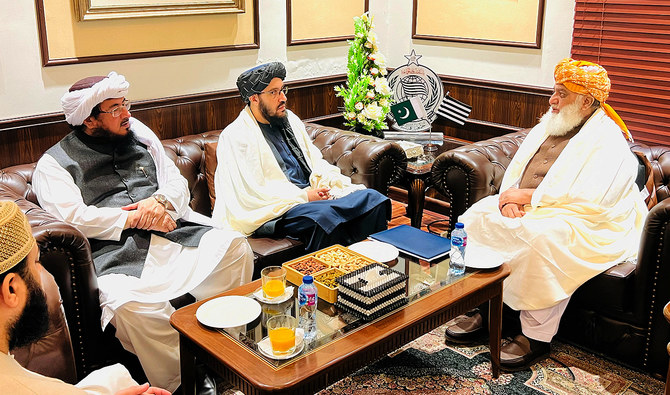
Political party Jamiat Ulema-e-Islam (JUI) leader Maulana Fazlur Rehman (right) meets with Afghanistan’s acting ambassador to Pakistan Sardar Ahmed Khan Shakib (2nd right) in Islamabad on December 16, 2023. (Photo courtesy: JUI)
Short Url
Updated 19 December 2023
Follow

Kabul invites pro-Taliban Pakistani politician as emissary between governments, people amid deteriorating ties

  • Invite comes amid rise in attacks in Pakistan that Islamabad blames on militants harboring in Afghanistan
  • Afghan Taliban say don’t want unrest or sour relations with Pakistan, deny granting safe havens to militants

PESHAWAR: A spokesperson for the Afghan Taliban government has confirmed an invitation to Pakistani pro-Taliban cleric and politician Maulana Fazal-ur-Rehman to visit Kabul as a mediator between the two governments and people, as relations have soured over rising attacks in Pakistan.

Pakistan has protested to the Afghan government over a number of recent attacks including one in which 23 soldiers were killed in an assault on a military base last week, demanding action against the perpetrators as Islamabad grapples with security challenges ahead of elections on Feb. 8.

Ties between Islamabad and Kabul have plunged in recent months to their lowest in years. 

In October, Pakistan ordered the expulsion of all Afghan nationals staying in the country without legal documents, holding them responsible for 14 of this year’s 24 suicide bombings.

Pakistan says militants, particularly from the Tehreek-e Taliban Pakistan (TTP), use safe havens in Afghanistan to train for and carry out attacks such as the one last week. Kabul denies the charge, saying Pakistan’s security is a domestic issue.

In a brief audio message released on Monday, Afghan Taliban spokesperson Zabihullah Mujahid confirmed Kabul had officially invited Rehman, the chief of the religious political Jamiat Ulema-e-Islam-F party, to brief him on the “aspirations” of the Afghan people and government toward the leaders of Pakistan and its people.

“He [Rehman] will let the Pakistani people know that we [Afghans] never want any unrest in Pakistan, [that] our relations sour or any action against Pakistan, we don’t want these at all,” Mujahid said. “And Maulana Fazlur Rehman can play this role [of conveying the message] very well.”

The Afghan Taliban’s statement comes two days after their envoy to Pakistan, Sardar Ahmad Jan Shakib, met the JUI-F chief in Islamabad to formally extend the invitation, according to media.

On Monday, Pakistan called on Afghanistan to ‘handover’ militants belonging to the TTP a day after Kabul said it had arrested up to 40 TTP fighters in the last year.

Though the Afghan Taliban-led government has always denied it allows Afghan soil to be used against any other country, in a rare admission, a spokesperson for the Afghan ministry of interior, Abdul Mateen Qani, said last week 35-40 TTP militants were currently under arrest in Afghanistan.

“We demand from the Afghan government to hand over all the detained TTP terrorists to Pakistani authorities and take action against their sanctuaries inside Afghanistan,” Balochistan information minister Jan Achakzai said at a press conference.

“Pakistan was witnessing attacks during the presence of the US Army in Afghanistan, but since Taliban came to power, the number of attacks in Pakistan have increased with more intensity.”


Women traders face ruin as years of work turn to ash in deadly plaza inferno

Updated 5 sec ago
Follow

Women traders face ruin as years of work turn to ash in deadly plaza inferno

  • Traders estimate losses of over $53 million, more than 100 women workers, dozens of women-led businesses wiped out in Gul Plaza fire
  • In Pakistan, where women run a fraction of formal enterprises, disasters like Gul Plaza fire can erase decades of efforts overnight

KARACHI: Yasmeen Bano stood on the edge of MA Jinnah Road, staring at the blackened remains of Gul Plaza, a shopping center that for decades had been a gateway to financial independence for small traders in Pakistan’s commercial capital.

For Bano, a 55-year-old businesswoman, the charred structure represents far more than a shopping mall. It held the labor of two decades, the savings of a lifetime and the fragile economic security of her family, all wiped out in a deadly fire that tore through the multi-story plaza last week.

Bano began her ladies’ undergarments business in the mid-2000s, gradually expanding to own three shops in the bustling market, a rare achievement in a country where women face steep barriers to entrepreneurship. 

That progress vanished in hours as a blaze broke out on Jan. 17, trapping workers and shoppers inside and burning for more than 24 hours before being brought under control. Recovery operations are still underway as teams sift through unstable debris at the site, which housed over 1,200 shops.

“For 20 years, we worked day and night to build this business,” Bano told Arab News, standing near the wreckage. “I had three shops above, which were my own. All of them have been destroyed.”

Like many traders at Gul Plaza, she had restocked heavily ahead of the wedding season and the holy fasting month of Ramadan starting next month, when sales typically peak. Her inventory, worth around Rs15 million ($53,800), was entirely destroyed.

“All the season’s goods came on loan. Everything is finished,” she said. “Now we have nothing [left], we are insolvent financially.”

FRAGILE FOOTHOLD ERASED

Women entrepreneurs were among the hardest hit by the blaze, traders say. Many had invested personal savings, borrowed informally or relied on family credit to run small businesses that served as their households’ sole source of income.

In Pakistan, women own or lead only a small share of businesses. According to the World Bank and government data, fewer than 5 percent of women participate in formal entrepreneurship, with most operating in the informal sector, where access to insurance, credit protection and safety nets is minimal. In cities like Karachi, markets such as Gul Plaza have long offered women one of the few accessible entry points into commerce.

That precarious foothold has now collapsed.

Kainat Memon, an 18-year-old medical student, ran an undergarments shop with her widowed mother. Both were present when the fire broke out in the building, which housed around 1,200 shops selling garments, luggage, crockery and household goods.

“It was time to close the shop. Everyone was closing their shops... Suddenly there was a loud noise. People started saying that there is a fire,” she recalled.

“We were crying and our eyes were burning. We were having a hard time talking.”

The losses are devastating.

“We have incurred a loss of Rs7–8 million ($28,600) because we had stocked up. Ramadan was coming,” Memon said. “The goods are all burnt. We had invested all our savings. Now we are jobless. All our business is gone.”

For women traders, the losses extended beyond their own families. Many employed other women, often from low-income households, who depended on daily wages or monthly salaries.

“From the basement to the fourth floor, women work here. There are more than a hundred women working here,” said Aisha Farrukh, a 37-year-old trader whose family also lost its business in the blaze.

“Our workers are jobless. We can’t do anything for them now.”

Karachi has a long history of deadly fires in markets and factories, often linked to faulty wiring, overcrowding, illegal construction and weak enforcement of safety regulations. Police have said the Gul Plaza fire may have been triggered by a short circuit, though investigations are ongoing.

Farrukh questioned how quickly the fire spread through the building, saying safety measures were inadequate.

“The government would have to compensate for the financial losses but at this moment, it is difficult to understand how in 10 minutes the entire Gul Plaza turned to ash,” she said. 

“In front of our eyes, our 20 years of hard work turned to ash in under 20 minutes.”

LONG ROAD BACK

The scale of the losses has pushed many traders into insolvency. Tanveer Pasta, president of the Gul Plaza Market Association, said all shops in the plaza were destroyed, estimating total losses at up to Rs15 billion ($53.6 million).

“There were big importers sitting here,” he said. “Just three days before this fire, 31 [shipping] containers were unloaded.”

For women like Bano, Memon and Farrukh, the fire has stripped away not just income but autonomy, turning business owners into debtors overnight in an economy already strained by inflation and slow growth.

The traders are now appealing for government support, warning that without assistance, many women-led enterprises will never reopen.

“We are ruined now,” Farrukh said. “Whether it happened accidentally or because of someone, we need a solution.”