North Korea says Hwasong-18 ICBM drill was response to US hostility

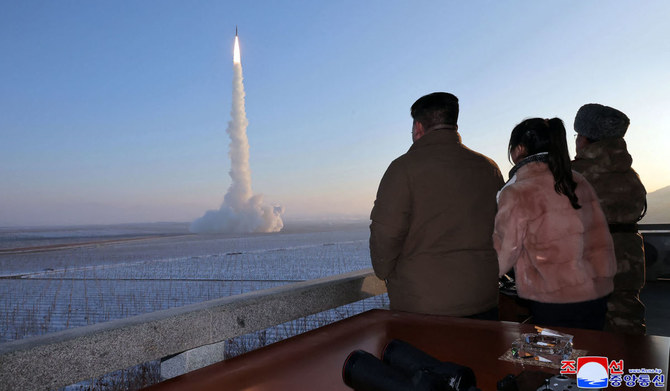
This picture taken on December 18, 2023 and released by North Korea's official Korean Central News Agency (KCNA) on December 19 shows North Korean leader Kim Jong Un (L) and his daughter watching the test launch of a Hwasongpho-18 intercontinental ballistic missile (ICBM) at an undisclosed location in North Korea. (AFP)
Short Url
Updated 19 December 2023
Follow

North Korea says Hwasong-18 ICBM drill was response to US hostility

  • The ICBM’s lofted trajectory and the 74-minute flight time are compatible with an operational range of up to 15,000 km (9,300 miles) if launched at a flatter, standard trajectory, which puts all of the mainland United States within reach

SEOUL: North Korea said on Tuesday it had launched a Hwasong-18 intercontinental ballistic missile (ICBM) on Monday as a drill to confirm the war readiness of its nuclear deterrence force in the face of mounting hostility by the United States.
State news agency KCNA said the country’s leader Kim Jong Un watched the launch of the ICBM at the site. The missile reached the altitude of 6,518 km (4,050 miles), flying 1,002 km (623 miles) and accurately hitting the intended target, KCNA said.
Kim said the launch sends “a clear signal to the hostile forces, who have fanned up their reckless military confrontation hysteria” against the North throughout the year, KCNA said.
The agency said the drill “displayed the DPRK’s will for toughest counteraction and its overwhelming strength.” DPRK is short for the Democratic People’s Republic of Korea.
He presented “some new important tasks for accelerating the development of the DPRK’s nuclear strategic forces,” KCNA said without elaborating.
“The US imperialists and their vassal forces’ vicious ambition for confrontation will not abate of its own accord, he said, stressing the need for the DPRK to never overlook all the reckless and irresponsible military threats of the enemies.”
South Korea and Japan said on Monday the North had fired an ICBM with a range to hit anywhere in the United States.
On Sunday, it condemned a US military show of force including the arrival of an aircraft carrier and nuclear-powered submarine in South Korea as “war” moves, and fired a short-range ballistic missile into the sea off its east coast.
South Korea said the missile fired on Monday was a solid-fuel Hwasong-18 ICBM. It flew in a sharply lofted trajectory landing in the sea west of Japan’s Hokkaido island.
North Korea’s state media published what it said were photographs of the launch, showing the missile blasting off from a snow-covered field trailing a plume of smoke.
The ICBM’s lofted trajectory and the 74-minute flight time are compatible with an operational range of up to 15,000 km (9,300 miles) if launched at a flatter, standard trajectory, which puts all of the mainland United States within reach.
North Korea also criticized a high-level meeting between US and South Korean officials last week where upgraded responses to nuclear threats and joint military drills were discussed, saying it stoked confrontation on the Korean peninsula.
The United States continued to demonstrate a confrontational attitude by bringing in nuclear-powered submarines, strategic bombers and an aircraft carrier near the Korean peninsula, it said.
The US nuclear-powered submarine Missouri arrived in the South Korean port of Busan on Sunday, the latest US strategic military asset to be deployed as part of Washington’s pact with Seoul to boost defense readiness.
The United States and South Korea have increased the intensity of joint military drills against rising threats from the North, which has tested a range of ballistic missiles and in November launched its first military spy satellite.


Pakistan rules out talks with Afghanistan, says more than 330 Afghan fighters killed in operations

Updated 5 sec ago
Follow

Pakistan rules out talks with Afghanistan, says more than 330 Afghan fighters killed in operations

  • More than 330 Afghan fighters killed in operations

ISLAMABAD: Pakistan has ruled out talks with Afghanistan until there is an end to “terrorism” emanating from Afghan soil, officials said on Friday. The statement follows the killing of more than 330 Afghan fighters in cross-border skirmishes this week.

The latest clashes between the neighbors erupted after Pakistani airstrikes on Afghan territory last weekend triggered retaliatory attacks along the border on Thursday, escalating long‑simmering tensions over Pakistan’s claim that Afghanistan shelters Pakistani Taliban militants. Afghanistan denies this, saying Pakistan is deflecting blame for its own security failures.

Pakistani Information Minister Attaullah Tarar said his country had killed 331 Afghan fighters, destroyed over 100 posts and targeted 37 military locations across Afghanistan. Afghan officials have said more than 50 Pakistani soldiers have been killed and several Pakistan posts captured. Neither casualty figures nor battlefield claims by either side could be independently verified.

Meanwhile, Mosharraf Zaidi, Prime Minister Shehbaz Sharif’s spokesperson for foreign media, ruled out any talks with Afghanistan until Kabul addresses the issue, while the US expressed support for what it called Pakistan’s “right to defend itself” against attacks from Afghanistan’s Taliban rulers.

“There won’t be any talks, there is nothing to talk about ... Terrorism from Afghanistan has to end,” Zaidi told state-run Pakistan TV Digital, saying Islamabad would continue to target militant havens inside Afghanistan.

“Pakistan’s responsibility is to protect its citizens. If we know that there is a terrorist in point A and we know that there is a terrorist enabler at point A, we will find a weapon to land at point A and eliminate the threat.”

Zaidi said he did not expect Pakistan to deviate from this position: “We have clearly articulated what we are doing and what we plan on continuing to do and what it will take for us to stop doing what we are doing.”

He added: “And we will expect that both the international community and the regime in question, the Afghan Taliban, will come to their senses and will help reduce instability and disorder in this region.”

Pakistan is a major non-NATO ally of Washington, while the US considers the Afghan Taliban a “terrorist” group.

“The United States supports Pakistan’s right to defend itself against attacks from the Taliban, a Specially Designated Global Terrorist group,” Reuters quoted a State Department spokesperson as saying.

US diplomat Allison Hooker said on X she had spoken with Pakistan Foreign Secretary Amna Baloch on Friday.

The State Department spokesperson said Washington was aware of the escalation in tensions and “outbreak of fighting between Pakistan and the Afghan Taliban,” adding the US was “saddened by the loss of life.”

“The Taliban have consistently failed to uphold their counterterrorism commitments,” it said. “Terrorist groups use Afghanistan as a launching pad for their heinous attacks.”

Meanwhile, Afghan Taliban spokesperson Zabihullah Mujahid called for talks to resolve the crisis.

“We have always emphasized peaceful resolution, and now too we want the issue to be resolved through dialogue,” he said on Friday afternoon.

Asked what Pakistan desired, Tarar said: “Neutralizing the threat and ensuring that Pakistan is safe. Because for us, we’ve been good neighbors, we’ve been very friendly neighbors, we’ve been very, very generous neighbors. Our generosity, unfortunately, has often been seen as our weakness. So the objective, aim is to neutralize the threat and make Pakistan safe.”

He added it was too early to comment on a ceasefire as it was an evolving situation.