

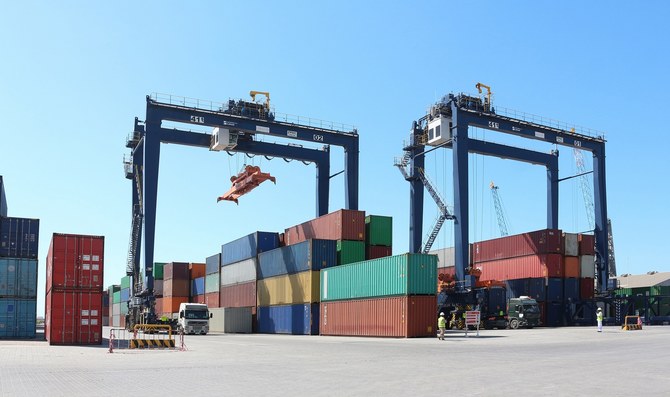
Ajman-Qatar trade volume rises by 68% in 2023

The rise was driven by Ajman’s exports of ships, boats, iron and steel products, and mineral oils to Qatar, a press statement said.  
Short Url
Updated 18 December 2023
Follow

Ajman-Qatar trade volume rises by 68% in 2023

RIYADH: The total trade volume between Ajman, one of the seven emirates in the UAE, and Qatar surged by 68 percent to 521 million dirhams ($141.86 million) until the third quarter of 2023, compared to the same period in the previous year.  

The rise was driven by Ajman’s exports of ships, boats, iron and steel products, and mineral oils to Qatar, a press statement said.  

The trade volume between Ajman and Qatar was 310 million dirhams in the first nine months of 2022.  

Mohamed Ali Al-Janahi, executive director of the Member Support Services Sector at the Ajman Chamber of Commerce and Industry, said that the volume of non-oil trade exchange between Ajman and Qatar reached 31 billion dirhams in 2022, compared to 14 billion dirhams in 2021, representing a growth rate of 124 percent. 

He also praised the deep-rooted bilateral relations between the UAE and Qatar. Furthermore, Al-Janahi highlighted their shared cultural and social heritage, and the extent to which these strong ties reflect on the economic cooperation and the volume of trade and investment exchange between the two nations.  

Earlier this month, Al-Janahi said that Ajman is keen on developing its trade with Bahrain and attracting Bahraini investors.  

In a press statement, he said that non-oil trade between Ajman and Bahrain reached 25.7 billion dirhams in 2022, compared to 23.7 billion dirhams in the previous year. Without specifying the exact figure, Al-Janahi revealed that Ajman’s exports to Bahrain increased by 27 percent until the third quarter of this year compared to the same period in 2022.  

“The economic relations between the UAE and Bahrain are witnessing annual growth that reflects the depth of the fraternal relations between the two countries,” he said.  

Al-Janahi added that Ajman is keen on providing an attractive investment environment for Bahraini business owners, noting an 8 percent growth in the Ajman Chamber’s membership from Bahraini business owners until the third quarter of this year. 

He also praised the continuous annual increase in the value of investments in both the UAE and Bahrain, especially in light of the diverse available opportunities.  


Middle East war economic impact to depend on duration, damage, energy costs, IMF official says

Updated 52 min 5 sec ago
Follow

Middle East war economic impact to depend on duration, damage, energy costs, IMF official says

  • Katz: Prolonged increase in energy prices could unanchor inflation expectations
  • IMF: 2026 global GDP outlook was solid, too early to judge war’s impact on growth

WASHINGTON: The Middle East war’s impact on the global economy will depend on its duration and damage to infrastructure and industries in the region, particularly whether energy price increases are short-lived or persistent, the International Monetary Fund’s number two official said on Tuesday.

IMF First Deputy Managing Director Dan Katz told the Milken Institute Future of Finance conference in Washington that if there is prolonged uncertainty from the conflict and a prolonged impact on energy prices, “I would expect central banks to be cautious and ‌respond to the ‌situation as it materializes.”
He said the conflict could ​be “very ‌impactful ⁠on ​the global economy ⁠across a range of across a range of metrics, whether it’s inflation, growth and so on” but it was still early to have a firm conviction.
Prior to the US and Israeli air strikes on Iran and counterattacks across the region, the IMF had forecast solid global GDP growth of 3.3 percent in 2026, powering through tariff disruptions due in part to the continued AI investment boom and expectations of productivity gains.
Katz said ⁠that the economic impact from the Middle East conflict would ‌be influenced by its duration and further geopolitical ‌developments.
Earlier, the IMF said it was monitoring the ​conflict’s disruptions to trade and economic activity, ‌surging energy prices and increased financial market volatility.
“The situation remains highly fluid and ‌adds to an already uncertain global economic environment,” the Fund said in a statement issued from Washington. Katz said the IMF will look at the conflict’s direct impacts on the region, including damage to infrastructure, and disruptions to key sectors.
“Tourism is an important one. Air travel. Is ‌there physical damage to infrastructure, production facilities, and the big industry in particular that everyone will be focused on is, ⁠of course, the energy ⁠industry,” he said.
Oil rose further on Tuesday as Iran vowed to attack ships passing through the Strait of Hormuz. Brent crude oil , the global benchmark, surged to $83 per barrel, up 15 percent from its level on Friday.
Katz said he expected central banks to “look through” a temporary rise in energy prices, given their focus on core inflation. But central banks could respond if a more persistent energy shock results in “a destabilizing of inflation expectations.”
He said the post-COVID inflation spike of 2022 was influenced by energy impacts from Russia’s invasion of Ukraine, with more pass-through from headline inflation to core inflation.
“And so I’m sure central banks, as they are thinking about how the ​geopolitical situation is translating into ​energy markets, will be looking at the lessons of the pandemic and seeing if they can apply any of those lessons in setting monetary policy,” Katz said.