

Turkiye’s lira bonds set to yield promising returns, central bank governor says

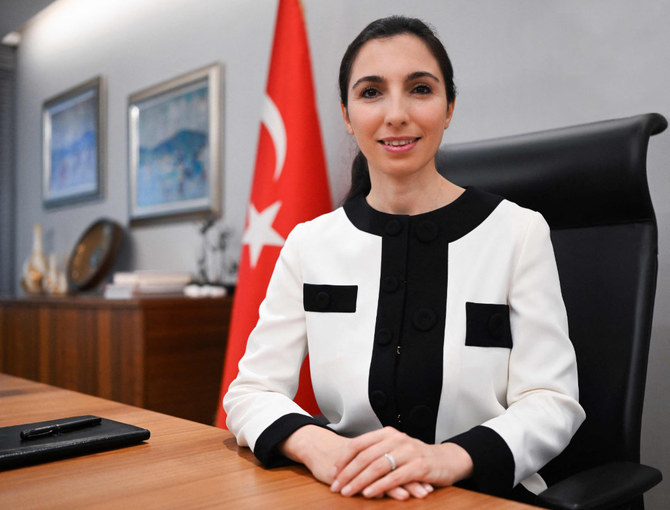
Turkish Central Bank Gov. Hafize Gaye Erkan indicated that while the stringent monetary policies have started to influence consumer prices, she does not anticipate inflation dropping to single digits until at least 2026. AFP
Short Url
Updated 17 December 2023
Follow

Turkiye’s lira bonds set to yield promising returns, central bank governor says

RIYADH: Turkiye is urging foreign investors to consider government bonds that offer yields in Turkish lira as the country approaches the end of its tightening monetary cycle, according to the central bank’s chief. 

Turkish Central Bank Gov. Hafize Gaye Erkan stated that the country is currently approaching economic stability and Turkish lira bonds will yield significant returns, Bloomberg reported, citing Erkan’s interview with Turkish daily newspaper Hurriyet. 

“At this time next year, we will be in a more moderate environment in terms of inflation and monetary tightening. I advise foreign investors to seize the opportunity now, as the yields will be lower after this time,” she said. 

She indicated that while the stringent monetary policies have started to influence consumer prices, she does not anticipate inflation dropping to single digits until at least 2026. 

Following Erkan’s appointment in June, the central bank has implemented a substantial interest rate hike, raising rates by over 30 percentage points to 40 percent. 

This announcement comes after a decade where foreign investors largely sidestepped lira-denominated bonds in response to a series of unconventional economic strategies deployed by Ankara aimed at curbing the short selling of the lira. 

Highlighting a positive development, the governor pointed out the recent uptick in interest from foreign investors, especially from the US, in Turkish government bonds over the last month. 

However, Erkan expressed a preference for direct investments over swap contracts, noting their limited impact on the country’s reserves. 

Erkan’s comments come in the backdrop of the Monetary Policy Committee’s announcement last month, suggesting a slowdown and imminent end to the ongoing monetary tightening cycle. 

She noted a decrease in the price hikes across various sectors, including automotive, electronics, and furniture. However, she acknowledged that more time is needed to see similar trends in transportation and food. 

Erkan also touched upon the persistently high inflation in sectors like education and housing. She highlighted the supply shortages impacting the housing market’s pricing dynamics and shared her personal experience with Istanbul’s increased rental costs. 

As of the end of November, Turkiye’s annual inflation rate stood at 62 percent, with the apex bank projecting it to climb to 65 percent by the year’s end and then fall to 36 percent by the end of the following year. 


RLC Global Forum highlights role of Saudi youth in retail digital shift 

Updated 8 sec ago
Follow

RLC Global Forum highlights role of Saudi youth in retail digital shift 

RIYADH: Saudi Arabia’s young and highly digital population is reshaping how the Kingdom’s retail sector adopts new technologies and artificial intelligence, advancing faster than many global competitors, industry leaders told Arab News. 

Speaking on the sidelines of the RLC Global Forum in Riyadh, executives told Arab News that the intersection of a youthful population and strong investment in AI is driving a shift in the industry’s priorities. 

From understanding consumer behavior to leveraging the Kingdom’s growing status as a global AI leader, Saudi Arabia is becoming as a unique destination for the retail sector to thrive, learn, and evolve in the digital sphere. 

Abdullah Al-Tamimi, CEO of commercial real estate company Hamat Holding, told Arab News that the firm is keen to analyze and understand consumer behavior, with a particular focus on the younger generation as a key part of that insight. 

“Actually, it’s a big part of our day-to-day operation,” he said, adding that the company invests heavily in understanding customer needs and behavior and works to correct any missteps. 

Al-Tamimi emphasized paying close attention to small details, noting that younger consumers are especially sensitive to the overall experience and “deserve that we work around the clock in order to improve it.” 

He added that this focus “can be a competitive advantage for Saudi Arabia as well.” 

Al-Tamimi said that as the younger generation grows accustomed to new technology shaping retail customer experiences, Hamat Holding is leveraging AI to enhance them further. 

“We started a couple of initiatives improving digitalization,” he said, adding that the company sees digital tools as a way to enhance its work by automating day-to-day operations and allowing teams to focus on bigger-picture and more complex tasks. 

While the firm has expanded its use of technology, he stressed it has not replaced human workers, emphasizing the continued importance of human capital for creativity and interaction. “AI is a big part of our strategy,” Al-Tamimi added. 

Amit Keswani Manghnani, chief omnichannel and AI officer at luxury goods retailer and distributor Chalhoub Group, told Arab News that bridging a younger customer base with continuous digital development is key to advancing the Kingdom’s retail strategies. 

On Saudi Arabia’s demographics, he said: “We look at 2030 as really building products which serve especially the younger population, which is growing and very digitally savvy.” 

Manghnani underscored the unique characteristics of the Kingdom’s retail market as a tool for developing effective products and customer experiences. 

“So it’s very digitally savvy, much more than in other markets,” he said, noting that e-commerce penetration is rising not only through online purchases but also via digital catalogs that drive in-store visits. 

Manghnani said investment is focused on making products more digitally accessible and easier to use, while strengthening customer service to meet the expectations of what he described as a demanding but welcome consumer base. “Service excellence, digital — all these things together are how we are tapping into the younger population, which again is extremely savvy.” 

Manghnani reinforced Al-Tamimi’s point that the Kingdom holds a competitive advantage, citing the speed at which its retail and technology industries are aligning. 

“As a market, we’re tending to see the adoption of digital,” he said, referring to AI, data and other forms of digital interaction, adding that these tools are increasingly being combined. 

He noted that this market is moving “much quicker than the other markets.” 

The two-day RLC Global Forum brought together more than 2,000 global leaders, policymakers, and innovators from over 40 countries over the two-day event to define the next chapter of growth across retail, consumer, and lifestyle industries.