

UAE bestows ‘gift’ of artificial rain on Pakistan’s Lahore in historic cloud seeding experiment

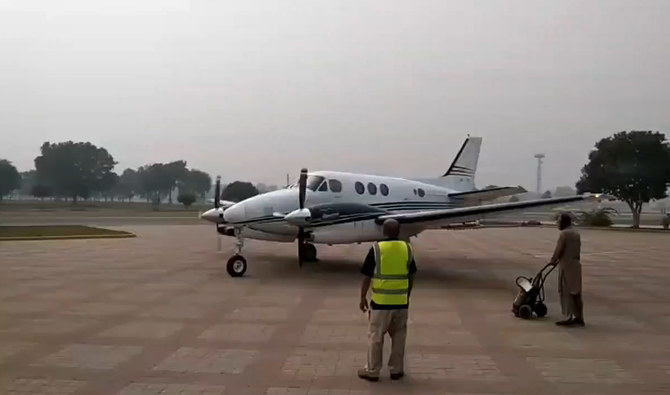
This screengrab, taken from a handout video released by Pakistan's Punjab government, shows aircraft preparing for takeoff to induce artificial rain in Lahore on December 16, 2023. (Photo courtesy: Punjab government)
Short Url
Updated 16 December 2023
Follow

UAE bestows ‘gift’ of artificial rain on Pakistan’s Lahore in historic cloud seeding experiment

  • The experiment was successfully executed to combat smog that has engulfed Lahore in recent months
  • Chief Minister Mohsin Naqvi says it is vital to carry out research study to determine what is causing smog

ISLAMABAD: In a historic first, Pakistan’s eastern city of Lahore witnessed artificial rain on Saturday following a cloud seeding experiment carried out by the United Arab Emirates as a “gift” to the South Asian nation to combat dense smog, announced Punjab Chief Minister Mohsin Naqvi.

Lahore has been ranked as one of the most polluted cities in the world in recent weeks, putting the interim government of Punjab province, of which Lahore is the capital, under pressure to take necessary measures to deal with the situation.

Naqvi and his administration had been pondering the idea of inducing artificial rain with the UAE’s assistance for several weeks before announcing the success of the experiment within a radius of 10 to 15 kilometers that included several important neighborhoods of the city.

“Today, by the grace of God, Pakistan’s first artificial rain was induced,” he told a news conference in Lahore. “We fired 48 flares for cloud seeding in the first mission which was carried out in the morning, and the second mission will take off shortly.”

“This was a gift from the UAE government,” he continued. “They managed everything for us. Our people were working with them.”

Naqvi informed that the UAE had sent two special planes along with a technical team, which waited in Lahore for several days for the right conditions to carry out the mission.

“We kept it quiet since it involved another country and we didn't want any negativity if the arrangement didn't work out for some reason,” he added. “We are all very happy. It was an experiment which was necessary for us to prevent the smog in the future.”

Asked about the potential impact of artificial rain on smog, the chief minister said his administration was closely monitoring the situation, as this was the country's first experience with cloud seeding.

“The primary objective was to overcome smog through rain,” he continued. “When smog subsides, its impact usually lasts for five to seven days. But let’s see what happens.”

Naqvi noted it was important to study smog in Lahore to identify the factors behind it.

“We have already assigned a research team,” he said. “If truth be told, at present we are blank [in terms of what is causing the smog].”

He maintained that thorough research would enable the upcoming government to make informed policy decisions in addressing the problem.


Saudi Arabia condemns separatist attacks in Pakistan’s Balochistan

Updated 8 sec ago
Follow

Saudi Arabia condemns separatist attacks in Pakistan’s Balochistan

  • Kingdom says it stands with Pakistan as security forces kill 92 militants in counteroffensive
  • Attacks hit multiple districts including Quetta and Gwadar, killing civilians and security personnel

ISLAMABAD: Saudi Arabia on Saturday condemned separatist attacks in Pakistan’s southwestern Balochistan province, expressing solidarity with Islamabad after a wave of coordinated violence killed civilians and security personnel across multiple districts.

In a statement cited by the Saudi ambassador to Pakistan, Nawaf bin Said Al-Malki, the Kingdom said it rejected violence in all its forms and stood with Pakistan as its security forces responded to the attacks.

“The Ministry of Foreign Affairs of the Kingdom of Saudi Arabia strongly condemns the attacks carried out by separatist elements in various areas of Pakistan’s Balochistan province,” he said in a social media message. “The Kingdom of Saudi Arabia renews its firm position rejecting all acts of terrorism and extremism.”

Pakistan’s military said on Saturday its forces killed 92 militants, including three suicide bombers, while repelling coordinated attacks across the southwestern province, following assaults that targeted civilians and law enforcement personnel in several towns, including Quetta, Gwadar, Mastung and Kharan.

The military said 18 civilians, including women and children, were killed in attacks on laborer families in Gwadar and Kharan, while 15 security personnel died during clearance operations and armed standoffs.

Saudi Arabia’s foreign ministry also conveyed condolences to the families of those killed and wished a speedy recovery to the injured, reaffirming its support for Pakistan’s efforts to safeguard stability and security.

Balochistan, which borders Iran and Afghanistan, has faced a decades-long separatist insurgency marked by attacks on security forces, infrastructure projects and civilians, as Pakistan steps up counter-militancy operations in the region.