

Saudi boxer Kalthoum Hantoul sacrifices day job for shot at Olympic boxing glory

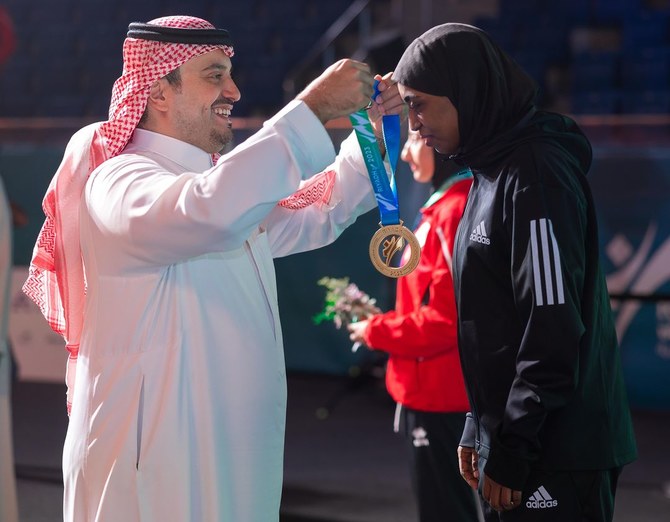
Saudi Kalthoum Hantoul realized her career as a telecommunications specialist in the private sector paled in comparison to her passion for boxing. (Instagram: wcgriyadh2023)
Short Url
Updated 16 December 2023
Follow

Saudi boxer Kalthoum Hantoul sacrifices day job for shot at Olympic boxing glory

  • The 29-year-old recently secured a silver medal in the women’s elite 50kg category at the Saudi Games after a challenging final against Sara Al-Shahrani

DUBAI: Kalthoum Hantoul, although a newcomer to the boxing world, swiftly made a pivotal choice.

On entering the ring, she realized that her career as a telecommunications specialist in the private sector paled in comparison to her passion for boxing.

The 29-year-old light flyweight from Dammam recently resigned from her job to fully devote herself to boxing, with her sights set firmly on the 2028 Olympics.

A silver medal at the recent Saudi Games 2023, after a challenging final against Sara Al-Shahrani, shows Hantoul could well be on the right path.

Born into a family of 11 siblings with a deep-rooted love for football, Hantoul started kicking a ball from an early age. However, when her women’s team failed to assemble the minimum seven players, that was when she turned to boxing.

“My parents have always been fans of Al-Nassr club, but most of us kids support Al-Hilal club, so there was always internal rivalry,” she said on the dynamics of her football family.

Hantoul pursued boxing secretly while her family believed she was still training for football. It was not until she clinched gold at the World Combat Games in Riyadh in October 2023 that her family began to embrace her dedication to this new sport.

“My family didn’t see boxing as a sport for women; they viewed it as brutal and physically demanding. Initially, I trained in secret, while they believed I was practicing football. That’s how it all began,” she said.

“My first fight was at the Saudi Games 2022. Until then, my family had refused my participation. But I kept going, and at the World Combat Games in Riyadh 2023, my whole family was watching. It was the real turning point for their support.”

Hantoul stumbled into the sport by chance in February 2022 when a boxing coach approached her as she was playing football and suggested she give it a try. Now she dedicates five days a week to training at Al-Taraji Club with her coach, Sajad Al-Jassas, a former boxer with the Saudi National Team and now their current coach.

Despite her desire to compete, her actual debut did not take place until November of last year at the Saudi Games.

“I attended around five different tournaments before the Saudi Games in order to compete, but there were no opponents in my weight category. I was eager to fight and excitedly awaited that day. When it finally arrived, I wasn’t nervous or scared just overjoyed to finally get to fight and I performed exceptionally well,” she said.

“After my participation in the Saudi Games 2022, I was invited to join the national team. I believe they took notice of my bout with Reem Al-Sharif, which was one of the most significant fights of the event. Following that, I took part in a local championship, and it was then made official — they selected me,” Hantoul said.

The boxing season in the Kingdom begins in January, featuring four annual main championships: the Regional Championship, the Saudi Cup, the Kingdom Cup, and the end-of-season qualification tournament for the Saudi Games.

The Saudi Boxing Federation has significantly contributed to the sport’s development, particularly in women’s boxing, with Rasha Al-Khamis — vice president of the federation — playing a pivotal role in this progress.

“Honestly, the Saudi Boxing Federation has helped the sport a lot, especially for women’s boxing,” Hantoul said.

“I heard that previously, there was minimal support for boxing,” she added. “But with the establishment of the new federation, many boxers, including those who had discontinued their careers, have started again due to the enhanced level of support.”

Despite taking up the sport as an adult, Hantoul displays fearlessness in the face of hard work and identifies the most challenging aspect of boxing as not the training or physical impact, but rather the mental battle of facing familiar opponents.

“I love the challenge. I love to be at the top of my sport. I love to be the best at every competition. This is what drives me — excellence, especially since I am representing the national team. It is a big thing to represent your country.”

In a short span of time, Hantoul has already graced the podium a few times with a silver medal on her debut at the Saudi Games in 2022, bronze at the 2023 Arab Games in Algeria, gold at the World Combat Games (Riyadh), and that silver at the recent Saudi Games 2023.

“Over the next few months, I want to go back to the drawing board and fix my mistakes, working on being better and winning gold medals from as many competitions as I can. I will just be training with my coach, Sajad Al-Jassas, at Al-Taraji Club as the new season of boxing starts soon in January,” Hantoul said.

“I know that I have four years to make it to the Olympics in 2028, and by doing this full-time, I think that I can be ready.”


From Jeddah to the world stage: Bader Idrees and Saudi Arabia’s tennis rise

Updated 25 December 2025
Follow

From Jeddah to the world stage: Bader Idrees and Saudi Arabia’s tennis rise

RIYADH: As tennis continues to gain momentum throughout Saudi Arabia, several local players are beginning to emerge on the national and international scene. One of them is Saudi national team player Bader Idrees, whose journey mirrors the Kingdom’s evolving relationship with the sport.

Idrees’ first exposure to tennis came at a time when the local game was still developing. His interest began in early 2010 after watching his older sister train regularly.

“I was five years old when I used to watch my older sister playing tennis every day,” he told Arab News. “One of her coaches recommended that I try it out, and from the first hit, I fell in love with the sport.”

Now 20 years old, Idrees finds himself progressing alongside a country that is investing heavily in tennis. Over the past three months alone, Saudi Arabia has hosted the Six Kings Slam, the WTA Finals, and the Next Gen ATP Finals, an indication of its growing ambitions on the global tennis stage.

A defining moment in Idrees’ development came at the 2025 WTA Finals, where he reached a personal milestone in his role as a hitting partner for some of the world’s best players.

“It was one of the best experiences I’ve had so far,” he said. “To actually see the players and train with them was an eye-opening experience for me.”

The exposure offered by hosting elite tournaments has had a direct impact on aspiring Saudi athletes, providing valuable insight into the professional game.

“Seeing how players prepare for matches — from how they behave off the court to actually practicing on the court — was an amazing experience,” he said.

Beyond individual growth, Idrees believes the broader sporting ecosystem benefits from welcoming international events to the Kingdom.

“Hosting these events motivates every Saudi athlete,” Idrees said. “Foreign players get to know the country and the players who represent it, and it pushes us to perform better knowing that the world is watching.”

That motivation has translated into concrete goals. Idrees is planning a busy start to the year, with four international tournaments scheduled for January.

“I feel very positive about what I’ve accomplished so far, so hopefully I can kick off with a strong start in 2026.”

Despite recent progress, Idrees credits his early development at home as the foundation of his success.

“I don’t think I would be at this level if I weren’t in Saudi Arabia, and if I didn’t meet my coach Wajih there, who played a big role in my journey,” Idrees said.

To further advance his career, he later relocated to Cairo, where increased competition and exposure helped accelerate his development.

“That experience, combined with my coach’s motivation, made me believe I could truly go pro,” he said.

The journey was not without challenges. Idrees reflected on the limitations that once existed in the local tennis landscape.

“Tennis has grown massively in Saudi Arabia over the last few years,” he said. “But before that, we didn’t always have the best facilities or infrastructure. That’s why seeing the progress now makes me happy.”

Today, that transformation is happening at a rapid pace — something Idrees notices each time he returns home from international competition.

“Month by month,” as he puts it.

Whether in Riyadh, Jeddah, or Dammam, the changes are increasingly visible. Looking ahead, Idrees is optimistic about the next generation of Saudi players.

“I wouldn’t be surprised to see the kids playing at the under-10 and under-12 level find themselves in the top 500 or 300 within the next 10 years,” he said. “I see the discipline and motivation in them, and it truly is something special.”

He is also realistic about his own development compared with today’s young talents.

“I wasn’t at this level at 10, 12 years old,” he admitted. “Training with kids at that age now, I’m genuinely impressed. It’s why I’m feeling very positive about their future.”

With growing infrastructure, elite-level exposure, and rising ambition, Idrees’ story represents more than personal achievement. It highlights how Saudi Arabia’s expanding role as a host of global sporting events is reshaping its tennis landscape — and how a new generation of players may be poised to make an impact on the world stage in the years ahead.