

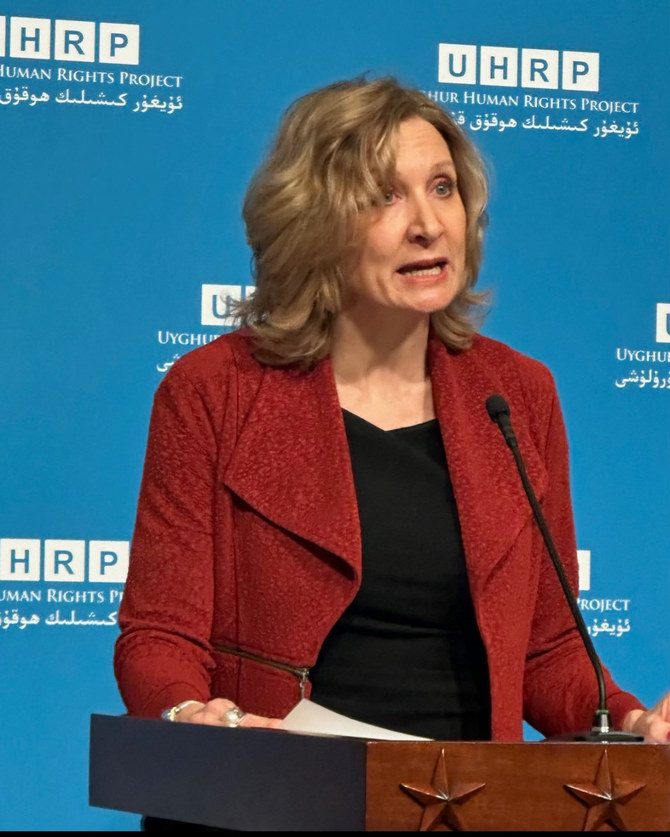

CHICAGO: Biden administration officials on Thursday ramped up their calls for the prosecution of warring Sudanese factions for war crimes against civilians but brushed aside questions about alleged Israeli war crimes against civilians in the Gaza Strip.
Beth Van Schaack, the US Department of State’s ambassador-at-large for global criminal justice, described the situation in Sudan, caused by the conflict between the Sudanese Armed Forces and rival militia the Rapid Support Forces, as “dire.” She said “at least 10,000” people have been killed and more than 6.8 million displaced.
Van Schaack highlighted the continuing efforts by Secretary of State Antony Blinken to “track and document” the “myriad” crimes in Sudan, in particular denounced the violence against civilians, women and children.
However, she declined to respond to numerous questions about similar allegations of war crimes against civilians in Gaza.
“We have all seen chilling media reports that reflect that thousands of people have been swept into detention sites in and around Khartoum, where we know that some have been tortured and some have been killed,” Van Schaack said during an online briefing attended by Arab News.
“The war has also been waged on the bodies of women and girls who have been terrorized by deliberate, systemic sexual violence inflicted by the RSF and its allied militia forces. They are attacked in their homes. They are kidnapped from the streets. Women and girls have been subjected to conflict-related sexual violence including rape, gang rape and sexual slavery. Survivors are often unable to access any kinds of medical care or psychological support, thus leaving lasting trauma.
“In Darfur in particular we have witnessed an explosion of violence against civilians along ethnic lines. People are not safe in their homes, in mosques or in schools. We have read numerous, credible reports of RSF and affiliated Arab militias seeking out, in particular, Masalit people and members of other African communities, hunting for men and boys, shooting people desperately fleeing for their lives, stealing everything of value, and burning the rest.”
Van Schaack continued: “We’re also really looking for ways to use some of our many sanctions authorities to put pressure on individuals and entities that are undermining peace in the region. So back in May we announced a new executive order, President Biden announced, that will allow for the designation of those responsible for targeting civilians and other serious human rights abuses."
She said the US was encouraged to hear that allegations of “war crimes and crimes against humanity” in Sudan “may be subject to investigation and prosecution” by the International Criminal Court.
“The laws of war demand that civilians and civilian objects, the civilian infrastructure, are immune from deliberate attack,” Van Schaack said. “And so warring parties are only supposed to engage with military objectives — so with troops or with military materiel, weapons, caches, etc.
“Unfortunately, we do see that some of these military objectives are within civilian areas. And so the message is always that the parties need to be extremely precise and deliberate in engaging with those military objectives so that they don’t inadvertently harm civilians that are in the immediate vicinity.”
Governments have a responsibility to protect civilians when targeting militant or armed groups, she added.
“There is a principle of proportionality that is in play here, where you’re allowed to target military objectives but you must do so with a level and degree of force that is proportionate to the value of that
military objective,” she said. “And when you have military objectives collocated with civilians, that proportionality analysis becomes extremely important.
“So, part of our messaging with the parties has been to adhere to their responsibilities and take all measures possible to protect civilian life but also to protect the civilian infrastructure.”
Van Schaak said she is also concerned by the targeting of journalists in Sudan and praised representatives of the media for their role in documenting the conflict.
“It’s a dangerous situation and I know that many of you are putting yourselves at personal risk to travel to these regions in order to be able to cover them firsthand, and to hear from survivors themselves so that those of us outside the region are able to learn more about what’s going on, so that we can inform and strengthen our own efforts to try and bring about a cessation of hostilities, bring the parties together, and chart a path forward for a civilian-led democratic future for the Sudanese people,” she said.
“So we’re really very grateful for all of your hard work and want to acknowledge that.”
Numerous questions were submitted asking Van Schaack to explain the differing stances of the Biden administration on the conflict in Sudan compared with the violence in the Gaza Strip, but those questions were ignored.
At the start of the briefing, the Department of State’s Africa Regional Media Hub moderator, Tiffany Jackson-Zunker, made it clear that no questions about issues outside of the Sudan conflict would be answered.
“We ask that you limit yourself to one question related to the topic of today’s briefing, the determination that members of the SAF and the RSF have committed war crimes, crimes against humanity and ethnic cleansing in Sudan,” she said.
Van Schaack said Blinken is determined “to bear witness to and to shine a light on the abuses suffered by the Sudanese people at the hands of the very forces who are meant to protect them.”
The Biden administration hopes “to rally the international community to help us end the violence, address the humanitarian crisis, and promote justice for survivors and victims,” she added


